.svg)
Wiring Up a Mouse Ventilation Line: SomnoFlo, Intubation Kit and RoVent Jr.
The SomnoFlo, the endotracheal intubation kit and the RoVent Jr. are bought separately and used as one line. The gas path, the two charcoal canisters this setup needs, the calibration step that decides whether your tidal volumes mean anything, and the settings the ventilator does not calculate for you.

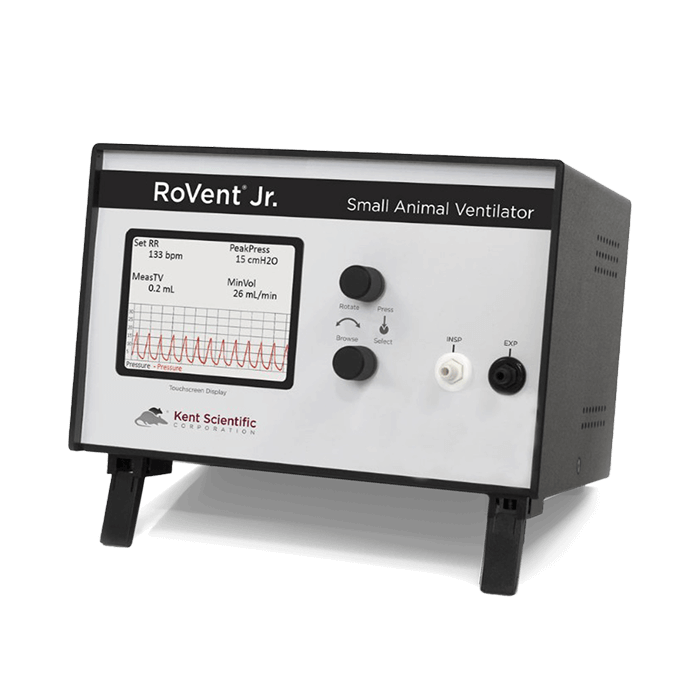
Three Kent instruments, bought separately, used as one line. The SomnoFlo delivers the isoflurane. The endotracheal intubation kit puts a tube in the airway while the animal is still on the mask. The RoVent Jr. then breathes for the animal through that tube.
The order is fixed. Anaesthesia, then airway, then ventilation. The RoVent Jr. will not ventilate through a nose cone, so a lab that buys a ventilator without an intubation kit has bought a ventilator it cannot use. That is the first thing worth knowing and it is usually the last thing that comes up in the quote.
Two canisters, not one
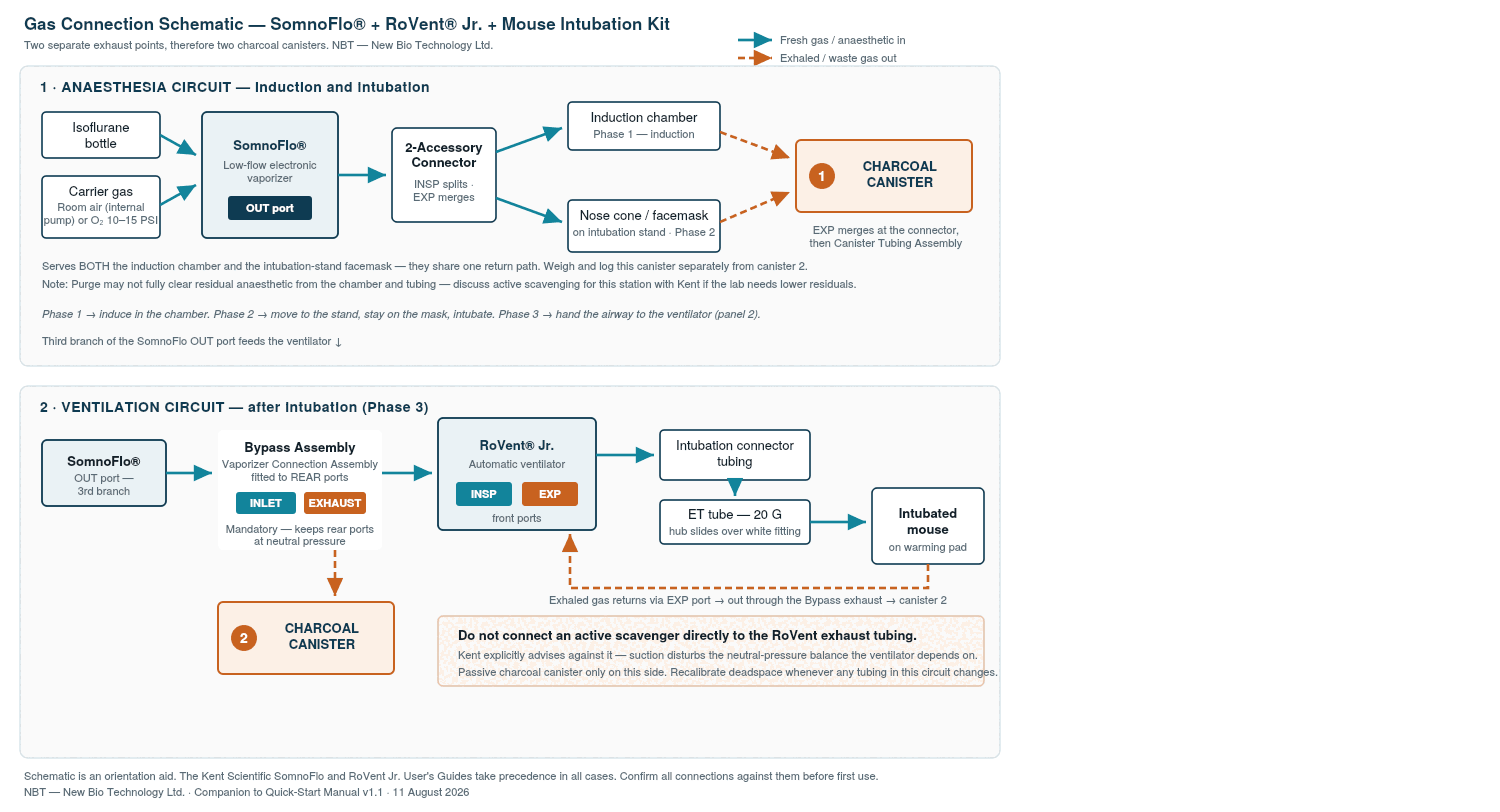
The SomnoFlo output feeds three things. Induction chamber, stand facemask, and the ventilator. The first two share a return path through the 2-Accessory Connector and one charcoal canister. The ventilator has its own exhaust and needs its own canister.
This is the question we get asked most often on this setup, so to be explicit about it: you need TWO canisters. They saturate at different rates. The anaesthesia canister absorbs during induction, the ventilator canister absorbs for the length of the procedure. Weigh both, log the start weight, replace at the weight-gain limit printed on the canister.
The Bypass Assembly
When the RoVent Jr. is fed from a vaporizer or any compressed gas source, the Vaporizer Connection Assembly with Bypass goes on the back of the ventilator. Gas source to the inlet side, charcoal canister on the exhaust side.
The RoVent Jr. is built to run with its rear ports at neutral pressure. Backpressure there affects ventilator function, which is why the Bypass exists and why Kent does not recommend connecting an active scavenger directly to the exhaust tubing. Passive canister on that side.
The SomnoFlo side is different. Kent states that the Purge function may not fully clear residual anaesthetic from the chamber and tubing, and active scavenging there is worth discussing. Two circuits, two answers. Do not carry the ventilator rule across to the chamber.
Calibrate before the first animal
The RoVent Jr. needs to know the volume of your tubing. At a mouse tidal volume of 0.2 mL, the tubing between the ventilator and the animal holds a large fraction of every breath. An uncalibrated setup delivers the wrong volume from the first breath and nothing on the screen tells you.
Run Measure Deadspace and Zero Sensors on first use and after any change to tubing or connectors. Calib and tests, Measure deadspace, seal the end of the endotracheal tube so there is no leak, press Dial B twice. Then Zero sensors, Dial B twice. Never with an animal connected, and the same goes for Purge and Leak Test.
What the ventilator does not decide for you
Enter the body weight and the RoVent Jr. calculates the respiratory rate and the tidal volume. Kent's worked example for a 30 g mouse is 133 bpm, 0.200 mL and 26 mL/min, which is roughly 6.7 mL/kg.
Plenty of published mouse protocols use 8 mL/kg to 10 mL/kg. That gap is large enough to matter and the ventilator will not flag it. Check what your protocol specifies before the first experiment rather than after.
The target pressure catches people out. In pressure priority the default is 15 cmH2O and it does NOT scale with body weight, so a 15 g mouse and a 40 g mouse both get 15 cmH2O until someone changes it. Minimum and maximum pressure limits in volume priority are also yours to set, and they are what protects the animal while the ventilator chases the target volume.
Where not to spend the money
Skip the large induction chamber unless you are working with rats. A 3 L chamber on a mouse line induces slower and wastes gas on every session. Skip the second SomnoFlo if the plan is throughput, because a 2-Accessory Connector on one SomnoFlo covers a chamber and a mask on the same unit.
Do not skip warming. An anaesthetised, ventilated mouse loses core temperature within minutes, and that loss will move almost any physiological number you are trying to measure. We wrote about that separately in anaesthesia-induced hypothermia in mice. A warming pad with a rectal probe running from induction costs a fraction of the ventilator and protects the data the ventilator exists to produce.
The full guide
The complete integration guide is a four page PDF covering the gas path, the three phases end to end, calibration, the settings table and every RoVent Jr. alarm with its trigger condition. It is in the Downloads section of the RoVent Jr., SomnoFlo and Endotracheal Intubation Kit pages.
NBT supplies Kent Scientific in Israel. If you are putting one of these lines together, send us the protocol and we will check the configuration against it before you order. Which tidal volume does yours specify?

NEED MORE INFORMATION ABOUT THIS PRODUCT?
Send us your emailFrequently Asked Questions
How many charcoal canisters does this setup need?
Two. The induction chamber and the stand facemask share one return path through the 2-Accessory Connector and one canister. The ventilator exhausts through the Bypass Assembly on the back of the RoVent Jr. and needs its own. They also saturate at different rates, so weigh and log both.
Can the RoVent Jr. ventilate through a nose cone?
No. The RoVent Jr. will not ventilate through a nose cone, so the animal has to be intubated or tracheotomised. A ventilator bought without an intubation kit is a ventilator you cannot use.
What does the deadspace calibration actually do?
It measures the volume of the tubing between the ventilator and the animal. At a mouse tidal volume of 0.2 mL that tubing holds a large fraction of every breath, so an uncalibrated setup delivers the wrong volume from the first breath and nothing on the screen tells you. Re-run it after any tubing change, and never with an animal connected.
Does the target pressure scale with body weight?
No. In pressure priority the default is 15 cmH2O regardless of the weight you entered. A 15 g mouse and a 40 g mouse both get 15 cmH2O until someone changes it.
RoVent Jr. or the full RoVent?
The Jr. covers volume control, pressure control, automatic set-up from body weight, measured tidal volume and parameter alarms. The full RoVent adds PEEP, sigh breath, assist mode, pulse ventilation mode, I:E ratio, user profiles and data output. If the protocol calls for PEEP or the work is open chest, buy the RoVent.
Still have questions?
Recent Blog Posts

.svg)
Advance Your Research
Contact NBT today for expert consultation on your neuroscience instrumentation needs.