.svg)
Eye tracking with EEG, and where the timing breaks
Fixation-related potentials, saccadic suppression and pupillometry all depend on knowing when the eye moved relative to when the cortex responded. That alignment is a hardware problem before it is a software problem. The trigger architecture, the photodiode calibration, and where the budget should go.
.jpg)
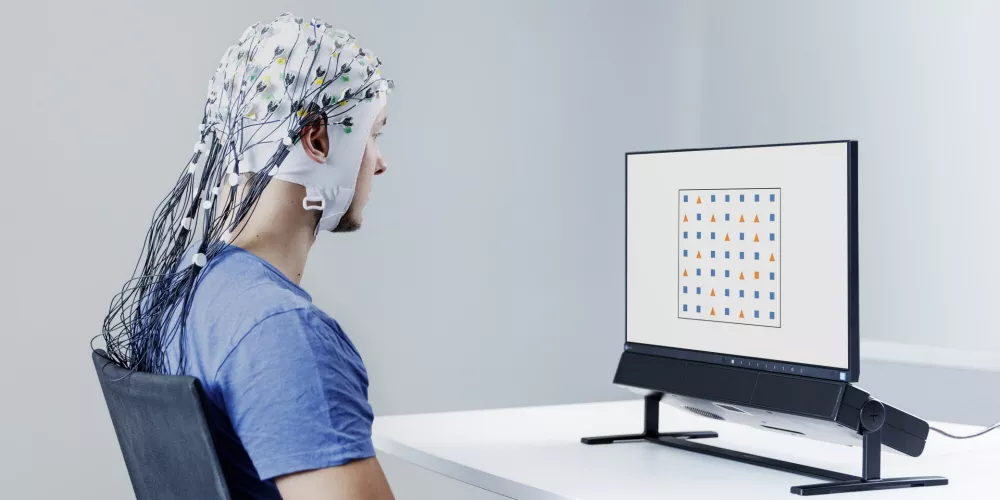
Fixation-related potentials, saccadic suppression, pupillometry as an index of cognitive load, and the co-registration literature that relates gaze behaviour to the N170, the P300 and the lambda response all rest on one requirement: knowing when the eye moved relative to when the cortex responded.
Eye tracking establishes where attention was directed. EEG establishes when the neural response occurred. Neither substitutes for the other, and the scientific value of recording both is created at the point where the two recordings are aligned in time. That alignment is a hardware problem before it is a software problem, and it is decided at specification stage rather than in analysis.
Three clocks, and nothing disciplining them
A co-registration setup contains three independent clocks: the stimulus PC, the eye tracker and the biosignal amplifier. Each free-runs. Aligning the recordings only on start and stop events leaves the intervening samples to drift, and the drift accumulates with session length.
For an N170, a drift of a few tens of milliseconds is the entire component.
One trigger word, two destinations
This is the item to specify first.
A TTL pulse routed into the digital input of the amplifier is sampled by the same converter that samples the EEG. No network, no buffer, no clock conversion, and nothing to correct afterwards.
The g.TRIGbox accepts a parallel port, USB, photodiode, audio, or a switch closure, and outputs isolated TTL pulses into the digital or analogue inputs of a g.tec acquisition system. g.tec specify greater than 4 kV isolation between trigger inputs and outputs, which is what allows one trigger source to reach two devices that must not share a ground. A single encoded trigger channel carries up to 16 experimental conditions.
The Tobii Pro Spectrum carries an 8-bit TTL input port that records 5 V markers alongside the gaze data. The amplifier has digital inputs of its own.
Send the same 8-bit word to both. Both recordings then carry identical event codes, and offline alignment becomes a fit on shared events rather than an estimate.
Lab Streaming Layer for the remaining streams
Gaze coordinates, motion capture and questionnaire responses require a software transport, and Lab Streaming Layer is the appropriate one.
The LSL reference paper (Kothe et al., Imaging Neuroscience) reports sub-millisecond synchronisation accuracy on standard hardware, with the residual difference between EEG and EMG streams under 0.5 ms once signal offset and jitter are corrected.
Read that carefully. Sub-millisecond is the achievable precision after correction. It says nothing about the constant offset each device contributes before its data reaches LSL. That offset is a fixed quantity you subtract once, provided you measure it.
Offset and jitter are separate quantities and should be reported separately. A large offset with small jitter describes a system behaving predictably. A small offset with large jitter usually indicates a USB trigger path or a compositing window manager, and no amount of correction in MATLAB recovers it.
g.Nautilus Research transmits over 2.4 GHz at roughly 10 m indoors. Wireless protocol latency and device-side buffering are the largest correctable term in the budget. We still prefer wireless wherever the head moves, because cable movement costs more in artefact than a measured constant offset costs in accuracy. Measure the offset.
Stationary paradigms: the higher specification route
Where the participant is seated at a screen and the montage is dense, the wireless headset is not the natural amplifier.
g.HIamp supports 16 to 256 simultaneously sampled channels at 24-bit resolution and sampling rates to 38.4 kHz, with DC-coupled wide-range inputs. For fixation-related potentials, source-level analysis, or any paradigm where the sampling rate rather than the participant is the constraint, this is the configuration.
g.tec supply it as a defined combination with Tobii, documented on their high-density EEG and eye tracking page. That configuration is compatible with Tobii Pro Fusion, Tobii Pro Spectrum, Tobii Pro Spark and Tobii Pro X2-120, synchronises over hardware TTL and LSL, and is handled in real time by g.HIsys Professional. g.tec specify the eye tracker latency at under 13 ms at 250 Hz, which is itself a constant to account for.
The photodiode
Stimulus software timestamps the moment the draw call returns, not the moment light leaves the display. On a 60 Hz screen the quantisation alone is 16.7 ms.
Mount a photodiode over a corner of the display and draw a high-contrast patch there on every stimulus frame. Route the photodiode through the g.TRIGbox into a digital input on the amplifier. g.tec list visual markers from a computer monitor as a supported trigger source, and the trigger output is a TTL pulse of at least 20 ms.
This does not consume an EEG channel. The g.TRIGbox output is designed for the digital or analogue trigger inputs, so the montage is unaffected.
The measured onset and the intended onset then sit in the same recording, and the difference between them is the figure that belongs in the methods section.
Calibration procedure
- High-contrast patch in a display corner on every onset, photodiode mounted over it
- Photodiode routed through the g.TRIGbox into a digital input
- Software trigger in parallel, to the amplifier digital input and the Tobii TTL port
- 200 trials minimum, on the exact hardware, refresh rate and settings intended for the study. Offsets do not transfer between setups
- Report the mean and standard deviation of photodiode minus software trigger separately
Subtract the mean in preprocessing. Report the standard deviation.
Repeat the check periodically rather than once at installation. A trigger cable that works loose in session twelve is otherwise found at analysis.
Where we would not spend the money
Where the paradigm is dwell time and fixation counts on static images, 1200 Hz gaze and 500 Hz EEG contribute nothing that will be reported. Our view is that Tobii Pro Fusion at 250 Hz, with the difference redirected into the trigger path, is the stronger specification. The timing budget constrains that study, not the sampling rate.
Saccade-locked potentials and microsaccade research are the cases where the faster tracker earns its cost. Then specify the Spectrum.
One hardware constraint before channel count is fixed: only one g.Nautilus operates in a room at 500 Hz. Where the design calls for two participants recorded simultaneously, that determines the configuration, and it is cheaper to establish before delivery than after.
The timing budget
| Path | Typical error | Correctable |
| TTL into the amplifier converter | One sample, 2 ms at 500 Hz | Not required |
| TTL into the eye tracker port | Sub-millisecond | Not required |
| LSL after offset correction | Sub-millisecond | Yes, once per setup |
| Device and wireless buffering | Up to tens of milliseconds | Yes, if measured |
| Display onset against software mark | One to two refresh intervals | Yes, with a photodiode |
| Start and stop alignment only | Accumulating drift | No |
The final row is the configuration to avoid. Everything above it is a solved problem with established tools.
The parts
| Stage | Product |
| Stimulus presentation | E-Prime Extensions for Tobii Pro, or PsychoPy and Psychtoolbox |
| Behavioural responses | Chronos response device |
| Eye tracking | Tobii Pro Spectrum at 300, 600 or 1200 Hz, or Tobii Pro Fusion to 250 Hz |
| Eye tracking software | Tobii Pro Lab, Tobii Pro SDK |
| EEG, mobile | g.Nautilus Research, 24-bit, 250 or 500 Hz, 8 to 64 channels |
| EEG, stationary and high density | g.HIamp, 16 to 256 channels, to 38.4 kHz |
| Trigger distribution | g.TRIGbox |
| Recording and analysis | g.Recorder, g.BSanalyze, EEGLAB with the EYE-EEG toolbox, or MNE-Python |
NBT supplies g.tec, Tobii and Psychology Software Tools in Israel, and installs them.
Send us the paradigm and the components whose timing matters to the result, and we will specify where the budget belongs. Does the analysis require sub-millisecond alignment, or is this a dwell time study?
NEED MORE INFORMATION ABOUT THIS PRODUCT?
Send us your emailFrequently Asked Questions
What is the most accurate way to synchronize an eye tracker with EEG?
Send the same 8-bit TTL word to both. Into the amplifier digital input, where the same converter that samples the EEG samples the trigger, and into the eye tracker TTL port. Both files then carry the same event codes, and offline alignment is a fit on known events instead of an estimate.
Is Lab Streaming Layer accurate enough for ERP work?
Sub-millisecond in the developers' own tests, but that is relative precision. Each device adds a constant offset from buffering and transmission before its data reaches LSL, and over a wireless link that reaches tens of milliseconds. Measure it once, subtract it, and LSL is fine. Skip the measurement and it is not.
Does the photodiode use up an EEG channel?
No. The g.TRIGbox output is designed for the digital or analogue trigger inputs of the amplifier, so the montage is unaffected. The photodiode is still worth fitting: stimulus software marks the moment the draw call returns, not the moment light leaves the display, and on a 60 Hz screen the quantisation alone is 16.7 ms.
Do I need the 1200 Hz tracker?
For dwell time and fixation counts on static images, no. Tobii Pro Fusion at 250 Hz with the difference spent on the trigger path is the better setup for that work. For saccade-locked potentials and microsaccades the fast tracker earns its price, and then take the Spectrum.
Which amplifier suits a seated screen-based paradigm?
g.HIamp rather than a wireless headset. It provides 16 to 256 simultaneously sampled channels at 24-bit and sampling rates to 38.4 kHz, and g.tec supply it as a defined configuration with Tobii Pro Fusion and Tobii Pro Spectrum, synchronised over hardware TTL and LSL. Reserve the wireless g.Nautilus for paradigms where the head moves.
Still have questions?
Recent Blog Posts

.svg)
Advance Your Research
Contact NBT today for expert consultation on your neuroscience instrumentation needs.