.svg)
Choosing an EEG System for Your Lab
Channel count, dry or wet electrodes, triggers and synchronisation, and who runs the RMA when the amplifier fails. The four questions we work through on the phone before anyone signs a purchase order for research EEG.
Most labs that contact us about EEG have already decided they want EEG. The harder question is which one, and it breaks into four parts: how many channels, dry or wet electrodes, what the amplifier has to synchronise with, and who runs the RMA when it fails.
NBT has supplied research instrumentation in Israel since 1992 and is the exclusive distributor of g.tec medical engineering here. This is the advice we give on the phone.
How many channels
8 to 16 channels covers BCI work built on motor imagery or SSVEP, and covers teaching labs.
32 channels is the practical floor for ERP research. Below that you have no room to reject a bad channel and still keep your montage.
64 channels is where source localisation starts to be worth attempting.
128 and above belongs to labs doing dense source reconstruction. The cost there is not only the amplifier. Preparation time per subject rises with every electrode, and so does the number of sessions you throw away.
Our opinion, and it is ours: buy the channel count your analysis needs, not the one your grant allows. A 64 channel system that takes 45 minutes to prepare gets used less than a 32 channel system that takes 15. We have watched this happen in Israeli labs more than once.
Dry or wet electrodes
Gel electrodes give lower impedance and cleaner low frequency data. If you are recording ERPs, slow cortical potentials, or anything below 1 Hz, gel is the safe choice.
Dry electrodes cut preparation to a few minutes and remove the hair washing problem. That is the deciding factor for children, for patient populations, and for any protocol with repeated sessions where subject dropout is what costs you the dataset. The trade is higher impedance and more sensitivity to movement artefact.
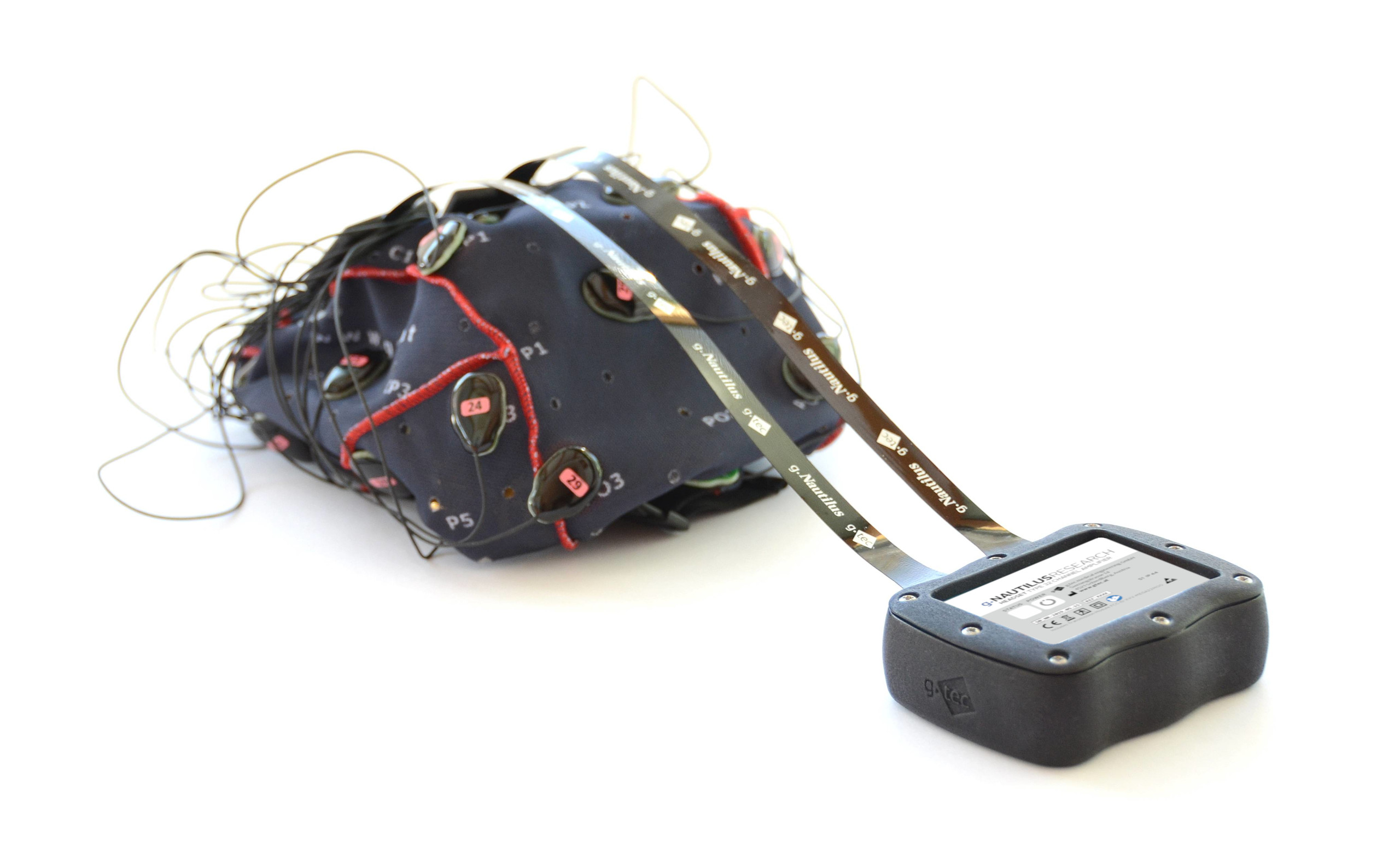
g.Nautilus Research takes g.SCARABEO gel electrodes or g.SAHARA hybrid electrodes that run dry or wet, at 8, 16, 32 or 64 channels. Same headset either way.
Wireless or tethered
Wireless removes cable movement, which is itself an artefact source, and it is the only option if the subject walks, cycles or reaches. On g.Nautilus the amplifier sits on the cap for exactly that reason.
Tethered amplifiers still win on channel count and on invasive work. g.HIamp runs 256 channels per device, scales to 1,024 synchronised channels, and is FDA cleared and CE certified for invasive and non invasive recording.
If your paradigm is a seated screen task, this decision is smaller than the vendors make it sound.
Triggers and synchronisation
This is where first EEG purchases go wrong, and it is the question almost nobody asks before signing.
Before you buy, confirm three things:
- How the stimulus computer sends the trigger. Parallel port, TTL input, LSL, or a software marker with unknown latency. The last one is NOT acceptable for ERP work.
- What the measured jitter is, not the specified jitter.
- Whether your presentation software is supported. E-Prime, PsychoPy and Psychtoolbox all behave differently.
g.Recorder reads TTL inputs directly and supports g.USBamp, g.HIamp and g.Nautilus. That is why TMS EEG works with it. The timing of the TMS pulse comes in on the TTL inputs of the amplifier and is stored alongside the EEG, so the ERPs can be averaged afterwards. g.Recorder also runs its own paradigm presenter, which takes E-Prime and Presentation out of the timing chain entirely.
Combining EEG with other measures
EEG and eye tracking is the combination we install most often, usually for ERP work where you need to know where the subject was looking when the component appeared. We wrote up the trigger architecture for that setup in eye tracking with EEG, and where the timing breaks.
EEG and fNIRS gives you electrical and haemodynamic signals from the same session. g.Nautilus Research works with g.SENSOR fNIRS for simultaneous recording from one headset.
EEG inside the MRI is a different purchase with different safety requirements. Ask us before you specify it.
EEG with TMS needs an amplifier that recovers fast enough from the pulse. Not every amplifier does.
Which g.tec system
g.Nautilus Research – 8, 16, 32 or 64 channels, wireless, gel or hybrid dry and wet, research use only
g.Nautilus PRO Flexible – wireless, configurable channel count, the clinical version of the same platform
g.USBamp Research – tethered biosignal amplifier and acquisition system
g.HIamp – 256 channels per device, tethered, invasive and non invasive
Buying EEG in Israel
You can buy an EEG system directly from a manufacturer in Europe or the United States. Labs do it, and for a single wearable headset it can work.
One thing to be straight about, because it is easy to imply otherwise. We do not repair or calibrate EEG amplifiers. When one fails it goes back to g.tec under RMA, and that is true whether you bought it from us or from Austria.
What changes is who runs the RMA. Buying direct, the lab opens the case, argues the fault with the manufacturer, arranges the shipping and handles the customs on the way back in. Through us, that is our job and not yours.
The rest is import handling, and application support in your time zone when a montage will not converge two days before a conference deadline.
NBT installs, trains and supports in Israel, Sunday to Thursday, on site when needed.
The full specification comparison sits on our EEG systems page.
Send me the paradigm you plan to run and the number of subjects, and I will tell you which of these four I would put in your lab and which I would leave out. If 32 channels is enough for what you are running, that is what you will hear from me, even though the 64 costs more. What do you think?
NEED MORE INFORMATION ABOUT THIS PRODUCT?
Send us your emailFrequently Asked Questions
How many EEG channels do I need?
32 is the practical floor for ERP research, 64 if you plan source localisation, 8 to 16 for motor imagery and SSVEP BCI work. Buy the channel count your analysis needs, not the one your grant allows.
Dry or wet electrodes?
Gel for ERPs, slow cortical potentials and anything below 1 Hz, because the impedance is lower. Dry where preparation time is the constraint, which usually means children, patient populations and repeated session protocols. g.Nautilus runs both from the same headset.
What should I check about triggers before I buy?
Three things. How the stimulus computer sends the trigger, what the measured jitter is rather than the specified jitter, and whether your presentation software is supported. A software marker with unknown latency is not acceptable for ERP work.
Can I record EEG together with fNIRS, eye tracking or TMS?
Yes. g.Nautilus Research combines with g.SENSOR fNIRS for simultaneous EEG and fNIRS from one headset, and EEG with eye tracking is the combination we install most often. TMS EEG needs an amplifier that recovers fast enough from the pulse, and g.Recorder stores the TMS pulse timing from the TTL inputs alongside the EEG. EEG inside the MRI is a separate purchase with different safety requirements, so ask us first.
Why buy through NBT instead of directly from the manufacturer?
Customs and import handling, a local team that runs the RMA when something fails, and application support in your time zone. To be clear about the repair question: we do not repair or calibrate EEG amplifiers. A failed unit goes back to g.tec under RMA either way. What we take off your hands is opening the case, arguing the fault, the shipping and the customs. NBT has supplied research instrumentation in Israel since 1992 and is the exclusive distributor of g.tec medical engineering here.
Still have questions?
Recent Blog Posts

.svg)

Advance Your Research
Contact NBT today for expert consultation on your neuroscience instrumentation needs.