.svg)
A buyer's guide to lab-on-a-chip
The chip is the cheap part of a lab-on-a-chip, so the money goes on the system around it. This guide walks the fluid path first, run-to-waste or recirculation, and points each to the pump that fits.

What to buy, and what to buy first.
Start here: the chip is the cheap part
A lab-on-a-chip puts several steps that normally take a whole bench onto one piece of plastic or glass that fits in your hand. Sample handling, mixing, a reaction, sometimes the readout, all on one chip. Why labs want it: less reagent, faster reactions, work at the single-cell scale, many conditions in parallel.
The chip on its own does nothing. Elveflow's review of the field says it plainly: a working lab-on-a-chip needs pumps, valves, sensors and often electronics around it to run at all. So the first rule of buying into lab-on-a-chip is to budget for the system, not the chip. A lab that spends its money on chips and treats the flow control as an afterthought ends up with a drawer of chips it cannot run.
This guide goes through the decisions in the order they cost you money.
1. Do you need moving fluid at all?
Before anything else, decide whether your assay needs active, controlled flow.
Some lab-on-a-chip work does not. Paper devices wick the sample by capillary action and cost almost nothing, which is why they carry point-of-care tests into low-resource settings. Centrifugal chips, the "lab-on-a-CD" format, move fluid by spinning the disc, so the only instrument is the spinner.
Active flow is the other camp, and it is where most academic research sits: cell culture under perfusion, organ-on-a-chip, droplet generation, long multi-step protocols, anything where you set a flow rate and hold it. If your work is here, the flow control is the instrument you live with for years. Spend the time on it.
2. The chip: buy it, or make it
Two routes.
Buy off-the-shelf chips. Companies sell ready-made channel chips, and for cell work ibidi sells sealed channel slides, the µ-Slide range, that drop straight onto a microscope. This is the fastest way to a result and the right call for a lab that wants to run experiments, not develop chips.
Make your own by soft lithography. You cast PDMS on a mold you pattern yourself, so you can change the channel design as often as you like. Soft lithography does not need a clean room, whatever you may have heard. Elveflow's review makes the point, and a bench under a fume hood is enough for PDMS prototyping. You need it only if you will redesign the chip often.
My view: if you are starting out and your design is standard, buy the chips. Set up soft lithography in-house only once you know you will iterate designs month after month. The mold and bonding kit pay off on the tenth design, not the first.
Which material, if you are choosing:
| Material | Good for | The catch |
| PDMS | Fast prototyping, gas-permeable for cell culture, easy to cast, easy to add valves | Ages, absorbs small hydrophobic molecules, hard to integrate electrodes, not for mass production |
| Thermoplastic (PMMA, PS, COC) | More chemically inert than PDMS, transparent, a route to production | Trickier and dearer to make in-house than PDMS |
| Glass | Optically clear, chemically inert, low non-specific binding | Needs a clean room and real microfabrication skill to make |
| Silicon | High-precision features, integrates electrodes and electronics | Expensive, not transparent in visible light, no high-voltage work like electrophoresis |
| Paper | Ultra-low-cost, disposable diagnostics | Limited to simple assays |
For most cell and organ-on-chip work the answer is PDMS or a ready-made ibidi slide. Thermoplastic enters the picture when you outgrow PDMS and start thinking about reproducibility across many chips, or an eventual product.
3. The fluid path: run-to-waste or recirculation
Before you pick a pump, decide what happens to the medium after it passes the cells. This choice drives the rest of the setup, and it is the one most people skip.
Run-to-waste (single pass). Medium flows once from the reservoir, through the chip or culture, and out to a waste bottle. The flow is as clean and defined as your pump allows, and nothing that left the cells comes back. The cost is the medium: a long run empties a large reservoir, and run length is set by how much medium you are willing to push through. This is the path when the medium is cheap, when you want the most precisely defined single-pass flow, and for a defined dose or a washout where you do not want spent medium returning.
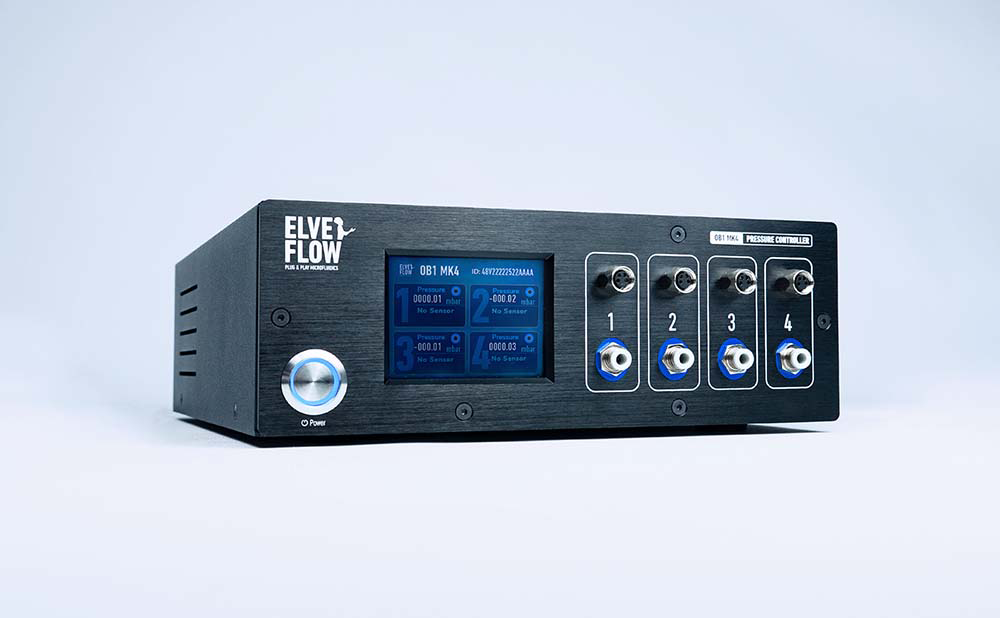
For run-to-waste, the pump depends on how demanding the culture is. A syringe pump is the simplest and cheapest, and fine for a constant low infusion, though the flow steps with the motor and in soft tubing the pump can spend minutes building pressure before the liquid moves at all. A pressure-driven controller pushes medium from a sealed reservoir straight through the culture and out to waste, so it is a run-to-waste setup by design, and it gives the cleaner result: pulseless flow up to 20 times steadier than a syringe or peristaltic pump (Elveflow's figure for the OB1), steady state in about 10 ms, and 0.1 µL/min to 500 mL/min when paired with a flow sensor. For shear-sensitive cells and live imaging on a single pass, this is where we point you to the Elveflow OB1.
Recirculation (closed loop). The same medium is pumped round a loop and reused, passing the cells again and again. This is the setup for long-term cell culture under flow, and it is where a lot of perfusion work sits, so for most labs asking about flow culture it is the main case, not the exception. Two reasons to do it. The medium supplements are in excess and are not spent in a single pass, so recirculation cuts reagent cost on a long run. And the molecules the cells secrete stay in a small circulating volume instead of being diluted into a large reservoir and lost below detection. The trade is that waste and secreted factors build up in the loop, so recirculation suits work where that is acceptable or wanted, such as long-term culture under a defined shear.
Where recirculation is key, we point you to the ibidi Pump System. It is an air-pressure pump sitting outside the incubator and a Fluidic Unit inside it, with two switching valves that recirculate the medium through an ibidi channel slide in one direction, in a closed, sterile loop. No mechanical part touches the medium, so the flow carries no roller pulse, and the system runs continuous, pulsatile or oscillatory laminar flow at a shear stress you set, across roughly 0.1 to 200 dyn/cm². Working volumes are 2.5, 12 or 50 ml, which keeps reagent use low over a long run, and one ibidi Pump drives up to four Fluidic Units for parallel conditions.
A pressure controller pushes from one reservoir to waste, so true recirculation is a different machine, not an add-on to the OB1. The ibidi Pump System is built for the closed loop, which is why recirculation work goes there and not onto a single-reservoir pump.
A word on peristaltic pumps. They also recirculate, and they cost less, but the rollers pulse, and the pulse rises and falls with the flow rate, so a shear-sensitive culture and a clean image both suffer. For recirculation where shear and imaging are the priority, the air-pressure ibidi system is the better tool. For simple recirculation of a culture that tolerates a pulse, a peristaltic pump is enough.
4. The parts nobody budgets for, then needs
A pump alone is not a fluidic setup. Plan for these from the start, not after the first failed run:
- Flow sensor. A pressure controller sets pressure, not flow. To hold an exact flow rate you add a sensor that reads the real flow and lets the controller correct to it. Without one you are controlling pressure and guessing at flow.
- Reservoirs and adapters. Sealed, autoclavable reservoirs are what a pressure system pushes from. Size them to your run length.
- Valves. Switching between solutions, or addressing several lines, needs distribution or rotary valves. This is how you run more than one condition without standing at the bench.
- Bubble trap or detector. One air bubble through a chip can strip a cell monolayer or ruin an imaging session in seconds. A trap in the line prevents it; a detector can stop the run when a reservoir empties.
- Tubing, fittings, connectors. Cheap, and the usual reason a first setup leaks.
5. Readout: plan how you will see the result
The chip integrates the assay. You still have to read it. Most academic setups read on a microscope, so the flow hardware has to sit on a stage without vibration, which is one more argument for pulseless flow. Other setups put an inline sensor or a small assay downstream of the chip and follow what the cells consume or secrete in real time, with no sampling. Decide the readout before you buy the chip, because it constrains the chip material (optical clarity) and the flow (steady enough to keep a measurement quantitative).
6. Software and automation
For a single afternoon experiment, software is a minor concern. For a multi-day perfusion or an unattended overnight run it decides whether the result is clean. Look for SDKs in the language your lab already uses (Python, MATLAB, LabVIEW, C++), triggers between the flow system and the microscope, and a sequencer so a protocol runs the same way whether you or a colleague launched it. That is what turns a manual rig into a reproducible one.
7. Turnkey pack or twelve separate parts
You can source the pump, sensors, valves, reservoirs, tubing and chip yourself, or buy an application pack built for one job: perfusion, organ-on-chip, droplet generation, lipid nanoparticle synthesis. The pack costs more than a parts list you assemble on a good day. It costs a lot less than three months of debugging a setup that almost works.
My view: a lab doing microfluidics for the first time should buy the pack for its main application and add parts later. A lab with a fluidics-experienced student can assemble from parts and keep the margin.
A short checklist before you spend
- Does the assay need active flow, or will paper or centrifugal do it for less?
- Are you buying chips or making them? If making, do you iterate designs often enough to justify the mold and bonding kit?
- Run-to-waste or recirculation? Recirculate if the medium is costly, or if you need secreted factors to stay concentrated in a small volume.
- Which pump fits: a syringe pump or the Elveflow OB1 for single-pass, the ibidi Pump System for recirculation under a defined shear?
- Have you budgeted the flow sensor, reservoirs, valves and bubble trap, not just the pump?
- How will you read the result, and does the chip material and flow suit that readout?
- Do you need automation for long or unattended runs?
- Pack or parts?
Further reading: webinars and blogs
ibidi and Elveflow both publish open webinars and articles that go deeper than this guide.
Webinars:
- ibidi, Cell Culture Under Flow: Setup and Applications
- ibidi, Cell Culture Under Flow and Shear Stress
- ibidi, Advanced Cell Culture Under Flow, Dynamic 3D Applications
- Elveflow, Advancements in perfusion cell culture for live-cell imaging
Blogs and articles:
- ibidi, Cell Culture Under Flow, an overview of the assay and the parts
- ibidi, Online course: Cell Culture Under Flow, shear stress and flow parameters
- Elveflow, Microfluidic perfusion for dynamic cell culture, a setup walkthrough with flow profiles
- Elveflow, Shear stress and mechanosensing, on how flow changes what cells do
Where NBT fits
NBT is the Israeli distributor for Elveflow (flow controllers, flow and pressure sensors, valves, reservoirs, bubble removers, soft-lithography fabrication stations and application packs) and for ibidi (channel slides, the ibidi Pump System and labware for cell work), alongside syringe and peristaltic pumps from Harvard Apparatus and others. For single-pass, run-to-waste perfusion where you want the cleanest defined flow, we point you to the Elveflow OB1. Where recirculation is key, we point you to the ibidi Pump System. Tell us the assay and the flow rate you are aiming for, and we will tell you which pump and which parts fit, and where a cheaper option is enough. Product details are on nbtltd.com.

NEED MORE INFORMATION ABOUT THIS PRODUCT?
Send us your emailFrequently Asked Questions
Run-to-waste or recirculation, which do I need?
Run to waste when the medium is cheap and you want the cleanest single-pass flow, for a defined dose or a washout. Recirculate when the medium is costly or you need the factors the cells secrete to stay concentrated, which covers most long-term cell culture under flow. For run to waste we point you to the Elveflow OB1; where recirculation is key, the ibidi Pump System.
Do I have to make the chip myself?
Not to start. Buy off-the-shelf chips or ibidi channel slides and run experiments. Set up soft lithography in-house only once you know you will iterate the design month after month; a bench under a fume hood is enough for PDMS, no clean room needed.
Still have questions?
Recent Blog Posts


.svg)

Advance Your Research
Contact NBT today for expert consultation on your neuroscience instrumentation needs.