.svg)
.svg)
Warner VCS Valve Control System
Touchscreen-driven multi-valve perfusion controller from Warner Instruments - automate solution delivery across up to 8 pinch, PTFE or Lee mini valves. UI-programmable protocols, TTL event markers on every valve switch, dedicated sync BNC for DAQ alignment, and standalone operation without a PC. The reference valve controller for patch clamp, live-cell imaging and Ussing-chamber perfusion.
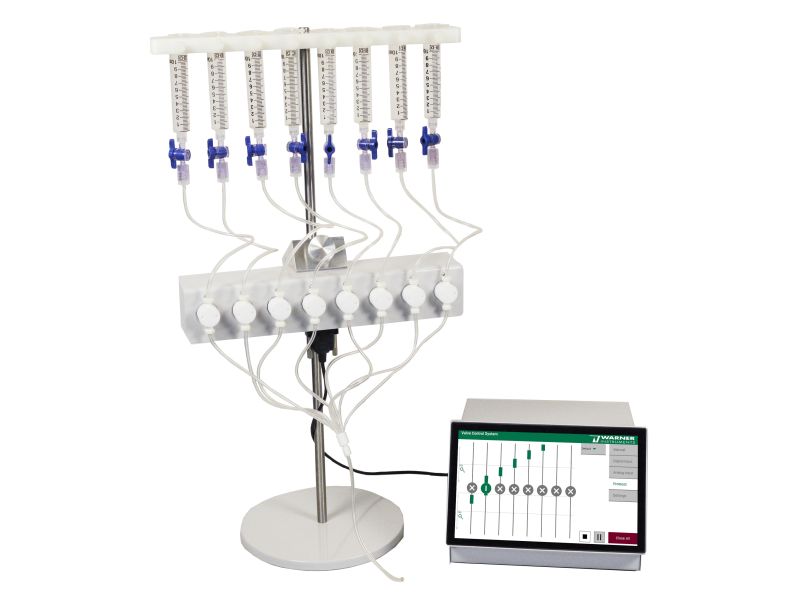
What is the Warner VCS Valve Control System?
The Warner Instruments VCS is the heart of a multi-valve perfusion bench - a touchscreen-driven controller that automates the delivery of up to eight solutions to imaging and recording chambers. Configured with pinch, PTFE, or Lee mini valves depending on solution chemistry and flow needs, the system gives patch-clamp, live-cell imaging, and chamber-perfusion workflows the precise, repeatable, software-defined solution switching that manual stopcocks can’t match.
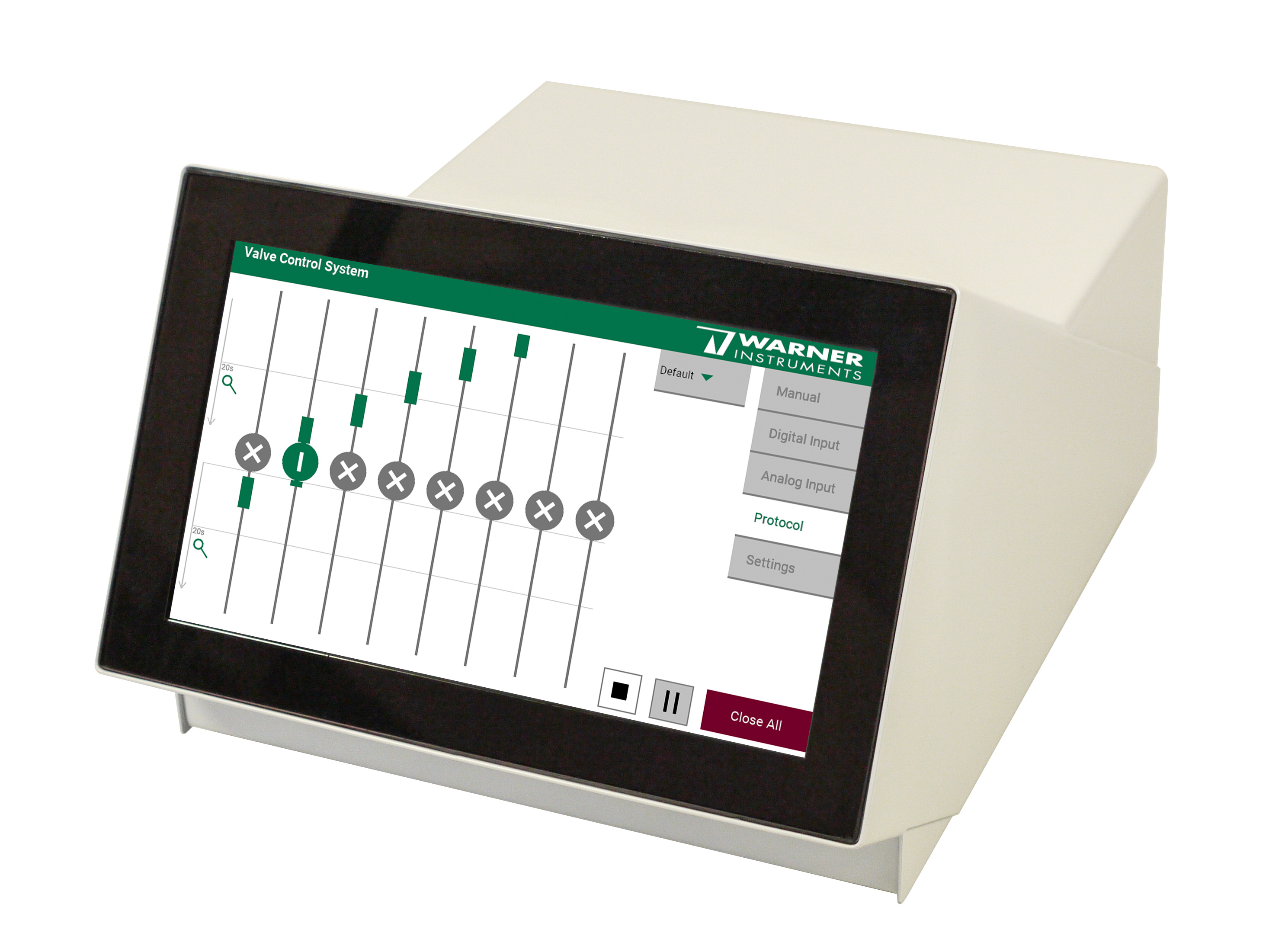
Valves are accessed four ways - via the integrated 7″ touch display, the included PC software, an external analog input, or external TTL digital lines. Every valve switch generates an event-marker pulse for chart recordings, and a dedicated trigger/sync BNC aligns valve timing with downstream data acquisition. Six- and eight-channel systems share the same controller architecture.
Key Features
- Up to 8 channels: 6- or 8-channel models for parallel solution delivery.
- Three valve options: Pinch (solution never contacts the valve), PTFE (chemical-resistant 2-way), or Lee mini valves (3-way, optimized for the SF-77C fast stepper).
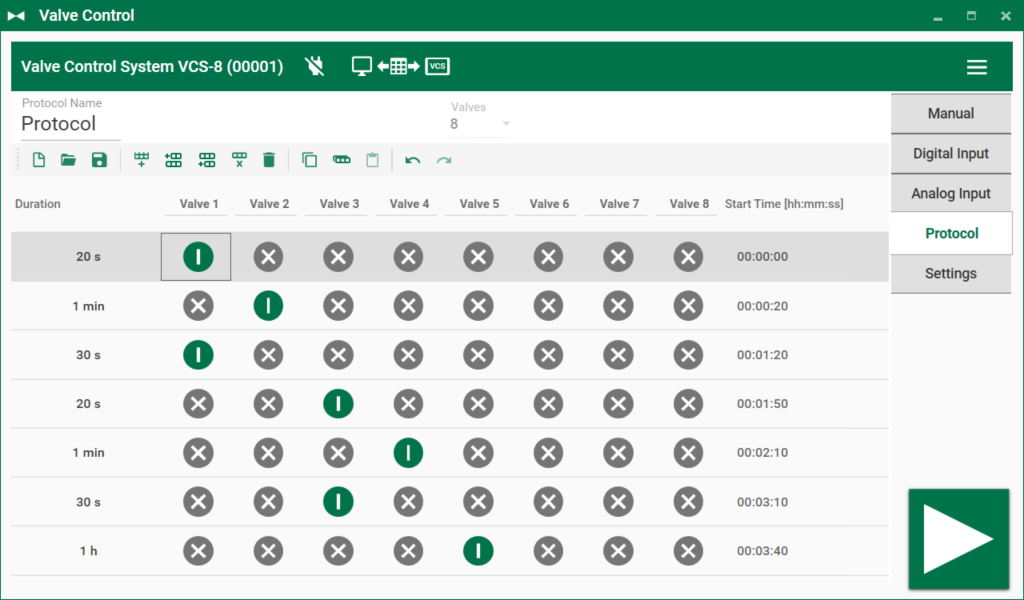
- Touch display + PC software + TTL/analog: Operate manually at the bench or under instrument control - four input modes share the same protocols.
- UI-programmable protocols: Build, save, and replay multi-step valve sequences; download to the controller for standalone operation without a PC.
- Event marker + sync pulse: Every valve switch emits a TTL pulse for chart recordings; dedicated trig/sync BNC for DAQ alignment.
- Low-noise, low-self-heating design: Suited to patch clamp where electrical and thermal noise matter.
- Standalone mode: Save protocols to the controller flash - run without a connected PC.
- Free SDK: Integrate VCS control into custom acquisition software.
.webp)

Why automated valve control matters for perfusion
Manual perfusion benches (reservoirs, stopcocks, manifold) are the source of most timing artifacts in patch-clamp and live-cell imaging experiments. Solution-onset time depends on operator reaction; protocol step duration drifts; alignment to recording timestamps is by stopwatch. For dose-response, agonist/antagonist sequences, washout kinetics, and timed-pulse protocols, this is the difference between publishable data and noisy data.
The VCS replaces all of that with software-defined timing: a protocol step is exactly as long as the program says, every solution onset is paired with a TTL event marker, and the entire sequence is repeatable across animals and across days. For multi-arm pharmacology and circuit-mapping experiments, the throughput improvement is significant; for any patch-clamp experiment, the artifact reduction makes the system pay for itself.
Typical Use Cases
- Patch clamp solution switching (agonist / antagonist / control / wash sequences).
- Live-cell imaging perfusion with pharmacological pulses.
- Brain slice and Ussing-chamber perfusion under defined timing.
- SF-77C fast-stepper integration for sub-second solution exchange.
- Multi-step washout and dose-response protocols requiring repeatable timing.

Models
| VCS-8-PINCH (64-3080) | 8-channel, pinch valves, 60 cc reservoirs |
| VCS-8-PTFE (64-3081) | 8-channel, PTFE valves, 60 cc reservoirs |
| VCS-8-MINI (64-3082) | 8-channel, mini valves, 10 cc reservoirs |
| VCS-8-MINI-LT (64-3083) | 8-channel, large-bore mini valves, 60 cc reservoirs (up to 10 mL/min) |
| VCS-6-PINCH (64-3084) | 6-channel, pinch valves, 60 cc reservoirs |
| VCS-6-PTFE (64-3085) | 6-channel, PTFE valves, 60 cc reservoirs |
| VCS-6-MINI (64-3086) | 6-channel, mini valves, 10 cc reservoirs |
| VCS-6-MINI-LT (64-3087) | 6-channel, large-bore mini valves, 60 cc reservoirs |
| VC-CONTROL UNIT (64-3088) | Touch screen valve control system controller (standalone) |
| VC-LAB STAND (64-3089) | VCS support stand |
Technical Specifications
| Display | 7″ touch screen on controller |
| Control Modes | Manual, PC software, analog input, digital (TTL) input, programmatic |
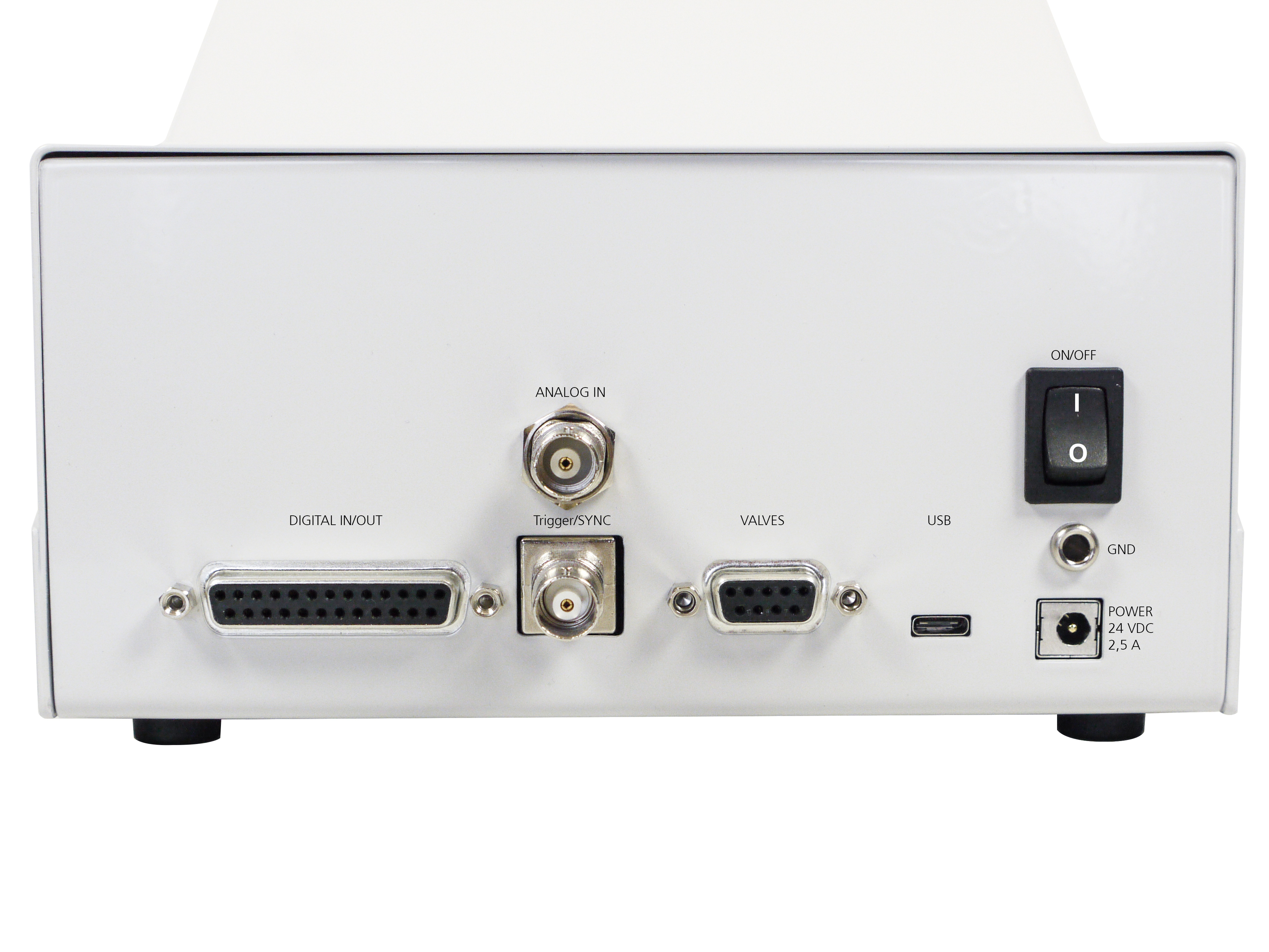
| Trigger / Sync | BNC TTL output for DAQ alignment |
| Event Marker | TTL pulse generated on every valve switch |
| Digital I/O | 16-bit, Dsub25 connector |
| Analog In | BNC connector |
| USB | USB-C, 3.0 |
| Power | 24 VDC |
| Controller Dimensions | 144 × 187 × 265 mm |
| Controller Weight | 2005 g |
| Valve Stand Dimensions | 89 × 203 × 305 mm |
| Valve Stand Weight | ~4950 g |
| OS Compatibility | Windows 7 / 8 / 8.1 / 10 (64-bit) |
| Operating Temperature | 10–40 °C |
Applications
- Patch clamp solution switching
- Live-cell imaging perfusion with pharmacological pulses
- Brain slice and Ussing chamber perfusion
- Sub-second solution exchange with SF-77C fast stepper
- Dose-response and washout kinetic protocols
Patch Clamp Techniques
Explore All ProductsElectro-Physiology
Explore All ProductsWarner VCS Valve Control System Publications
The Warner VCS is widely cited in patch-clamp, live-cell imaging and chamber-perfusion methods sections where reproducible automated solution switching is essential. Studies typically describe its use in pharmacology, electrophysiology, and Ussing-chamber workflows.
How many channels, and which valve types?
Six or eight channels, in three valve types. Pinch, where the solution never touches the valve. PTFE, two-way and chemically resistant. Lee mini valves with 10 cc reservoirs, or large-bore mini valves with 60 cc.
Can I run it from software?
Yes. Touchscreen at the bench, PC software, or TTL and analog input from another instrument. Protocols are built in the interface, saved, and downloaded to the unit.
How do I align valve switches with my recording?
Every valve switch emits a TTL event marker, and there is a dedicated sync BNC for the DAQ. The switch time lands in the data rather than on a notepad.
Is it quiet enough for patch clamp?
It is built low-noise and low-self-heating for exactly that. If you are patching, say so when you order and we will confirm the valve type with Warner first.
Which model number do I need?
It depends on channel count, valve type and reservoir size. 64-3080 through 64-3087 cover the combinations, and 64-3088 is the controller on its own. Tell us the channels and the solution and we will pick it.
Still have questions?
Request for Quote
Please fill in as much details as possible and we will take care of your request as soon as possible
Request for Quote
Please fill in as much details as possible and we will take care of your request as soon as possible