.svg)
.svg)
OB1 Perfusion System for Cell Culture and Analysis
Pressure-driven flow control that keeps cultured cells viable under continuous medium renewal, at a set flow rate from 0.1 µL/min to 500 mL/min, while you image them live or measure what they consume and secrete. Pulseless flow up to 20× steadier than a syringe or peristaltic pump, with the pump never touching the medium.
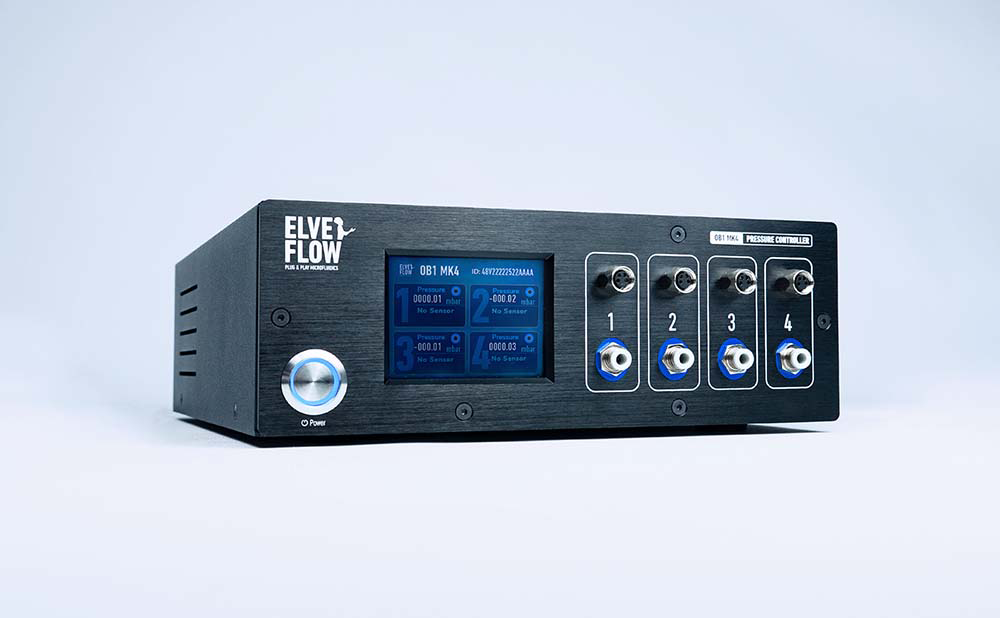
What is the OB1 Perfusion System for Cell Culture and Analysis?
The Elveflow OB1 is a pressure-driven flow controller that keeps cultured cells viable under continuous medium renewal while you image them live or measure what they consume and secrete. Clean gas pressurises a sealed reservoir and pushes medium through your culture vessel, so no moving part ever touches the liquid and the flow is stable and pulseless from the first second. Set a pressure and medium flows; add a flow sensor and the OB1 holds an exact flow rate for you, anywhere from 0.1 µL/min to 500 mL/min.

▶ Watch on YouTube: setting up the OB1 pressure controller
Why pressure-driven flow for cell culture?
- Pulseless, controlled shear: With no moving part in the liquid, the flow carries no pulse, up to 20× steadier than a syringe or peristaltic pump, holding cells at a steady wall shear stress and keeping live-imaging fields free of drift and vibration.
- Millisecond reactivity: Pressure is applied directly, so flow reaches steady state almost at once, instead of the minutes a syringe pump can take to build pressure in soft tubing and chambers.
- No contact with your medium: The pump sits on the gas side and never touches the medium, so it adds no dead volume and no contamination - only your reservoir, tubing and vessel are ever wetted.
- No volume limit: Pressure drives medium from a reservoir of any size, from a millilitre to several litres, so long runs are a matter of reservoir size, not a fixed syringe.
- Reproducible conditions: A feedback loop holds the same flow rate, and the same shear, run to run: set 5 µL/min today and you get 5 µL/min next week.
- Up to four channels: Drive one to four independent lines at once, each with its own medium and flow rate, to compare conditions side by side or feed many identical cultures in parallel.
.webp)

Study cells under controlled, repeatable conditions
Hold a defined flow rate, and through it a defined wall shear stress, or switch the medium and add reagents at set times, then study the cellular response. Because the flow is steady and repeatable, the condition is the variable you test, not a source of noise. Add an MFS or BFS flow sensor to lock the rate: enter a target, the sensor measures the real flow, and the OB1 trims its pressure until the two match.
Image cells live under continuous perfusion
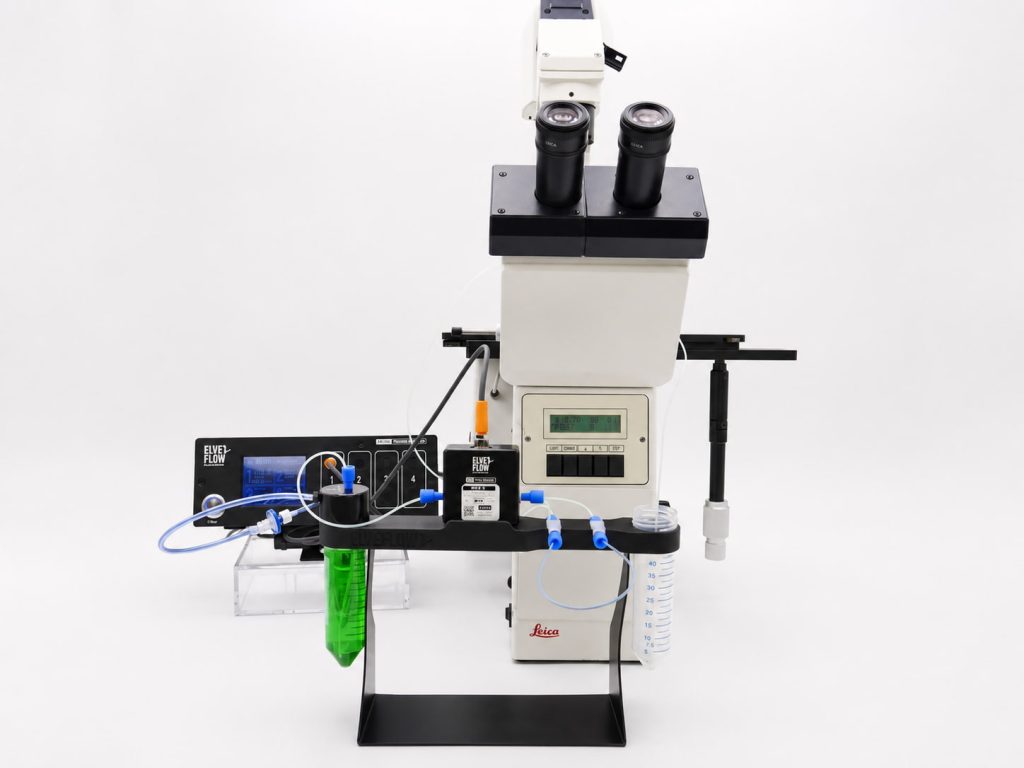
Non-contact, pulseless delivery suits live-cell microscopy - the culture stays under continuous medium renewal with no pump vibration in the field. The Elveflow Smart Interface sends a TTL trigger to start acquisition the moment the flow changes, or takes a trigger from the microscope to start an injection, so your images and your medium changes stay on one clock.
Monitor cellular activity in real time
Place an inline assay downstream of the culture and follow what the cells consume or secrete as it happens (a metabolite such as glucose, or a secreted factor) with no discrete sampling. Steady flow keeps that measurement quantitative and comparable across the whole run.
Automate medium changes, stimulation and imaging
Program medium exchanges, timed reagent additions and imaging triggers once, and the software runs the whole protocol hands-off, so a multi-day experiment runs the same way whether or not someone is at the bench.
- Long runs, unattended: set the flow and scheduled medium exchanges over hours or days and walk away.
- Timed reagent injection: switch solutions on a schedule, including the 2 a.m. step nobody wants to be there for.
- Microscope sync: trigger acquisition on a flow change, or start an injection on a trigger from the microscope.
- Push–pull level control: run one line in and one line out at matched rates to hold a constant medium volume in an open chamber or well.
SDKs are available for Python, MATLAB, LabVIEW and C++ for building the OB1 into a larger automated setup.

Technical Specifications - OB1 MK4
| Channel pressure ranges | 0 to 200 mbar · 0 to 2,000 mbar · 0 to 8,000 mbar · −900 to 1,000 mbar · −900 to 6,000 mbar (per channel) |
| Pressure stability | 0.005–0.015 % full scale |
| Response time | Down to 10 ms |
| Settling time | Down to 50 ms |
| Channels | 1 to 4 independent channels |
| Flow-rate range (with sensor) | 0.1 µL/min to 500 mL/min (with MFS/BFS flow sensor) |
| Flow sensor compatibility | Full MFS and BFS range; monitoring and feedback-loop flow control |
| Liquid compatibility | Non-contact pump - any aqueous, oil or biological sample solution |
| Pressure supply | 1.5 bar (or max + 0.5 bar) to 10 bar; non-corrosive, dry, oil-free gas |
| Software | Elveflow Smart Interface - Windows 10/11 (32 & 64-bit) |
| SDK | MATLAB, Python, LabVIEW, C++ |
| Input profiles | Ramp, sine, triangle, square or custom; step-by-step sequences |
| Data management | Log and export data (CSV) per channel and sensor |
| Triggers | Input and output TTL, 0 V or 5 V |
| Display | LCD showing pressure and sensor flow rate in real time |
| Interface | USB Type-B; serial communication |
| Sensor connection | M8 4-pin, one connector per channel |
| Power | 24 V, typical 12 W; 100–240 VAC, 50–60 Hz |
| Dimensions | 240 × 223 × 83 mm |
| Weight | 1.4 to 2.9 kg |
A vacuum source is required for calibration and for dual-channel use, even when the channels are used in pressure only.
Applications
- Continuous-perfusion cell culture with controlled wall shear stress
- Live-cell imaging under pulseless, vibration-free flow
- Real-time monitoring of metabolite consumption and secretion via inline assays
- Organ-on-a-chip and microphysiological systems
- Single-cell mechanical phenotyping and deformability measurement
- Long-term, automated multi-day perfusion and medium recirculation
Cell Culture Under Flow
Explore All ProductsMicrofluidics
Explore All ProductsCell Cultivation and Imaging
Explore All ProductsOB1 Perfusion System Publications
Researchers use the Elveflow OB1 pressure-driven flow controller to perfuse cell cultures under controlled shear for live-cell imaging, real-time metabolite monitoring, and single-cell mechanical phenotyping. Published work spans liver, endothelial, neuronal and epithelial cell models.
Why use a pressure-driven system instead of a syringe or peristaltic pump for cell culture?
The flow is pulseless, up to 20× steadier than a syringe or peristaltic pump, so shear-sensitive cells stay attached and live imaging stays free of vibration. It reaches steady flow in milliseconds where a syringe pump can take minutes, feeds from a large reservoir so a run can go for days, drives up to four lines at once, and never touches the medium.
Is the flow really pulseless, and why does pulsation matter for cells?
Yes. The OB1 has no moving part in contact with the liquid, so it delivers a smooth, continuous flow. Pulsation matters because cells feel it: a fluctuating flow means a fluctuating wall shear stress, which can reduce viability, detach a monolayer or shift phenotype, and in live imaging it shows up as drift and vibration.
Can I image live cells while I perfuse them?
Yes. The pump sits off the fluid path and delivers pulseless flow, so there is no vibration in the field and the culture stays under continuous medium renewal while you image. The software can send a TTL trigger to start acquisition when the flow changes, or take a trigger from your microscope to start an injection.
How do I control the shear stress on my cells?
You set it through the flow rate. Wall shear stress comes from the flow rate and your channel geometry, so you calculate the flow that gives your target shear and hold it. Enter a target flow rate, an MFS or BFS sensor reads the real flow, and the OB1 trims its pressure until they match, from 0.1 µL/min to 500 mL/min.
Can it run long-term perfusion for days to weeks?
Yes. The limit is your reservoir, not the pump. The OB1 feeds from reservoirs holding a millilitre to several litres, so the medium lasts and the flow never breaks for a refill. In one published study a perfused liver-cell culture on an OB1 stayed viable for up to ten days, and longer runs are a matter of reservoir size and protocol.
Still have questions?
Request for Quote
Please fill in as much details as possible and we will take care of your request as soon as possible
Request for Quote
Please fill in as much details as possible and we will take care of your request as soon as possible