.svg)
.svg)
ibidi µ-Plate 96 Well Square Glass Bottom
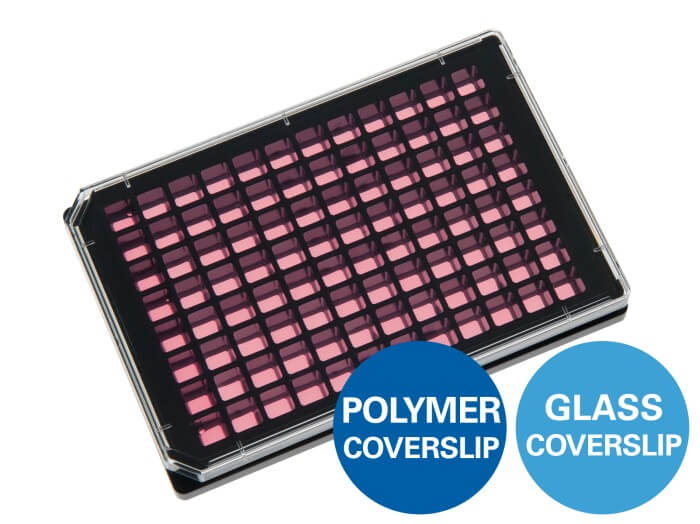
A 96 well plate with black walls, square wells of 7.5 x 7.5 mm, and a flat No. 1.5H glass coverslip bottom of 170 µm ± 5 µm. 0.56 cm² and 300 µl per well, close to twice the growth area of the round well version, on the same ANSI/SLAS footprint and 9.0 mm pitch. More imageable area per well, and more coating reagent to fill it.
What is the µ-Plate 96 Well Square Glass Bottom?
A 96 well plate with black walls, square wells of 7.5 x 7.5 mm and 13.0 mm deep, and a flat No. 1.5H glass coverslip bottom of 170 µm ± 5 µm in Schott D 263 M borosilicate. Growth area is 0.56 cm² per well and working volume 300 µl. Pitch is the standard 9.0 mm and the footprint follows ANSI/SLAS 1 to 4:2004.
What the square wells buy
0.56 cm² against 0.30 cm² on the round well version, 89607, and 300 µl against 200 µl. Squaring the well pushes the flat imageable surface out to the corners, so more fields of view can be tiled per well in a high content run, and the extra 100 µl of medium is 50 percent more buffer against evaporation on a long unattended live cell experiment.
The cost is coating reagent. Coating area is 2.35 cm² per well against 1.61 cm², so a Matrigel or collagen coat across a full plate is meaningfully more expensive.
Where I would not spend the money
The polymer bottom version, 89626, is the same plate with a #1.5 polymer coverslip and costs less, and it is enough for widefield and confocal screening. Buy this glass version for TIRF, single molecule detection and super-resolution. If your assay is not limited by imageable area and your liquid handling already runs on round wells, 89607 is the cheaper and less disruptive plate. And the glass bottom is fragile, which is worth thinking about before it goes onto a robot deck.
Key Features
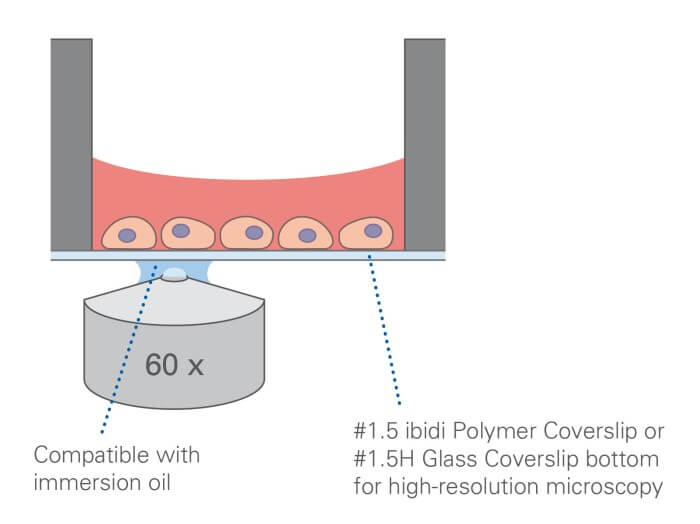
- No. 1.5H glass coverslip bottom, 170 µm ± 5 µm, Schott D 263 M
- 96 square wells, 7.5 x 7.5 mm, 0.56 cm² and 300 µl each
- Black walls for low well to well crosstalk
- ANSI/SLAS footprint, 9.0 mm pitch, flatness for automated screening
- Compatible with all immersion oils, 15 or 90 per box
.webp)

| Catalog number | 89627 |
| Number of wells | 96 |
| Well geometry | Square, 7.5 x 7.5 mm |
| Well depth | 13.0 mm |
| Growth area per well | 0.56 cm² |
| Coating area per well | 2.35 cm² |
| Volume per well | 300 µl |
| Well to well distance | 9.0 ± 0.1 mm |
| Coverslip bottom | Glass, No. 1.5H, 170 µm ± 5 µm |
| Glass type | Schott borosilicate, D 263 M |
| Refractive index | 1.523 |
| Abbe number | 55 |
| Outer dimensions | 127.8 ± 0.2 x 85.5 ± 0.2 mm |
| Height with lid | 17.2 ± 0.4 mm |
| Height without lid | 15.0 ± 0.4 mm |
| Footprint standard | ANSI/SLAS 1-2004, 2-2004, 3-2004, 4-2004 |
| Recommended cell concentration | 2 to 5 x 10⁴ cells/ml |
| Immersion oil | Compatible with all immersion oils |
| Sterilization | Sterile, single use |
| Temperature | Stable to 80 °C, not autoclavable |
| Storage | RT (15 to 25 °C), dry, no direct sunlight |
| Shelf life | 36 months |
| Pieces per box | 15 or 90, individually packed |
| Polymer bottom version | 89626, #1.5 polymer, 180 µm (+10/-5 µm) |
Applications
- High content screening and large area imaging
- TIRF microscopy
- Single molecule detection
- Super-resolution microscopy
- Long term live cell imaging and immunofluorescence

Cell Cultivation and Imaging
Explore All ProductsFluorescence Imaging
Explore All Productsibidi Labware Publications
Comprehensive collection of peer-reviewed research publications demonstrating the use of ibidi labware including µ-Slides, µ-Dishes, µ-Plates, and specialized microfluidic devices for cell biology, neurobiology, vascular biology, and cancer research.
What do the square wells actually buy me?
0.56 cm² against 0.30 cm² on the round version, 89607, and 300 µl against 200 µl. The flat imageable surface runs out to the corners, so more fields of view tile per well in a high content run, and the extra 100 µl is 50 percent more buffer against evaporation on a long live cell experiment.
What does it cost me?
Coating reagent. 2.35 cm² per well against 1.61 cm² on the round version, so a Matrigel or collagen coat across a full plate is meaningfully more expensive. If imageable area is not what limits your assay, buy the round plate.
89627 or 89626?
89627 is the glass bottom, 89626 the polymer. For widefield and confocal screening, 89626 is enough and costs less. Take the glass for TIRF, single molecule detection and super-resolution.
Immersion oil and handling?
Compatible with all immersion oils. The glass bottom is fragile and breaks easily, so think about it before the plate goes onto a robot deck.
Is it available in Israel with local support?
Yes. NBT is the ibidi distributor in Israel. We hold labware locally, and we will tell you when the polymer bottom version would have been enough.
Still have questions?
Request for Quote
Please fill in as much details as possible and we will take care of your request as soon as possible
Request for Quote
Please fill in as much details as possible and we will take care of your request as soon as possible