.svg)
.svg)
EVOM™ Manual – TEER Measurement Meter
The EVOM™ Manual is WPI's next-generation manual TEER meter - replacing the EVOM3, EVOM2, and MilliCell® ERS-2. Features automatic data logging, 20X sample averaging, adjustable currents (2, 4, or 10 μA), and resistance auto-ranging from 1 Ω to 100,000 Ω for reliable epithelial and endothelial barrier measurements.

The EVOM™ Manual is WPI's next-generation manual TEER meter, replacing all previously manufactured WPI manual TEER instruments - including the EVOM3, EVOM2, and MilliCell® ERS-2. Engineered for reliability, repeatability, and ease of use, the EVOM™ Manual delivers improved workflow efficiency and more stable measurements for epithelial and endothelial cell culture research.
At its core, the EVOM™ Manual features automatic 20X sample averaging, a low-noise circuit design for greater resolution, and adjustable fixed measurement currents (2, 4, or 10 μA) to suit a wide range of membrane types. Resistance auto-ranging covers 1 Ω to 100,000 Ω across three selectable current ranges, with fast stabilization on low-level readings under 200 Ω to a resolution of 0.1 Ω. The low-current, low-voltage design prevents metal ion transport and is non-destructive to cells and membranes.
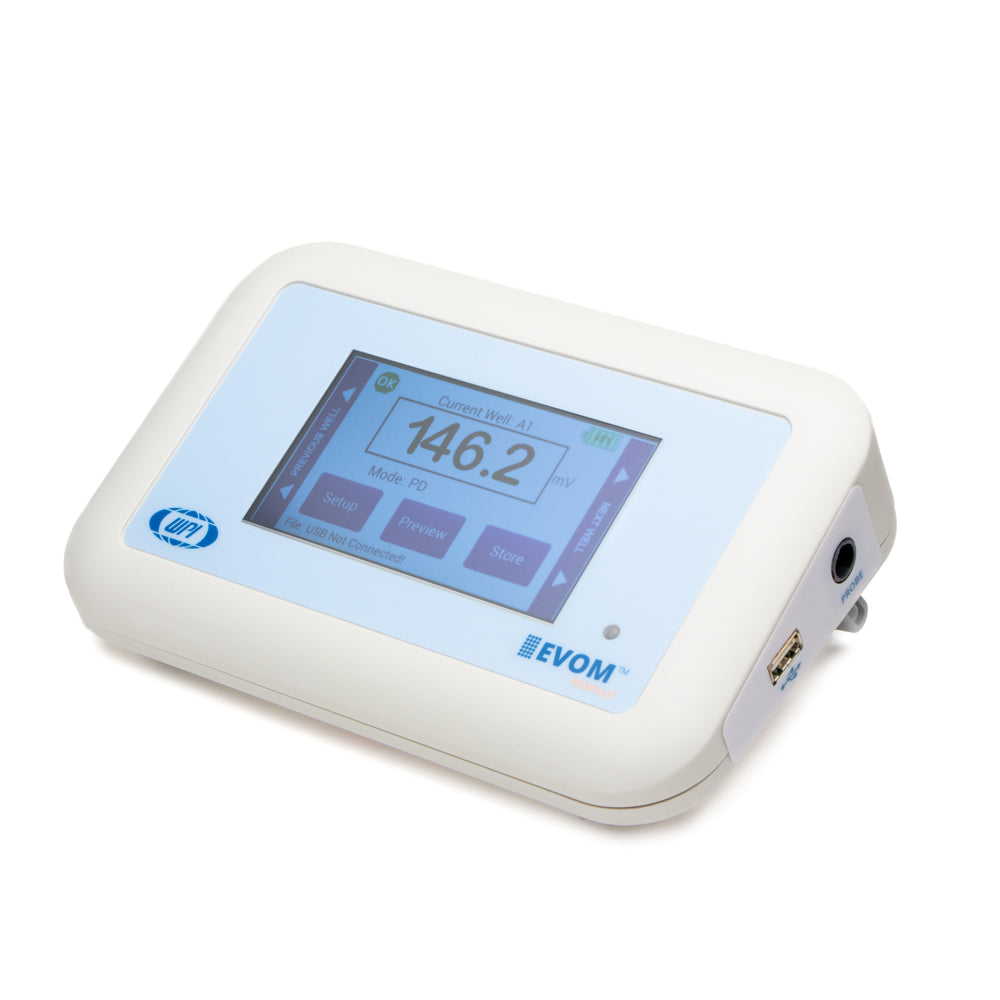
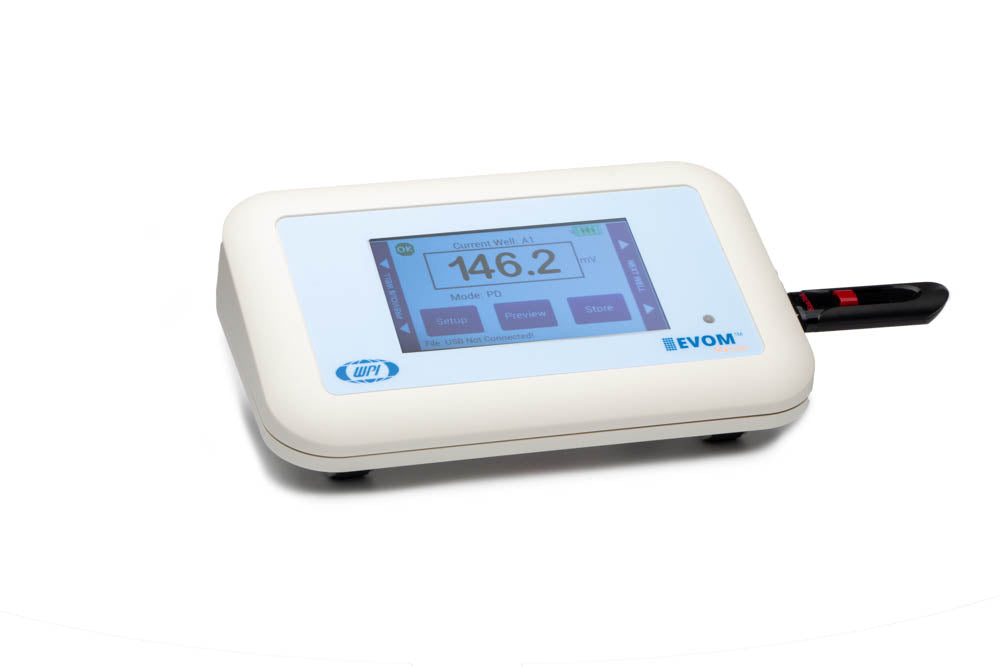
Data collection is seamless - the EVOM™ Manual logs measurements continuously to a USB flash drive in CSV format, date-stamped and ready for direct spreadsheet import. A new Windows® companion application provides a secured mode of data transfer in addition to USB storage. The ergonomic tilt stand reduces glare, while automatic plate indexing supports operation with or without control well subtraction for both resistance and potential difference (PD) measurements. Graphical display of popular well plate formats (6, 12, 24, 96) enables trend analysis at a glance. A footswitch enables hands-free recording during experiments.
Key Features
Low-noise design for greater accuracy and resolution in TEER measurement protocols. Automatic 20X sample averaging for improved stability. Adjustable fixed currents: 2, 4, or 10 μA. Resistance auto-ranging from 1 Ω to 100,000 Ω, plus three fixed current ranges. Fast resistance stabilization for readings under 200 Ω, resolution to 0.1 Ω. Continuous USB data logging (PC, Mac, Linux) with date-stamped CSV output. New Windows® companion app for secured data transfer. Graphical display of 6-, 12-, 24-, and 96-well plate formats. Automatic plate indexing with optional control-well subtraction. Footswitch for hands-free recording. Auto-save and data recovery when battery is low. Upgradable firmware. CE certified.
How It Works
Cell monolayer confluence is determined by measuring an increase or plateau in tissue resistance, detected through the EVOM™ Manual's low AC current circuit and the STX4 electrode. The instrument qualitatively assesses monolayer health and quantitatively measures cell confluence. Because it uses low AC current, electrode metal deposits and adverse tissue effects are avoided - unlike DC current approaches. Resistance readings are unaffected by membrane capacitance or voltage, making the system ideal for permeability, PD, and detailed membrane studies.
What is TEER?
TEER (Trans-Epithelial Electrical Resistance) measures the electrical resistance across a cellular monolayer to quantify barrier integrity. High TEER values indicate a tight, intact monolayer with restricted ion permeability. A decreasing TEER signals compromised barrier function. TEER measurement is routinely used to confirm confluent monolayer formation in transwell culture systems before beginning permeability or drug transport studies.
TEER Value Calculation
TEER is a normalized resistance value per unit area (Ω·cm²). To calculate TEER, multiply the measured resistance by the membrane surface area: 6-well plate (24 mm inserts) 4.53 cm², 12-well plate (12 mm inserts) 1.13 cm², 24-well plate (6.5 mm inserts) 0.33 cm², 96-well plate (4.3 mm inserts) 0.145 cm². Example: a 12 mm insert measuring 565 Ω gives a TEER of 565 × 1.13 = 638.5 Ω·cm².
Applications
Blood-brain barrier transport studies. Lung epithelial tissue research. Intestinal tissue permeability assays. Skin barrier studies. Drug permeability and absorption testing. Toxicity and cytotoxicity screening. Continuous digital monitoring of target membranes. Measure epithelial or endothelial tissues for confluence, TEER, and potential difference.
Compatible Electrodes
The EVOM™ Manual is compatible with the STX4 EVOM™ Electrode with Removable Blades (EVM-EL-03-03-01) for 6 mm inserts - the recommended electrode for use with this instrument. Legacy STX2 and STX3 electrodes are supported via the 99672 EVOM Legacy Adapter (sold separately). ENDOHM chambers for endothelial/epithelial measurement are available in 6, 12, and 24 mm insert sizes (EVM-EL-03-01-01 to -03), and include the EVOM™ Manual cable 99916.
What’s Included
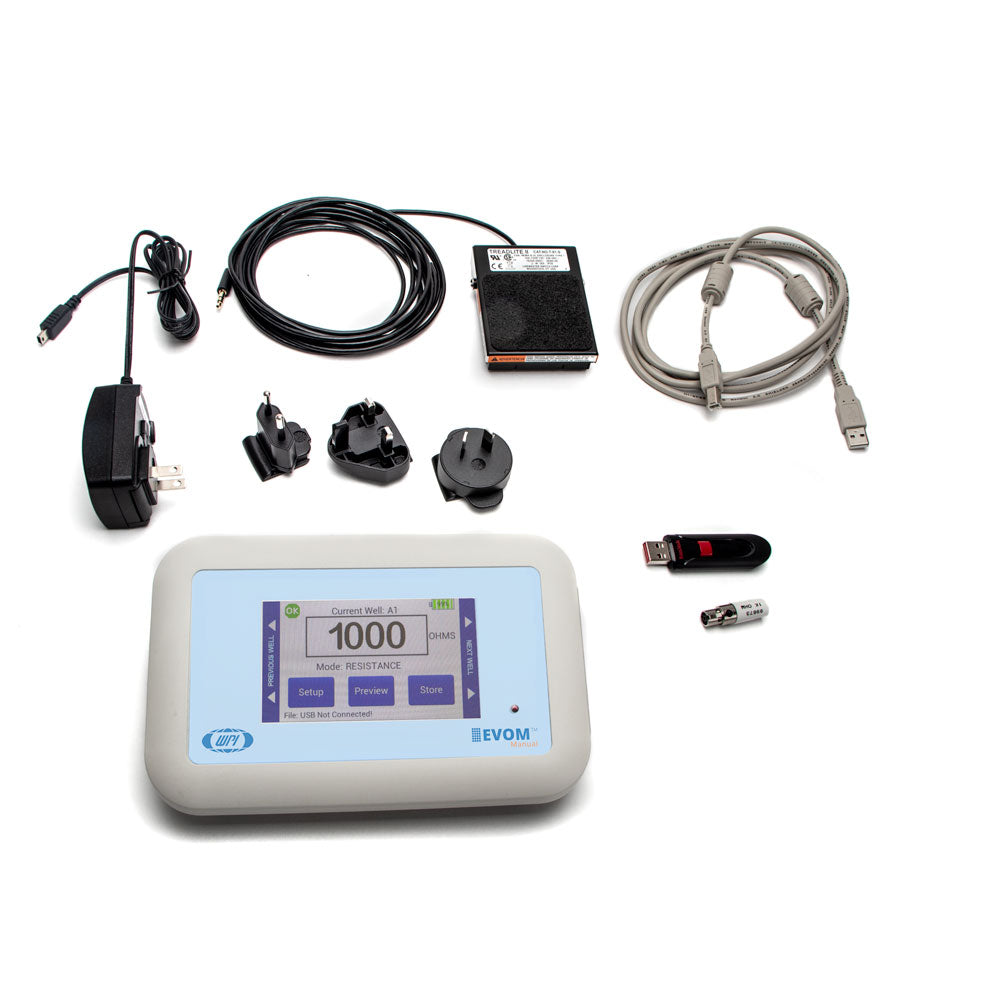
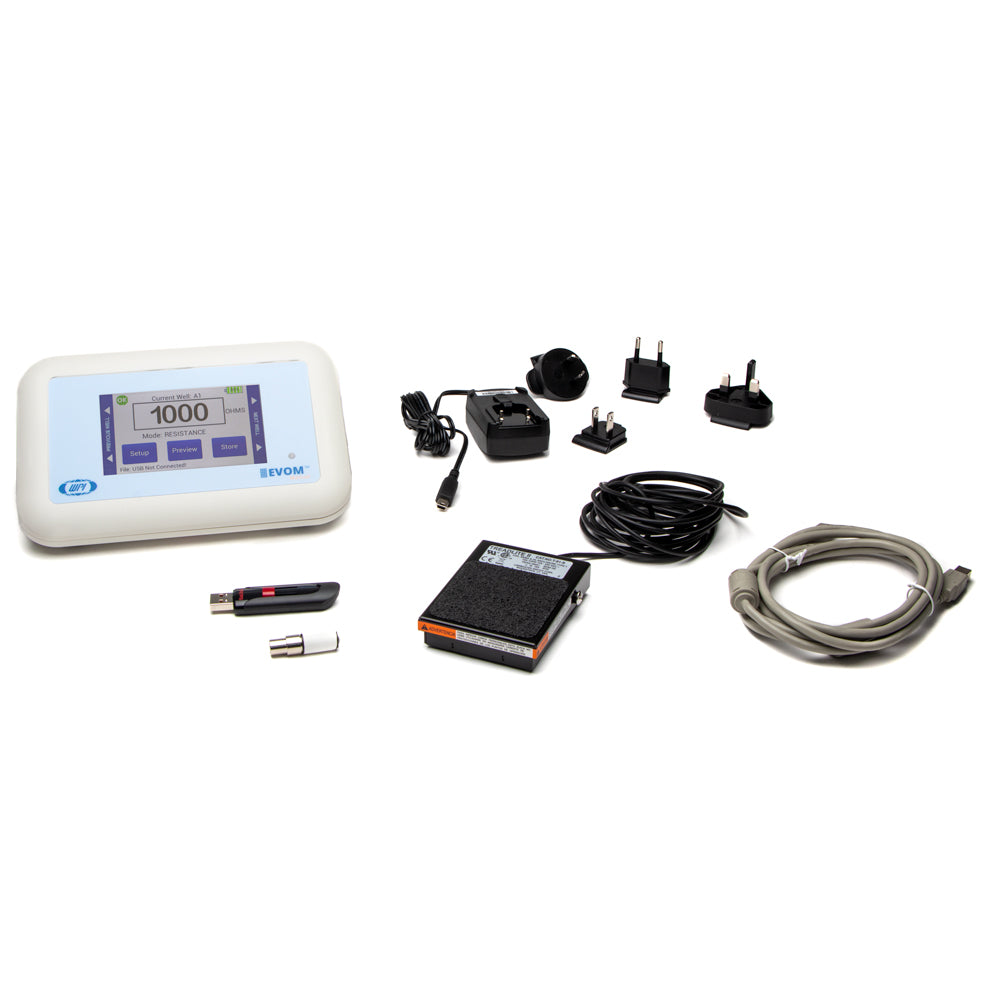
EVOM™ Manual Epithelial Volt Ohm Meter (EVM-MT-03-02), 32 GB USB drive (with Python 3.8 program for continuous monitoring), USB cable (503535), 1000 Ω calibration test resistor kit (99673), AC power cord and charger (803025), and foot switch (13142). Note: The 99672 Legacy Electrode Adapter for STX2/STX3 electrodes is sold separately.
.webp)

| Parameter | Specification |
|---|---|
| Tissue Sampling Frequency | 12.5 Hz |
| Sample Averaging | 20 samples/second |
| Resistance Range - Auto | 1 Ω to 100,000 Ω (auto current) |
| Resistance Range - 10 μA | 0 to 10,000 Ω |
| Resistance Range - 4 μA | 0 to 50,000 Ω (±5%) |
| Resistance Range - 2 μA | 0 to 100,000 Ω (±5%) |
| Measurement Currents | ±10 μA, ±4 μA, ±2 μA, auto |
| Resistance Resolution | 0.1 Ω (under 200 Ω); 1 Ω (over 200 Ω) |
| Resistance Accuracy | 0.1 Ω (under 200 Ω); 1 Ω (over 200 Ω); 0.1% at 100,000 Ω |
| Voltage Resolution | 0.001 V (0.1 mV) |
| Voltage Accuracy | ±0.1 mV |
| Display Update Rate | 0.5 seconds |
| Battery | 3.7V Li-ion 2500 mAh |
| Charging Time | ~5.5 hours (power off); ~6 hours (run time) |
| Charge Current | 200 mA |
| Power Consumption | ~250 mA |
| Certifications | CE |

Cell Cultivation and Imaging
Explore All ProductsEVOM™ Manual Publications
Academic publications and research studies citing the WPI EVOM™ manual TEER meter for epithelial and endothelial electrical resistance measurements in cell culture barrier research.
What is the EVOM™ Manual – TEER Measurement Meter and what is it used for?
The EVOM™ Manual is WPI's next-generation manual TEER meter - replacing the EVOM3, EVOM2, and MilliCell® ERS-2. Features automatic data logging, 20X sample averaging, adjustable currents (2, 4, or 10 μA), and resistance auto-ranging from 1 Ω to 100,000 Ω for reliable epithelial and endothelial barrier measurements.
What research applications is the EVOM™ Manual – TEER Measurement Meter suited for?
The EVOM™ Manual – TEER Measurement Meter is suited for researchers in neuroscience, behavioral science, physiology, and related life science fields. It is designed to support experimental workflows that require reliable, high-quality data acquisition and analysis.
What are the key technical features of the EVOM™ Manual – TEER Measurement Meter?
The EVOM™ Manual – TEER Measurement Meter (catalog number: EVM-MT-03-02) is engineered for precision performance in laboratory settings. It offers user-friendly operation, robust construction, and compatibility with standard laboratory workflows to maximize experimental efficiency and reproducibility.
Is the EVOM™ Manual – TEER Measurement Meter available in Israel with local support?
Yes. NBT Ltd is the exclusive distributor of this product in Israel. Our team of scientific specialists provides full local support including installation, application training, and ongoing technical assistance for the EVOM™ Manual – TEER Measurement Meter.
What accessories or systems is the EVOM™ Manual – TEER Measurement Meter compatible with?
The EVOM™ Manual – TEER Measurement Meter is designed to integrate seamlessly with complementary laboratory instruments and software used in its application domain. NBT Ltd can advise on compatible accessories, consumables, and system configurations to meet your specific research needs.
Still have questions?
Request for Quote
Please fill in as much details as possible and we will take care of your request as soon as possible
Request for Quote
Please fill in as much details as possible and we will take care of your request as soon as possible