.svg)
.svg)
Complex Wheel for RotaRod
The Ugo Basile Complex Wheel is a high-sensitivity accessory for the RotaRod family that replaces the standard rod with an irregular-bar wheel, significantly increasing task difficulty and engaging motor cortex and hippocampus beyond conventional rotarod protocols. Validated in sleep-dependent motor learning research by Nagai et al. (2017), it enables detection of subtle motor skill deficits and recovery trajectories that are beyond the resolution of standard RotaRod testing.
What is the Complex Wheel for RotaRod Family?
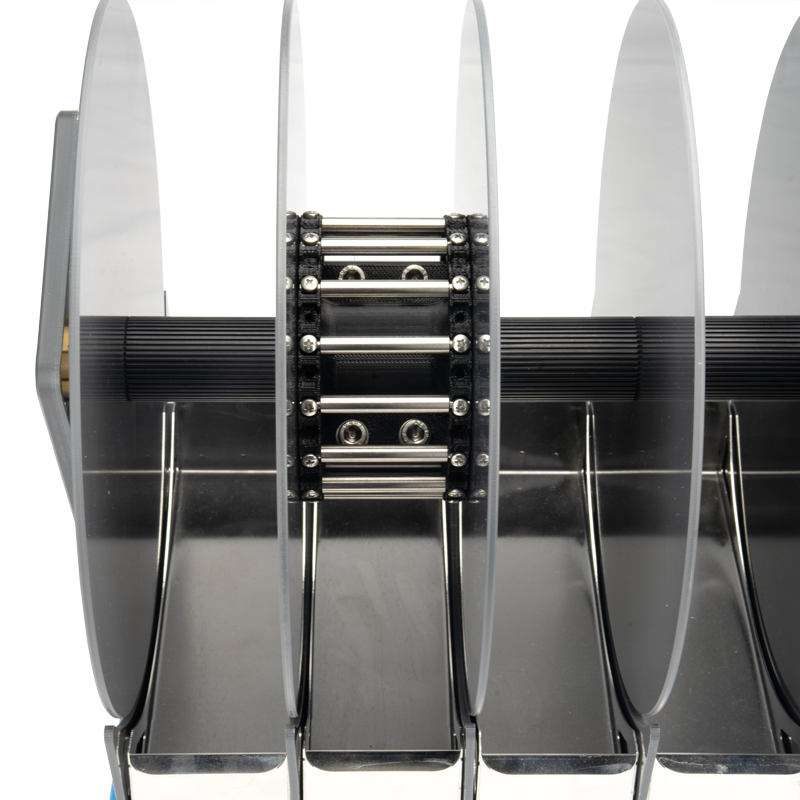
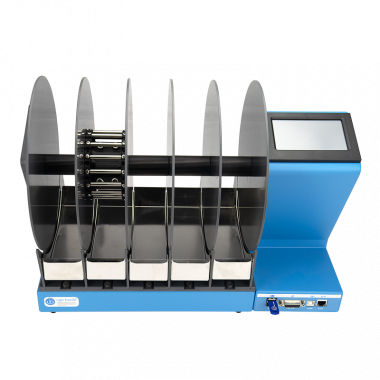
The Ugo Basile Complex Wheel for RotaRod Family (catalog numbers 47650-327, 47750-327, 47750-D01-327) is an advanced add-on accessory that replaces the standard rotating rod with a wheel featuring asymmetrical, adjustable rungs. Developed in collaboration with Prof. Michele Bellesi and Prof. Luisa de Vivo from the University of Camerino, the Complex Wheel significantly increases RotaRod task sensitivity by engaging motor cortex and hippocampal circuits to a greater degree than the classic smooth-rod protocol.
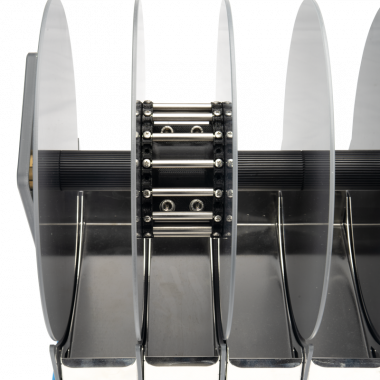
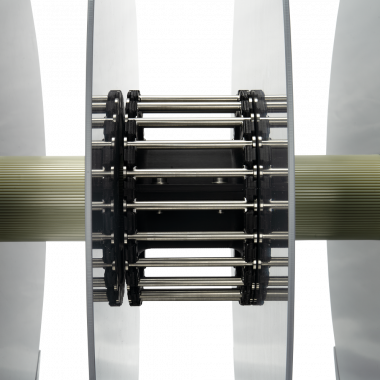
The wheel contains 22–30 removable bars (depending on model) that can be arranged symmetrically or asymmetrically to tune task complexity. This makes it possible to detect motor learning differences between cohorts or treatment groups that would be indistinguishable using the standard RotaRod protocol - particularly valuable in models where subtle cortical or cerebellar motor circuit dysfunction needs to be resolved.
Key Features
- Adjustable Rung Configuration: 22–30 individually removable bars can be arranged in symmetric or asymmetric patterns, giving full control over task complexity from session to session.
- Enhanced Motor Cortex & Hippocampus Engagement: The irregular rung spacing demands active motor planning and spatial coordination, recruiting circuits beyond simple balance, enabling detection of subtler deficits.
- Models for All RotaRod Variants: Dedicated sizes for Mouse (47650-327), Rat (47750-327), and Large Rat (47750-D01-327) ensure proper dimensional fit with each RotaRod drum.
- Direct Replacement - No Additional Hardware: The Complex Wheel mounts onto the existing RotaRod drum using the same attachment as the standard rod, with no modification to the base unit.
- Scientifically Validated: Developed and validated with academic collaborators; published data confirm superior sensitivity for detecting cortical motor deficits compared to the classic RotaRod protocol.
.webp)

| Parameter | Mouse (47650-327) | Rat (47750-327) | Large Rat (47750-D01-327) |
|---|---|---|---|
| External Diameter | 95 mm | 144 mm | 180 mm |
| Internal Diameter | 30 mm | 60 mm | 80 mm |
| Width | 56.3 mm | 83 mm | 110 mm |
| Number of Bars | 30 | 22 | 26 |
| Inter-bar Distance | 9 mm | 20 mm | 19 mm |
| Weight | 492 g | 675 g | 1,090 g |
| Units per RotaRod | 5 | 4 | 4 |
System
| Parameter | Specification |
|---|---|
| Bar Configuration | Removable bars; symmetrical or asymmetrical positioning |
| Compatible Instruments | RotaRod for Mice (47650), RotaRod for Rats (47750), Large Rat RotaRod (47750-D01) |

Motor Functions
Explore All ProductsSleep Consolidates Motor Learning of Complex Movement Sequences in Mice
Nagai et al. (2017) demonstrated that mice undergoing complex wheel experiments consolidate motor skills during sleep, with significantly greater engagement of motor cortex and hippocampus compared to standard RotaRod protocols. This study validated the Complex Wheel as a tool for studying motor skill learning and sleep-dependent memory consolidation.
What is the Complex Wheel and how does it differ from the standard RotaRod?
The Complex Wheel (Cat. 47650-327 for mice, 47750-327 for rats) is a RotaRod accessory that replaces the smooth rotating rod with a wheel featuring asymmetrically placed, removable bars. This irregular pattern engages motor cortex and hippocampus more extensively than standard rotarod testing, providing higher sensitivity for detecting subtle motor learning and coordination deficits.
How can the difficulty of the Complex Wheel be adjusted?
Bars on the Complex Wheel are individually removable, allowing researchers to configure symmetrical or asymmetrical patterns to adjust task difficulty. Fewer bars reduce challenge; fully asymmetric arrangements maximize complexity and motor cortex engagement. This programmable difficulty makes the Complex Wheel suitable for longitudinal learning studies.
What research validated the Complex Wheel, and what were the key findings?
Nagai et al. (2017) in Sleep (40:2, zsw059) demonstrated that mice trained on the Complex Wheel consolidated motor skills during subsequent sleep more effectively than those trained on a standard RotaRod. This validated the Complex Wheel for sleep-dependent motor learning paradigms and studies requiring high hippocampal and cortical engagement.
Is the Complex Wheel available in Israel with local support?
Yes. NBT Ltd is the exclusive distributor of Ugo Basile products in Israel and can supply all Complex Wheel variants (mouse, rat, and large rat) alongside the RotaRod platform.
Which RotaRod models is the Complex Wheel compatible with, and how many units are included?
The mouse Complex Wheel (Cat. 47650-327, 30 bars) is supplied in sets of 5 for the RotaRod for Mice (Cat. 47650). The rat Complex Wheel (Cat. 47750-327, 22 bars) comes in sets of 4 for the RotaRod for Rats (Cat. 47750). The large rat version (Cat. 47750-D01-327, 26 bars) also comes in sets of 4.
Still have questions?
Related Products:

Request for Quote
Please fill in as much details as possible and we will take care of your request as soon as possible
Request for Quote
Please fill in as much details as possible and we will take care of your request as soon as possible