.svg)
Three Arms, One Decision: The Y-Maze for Learning and Memory
Three identical arms and an animal free to choose. Noldus walks through what that single decision reveals about spatial and working memory, and how automated tracking turns arm entries into clean, objective data.
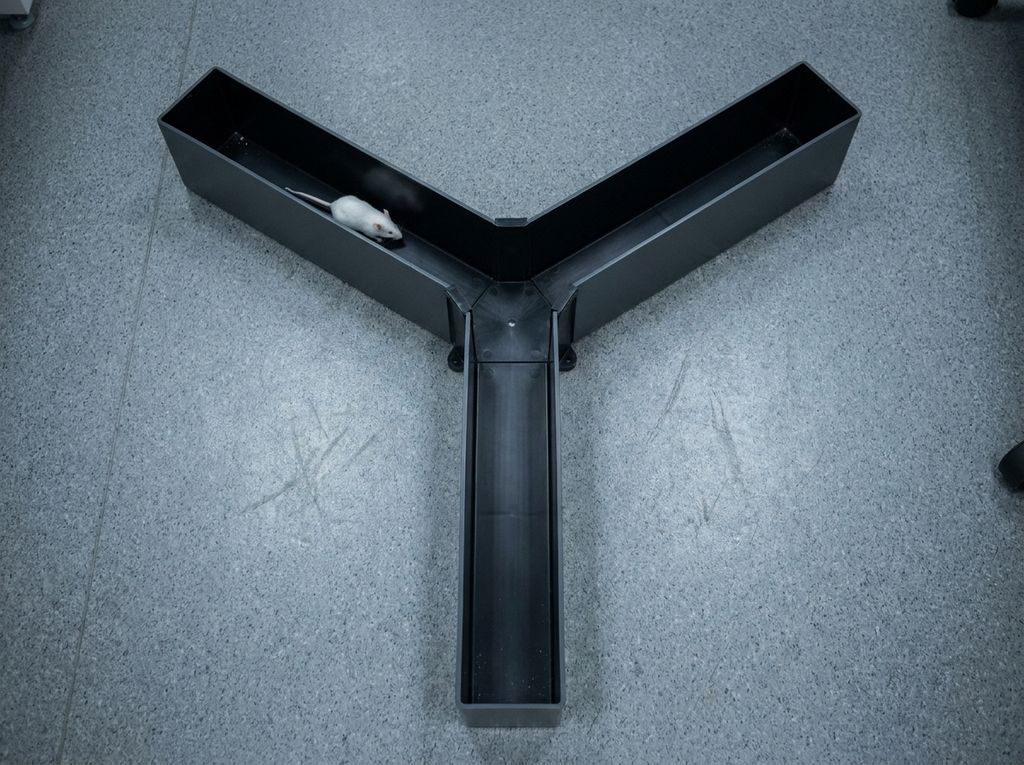
The Y-maze is deceptively simple: three identical arms, an animal free to wander down whichever it likes. A recent piece by Huib van den Heuvel on the Noldus blog looks at what that single choice can reveal about the brain, and why the apparatus has stayed in constant use across very different research areas.
Why the Y and not the T
A Y-maze has three identical arms set at 120 degrees to one another. It is close in form and function to the T-maze, but the gentler turns are easier for an animal to negotiate and decide. Kraeuter and colleagues, in a widely cited protocol paper, describe how this small, low-stress apparatus can probe both spatial working memory and spatial reference memory, drawing on hippocampus, medial septum, prefrontal cortex and basal forebrain.
Its most popular variant, spontaneous alternation, relies purely on a rodent's natural drive to explore somewhere new. No food deprivation, no aversive stimuli, very little training. That makes it fast, repeatable and low stress.
What you can actually measure
The maze accommodates several protocols. Bait one arm with a reward and check later whether the animal heads straight back to it, and you are probing spatial reference memory. Block one arm during first exposure and then open it, and a healthy animal will notice the new arm and explore it more - recognition memory, much like novel object recognition. In spontaneous alternation you simply let the animal roam: rodents tend to alternate rather than revisit, so the percentage of successful alternations becomes a clean working-memory readout. In rewarded alternation, the reward keeps moving and the animal has to alternate to succeed.
Across all of these, the same handful of measures matter, which arm is entered, in what order, how quickly and for how long. Counting those by hand is exactly the slow, subjective step that automation removes.
How far the paradigm travels
The blog collects recent studies that show the breadth of application:
- Alzheimer's and dementia. Aleksandrova and colleagues used a delayed spontaneous-alternation Y-maze scored with EthoVision, alongside the Morris water maze and novel object recognition, to show memory improvement in 5xFAD transgenic mice.
- Traumatic brain injury. Pischiutta and colleagues used a two-trial Y-maze to test whether a mesenchymal stromal cell secretome could restore spatial recognition memory in injured mice. A separate 2026 study by Sheng and colleagues paired the Y-maze with NOR and the Morris water maze to show that silencing a neuronal inflammasome rescued cognition after controlled cortical impact.
- Anaesthesia and vulnerable brains. Li and colleagues exposed P301L tau transgenic mice to sevoflurane and found the anaesthetic worsened tau-related memory deficits.
- Compound screening. Yi and colleagues benchmarked an Alpinia oxyphylla fruit extract against donepezil in an LPS neuroinflammation model.
- Fatigue and stress. Wu and colleagues induced cognitive fatigue in rats through repeated sleep deprivation and found a reduced alternation rate, with a regionally specific rise in prefrontal TGF-B1.
Not only rodents
Zebrafish have become a mainstay of translational neuroscience - conserved neurotransmitter systems, disease-related genes shared with mammals, fast breeding and higher-throughput testing. In a Y-shaped tank an adult zebrafish explores much as a rodent does, and the same logic applies: intact memory means alternating choices or favouring a newly opened arm. Cleal and colleagues established the free-movement-pattern Y-maze as a validated cross-species measure of working memory and executive function, scored from the sequence of left and right turns during free exploration.

The article also notes a genuinely unusual application: researchers from James Madison University and the Fort Collins Science Center used an enclosed Y-maze to assess exploratory and choice behaviour in Burmese pythons, exploiting the snakes' strong response to chemical cues.
Automating the scoring
Whatever the species, the bottleneck is the same - arm entries only mean something if they are scored accurately and consistently, trial after trial. With EthoVision, deep-learning detection locates nose, body centre and tail base, so an arm entry registers only when the animal has genuinely committed rather than merely poking its nose past a threshold. Order of arm visits, latencies, durations and alternation percentage are reported automatically. EthoVision 19 adds a calibration card that focuses the camera and calibrates an arena in one click, plus refined AI models that return data within seconds of a recording.
The closing point in the original is a good one: the Y-maze endures because it makes a private internal process, remembering where you have just been, visible as a simple sequence of choices. What turns that into reliable science is consistent, objective measurement.
NBT represents Noldus in Israel, including EthoVision XT, DanioVision, PhenoTyper and The Observer XT. Contact us to discuss automating your learning and memory assays.
Source: Noldus blog.

NEED MORE INFORMATION ABOUT THIS PRODUCT?
Send us your emailRecent Blog Posts

.svg)

Advance Your Research
Contact NBT today for expert consultation on your neuroscience instrumentation needs.