.svg)
A buyer's guide to the SomnoFlo anesthesia setup
One vaporizer, three builds. How we scope a SomnoFlo anesthesia setup before it goes to quote: the gas path that writes the parts list, chamber and mask sizes by species, the MRI rule that keeps the vaporizer in the control room, and where not to spend the money.
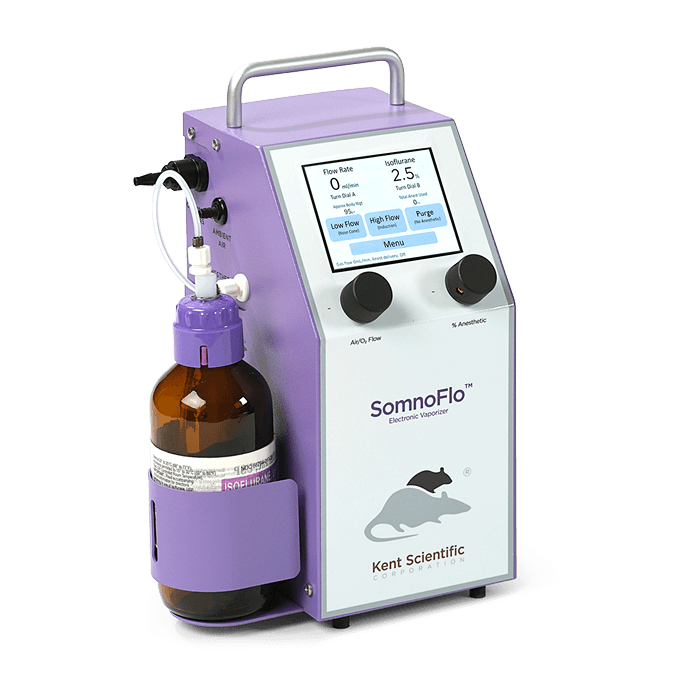
The SomnoFlo is one catalog number, KENT-SF-01. The working setup around it is another eight, and the eight are where quotes go wrong. The chamber arrives sized for a rat when the colony is mice. The mask fouls the ear bars on the frame. The facility air line runs 100 psi into an inlet rated for 15.
This is how we scope a SomnoFlo Complete Anesthesia Setup before it goes to quote. Same vaporizer every time. The rest depends on the procedure.
The gas path is the parts list
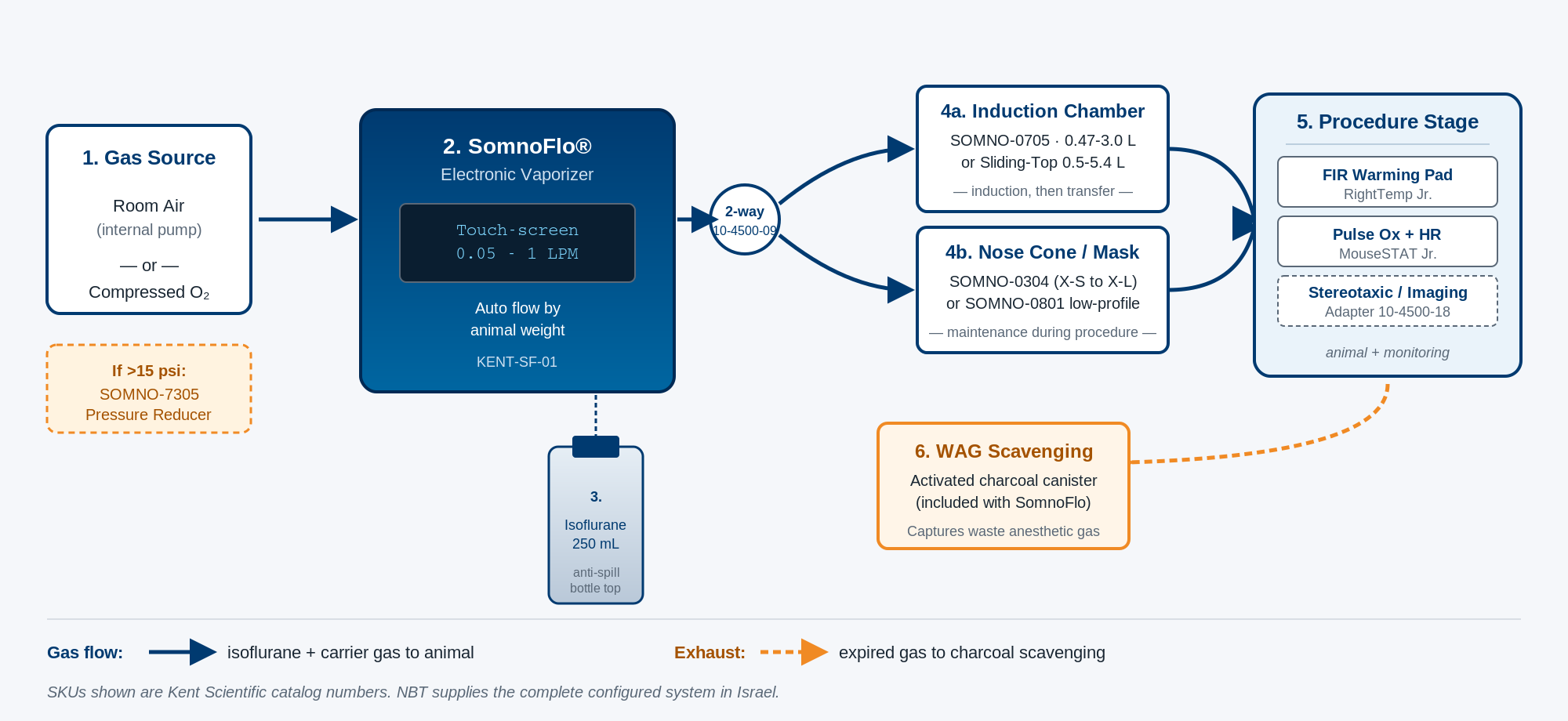
The source is room air through the internal compressor, or a regulated compressed line. Above 15 psi the line needs the SOMNO-7305 pressure reducer, which takes 100 psi down to 15. Ask the facility what pressure is at the wall before ordering, not after.
The vaporizer is the SomnoFlo itself. Touch screen, flow calculated from the animal's body weight, 0.05 to 1 LPM. Isoflurane consumption is typically under 1 mL per hour. No annual calibration.
The 250 mL isoflurane bottle threads onto the integrated anti-spill bottle-top adapter. No syringe pump and no manual fill.
The 2-Accessory Adapter (10-4500-09) splits the output two ways, usually an induction chamber and a maintenance mask, so the animal moves from chamber to mask without anyone touching the tubing.
Expired gas ends at the WAG charcoal canister, which ships with the SomnoFlo. Weigh it, log the start weight, replace at the weight-gain limit printed on the canister. That is what keeps the room inside institutional exposure limits, so budget the replacement canisters with the system, not later.
Why low-flow
A traditional precision vaporizer runs at 0.5 to 1 L/min. The SomnoFlo delivers as little as 0.05 LPM, and Kent puts the isoflurane saving at up to 90%. Less agent bought, less waste gas in the room, and one less calibration certificate for the facility inspection.
Three builds from one base
Surgery is the simple one. Chamber sized to the species, mask sized to body weight, the 2-Accessory Adapter between them. Add a RightTemp Jr. warming pad and a MouseSTAT Jr. pulse oximeter, because an anaesthetised mouse loses core temperature within minutes and that loss moves the data the procedure exists to produce.
Imaging needs one fact up front: the SomnoFlo is NOT MRI safe. The vaporizer stays in the control room. Only the low-profile SOMNO-0801 mask and the tubing enter the bore, and the tubing is cut to length per site, so measure the run from the control room to the magnet before the order goes in. Facilities without an air supply at the magnet add a compressed line and the SOMNO-7305 reducer.
Stereotaxic and electrophysiology adds the stereotaxic adapter kit (10-4500-18) and swaps the standard mask for the low-profile one, which clears the ear bars. For parallel rigs, a 3-Accessory Connector (10-1000-185) runs more than one station off a single vaporizer.
If the protocol intubates and ventilates, that is a different line with its own rules, and we wrote it up separately in the SomnoFlo, intubation kit and RoVent Jr. guide.
Chamber and mask sizes
| Animal | Induction chamber | Mask (SOMNO-0304) | Low-profile mask (SOMNO-0801) |
|---|---|---|---|
| Weanling mouse | 0.47 L | X-Small | Small (under 100 g) |
| Adult mouse (20 to 40 g) | 0.47 to 1.0 L | Small (up to 150 g) | Small (under 100 g) |
| Small rat (150 to 200 g) | 1.0 to 2.0 L | Medium | Medium (up to 100 g) |
| Adult rat (200 to 350 g) | 2.0 to 3.0 L | Large | Large (up to 300 g) |
| Large rat (over 350 g) | 3.0 to 5.4 L (sliding-top) | X-Large | Extra Large (over 300 g) |
Where not to spend the money
Skip the 3 L chamber for a mouse line. A large chamber induces slower and burns gas on every session. The 0.47 L is the right chamber for mice and it is also the cheapest one.
Skip the second SomnoFlo if the goal is throughput. The 2-Accessory Adapter covers a chamber and a mask on one vaporizer, and the 3-Accessory Connector adds stations beyond that. A second vaporizer earns its place only when two procedures run in different rooms.
Do not skip the warming pad. It costs a fraction of the vaporizer and protects everything downstream of it.
The full guide
The complete setup guide is a PDF with the buildable matrix, the gas-path schematic, the sizing table above and every Kent catalog number in the setup. It is in the Downloads section of the product page.
NBT is the exclusive distributor of Kent Scientific in Israel. Send us the protocol, the animal model and the procedure, and we will check the build against it before you order. Which of the three builds is your line?

NEED MORE INFORMATION ABOUT THIS PRODUCT?
Send us your emailFrequently Asked Questions
Do I need compressed gas to run a SomnoFlo?
No. The internal compressor runs the system on room air. If the facility connects a compressed line above 15 psi, add the SOMNO-7305 pressure reducer, which takes 100 psi down to 15.
Which induction chamber fits a mouse line?
0.47 L for weanlings and most adult mice, up to 1.0 L for larger adults. Rats take 1.0 to 3.0 L by weight, and rats over 350 g take the sliding-top chambers up to 5.4 L.
Can the SomnoFlo go into the MRI room?
No. The vaporizer is not MRI safe and stays in the control room. Only the low-profile SOMNO-0801 mask and extended tubing enter the bore, and tubing length is specified per site when ordering.
How many animals can one SomnoFlo run?
The 2-Accessory Adapter (10-4500-09) covers an induction chamber and one mask. The 3-Accessory Connector (10-1000-185) adds parallel stations off the same vaporizer for multi-animal work.
How much isoflurane does the SomnoFlo use?
Typically under 1 mL per hour at flow rates of 0.05 to 1 LPM. Kent puts the saving against a traditional precision vaporizer running 0.5 to 1 L/min at up to 90%.
Still have questions?
Recent Blog Posts

.svg)


Advance Your Research
Contact NBT today for expert consultation on your neuroscience instrumentation needs.