
Before the First Mouse: Simulators in Handling Courses and Lab Onboarding
A student's first attempts at a scruff, a gavage or a tail vein are the worst ones. Where the Humaneway simulators from Hundred Medical move those attempts off live animals in Israeli handling courses and lab onboarding, and where they do not.
Most people scruff their first mouse on a live animal. In a course, with an instructor watching, and a cage of animals that will each be picked up a dozen times that afternoon.
The animal learns nothing from this. The student learns slowly.
In Israel the frame is the Prevention of Cruelty to Animals (Experiments on Animals) Law of 1994, and each institution builds its training on top of it. At the Hebrew University, a new researcher starts on a temporary permit valid for six months. The PI has to perform at least two of the planned procedures with the new person present. The permanent permit needs the basic course, which ends in a practical rodent exam with a pass mark above 60. Every one of those steps happens on live animals, and every one of them could start a week earlier on something that feels no pain.
What a simulator can and cannot do
Reduction and refinement are two of the three Rs that Russell and Burch set out in 1959. A good simulator serves both. Fewer animals get handled to teach a grip, and the animals that do get handled meet a student who already knows where the thumb goes.
A simulator does not replace the live exam. Nothing on the market does, and no ethics committee in the country would accept a course built on that claim. The honest claim is narrower: the first attempts are the bad ones, and those can move off the animal.
The Humaneway line
Hundred Medical, in Koriyama, Japan, makes the Humaneway range. NBT distributes it in Israel. Five products, one step each:
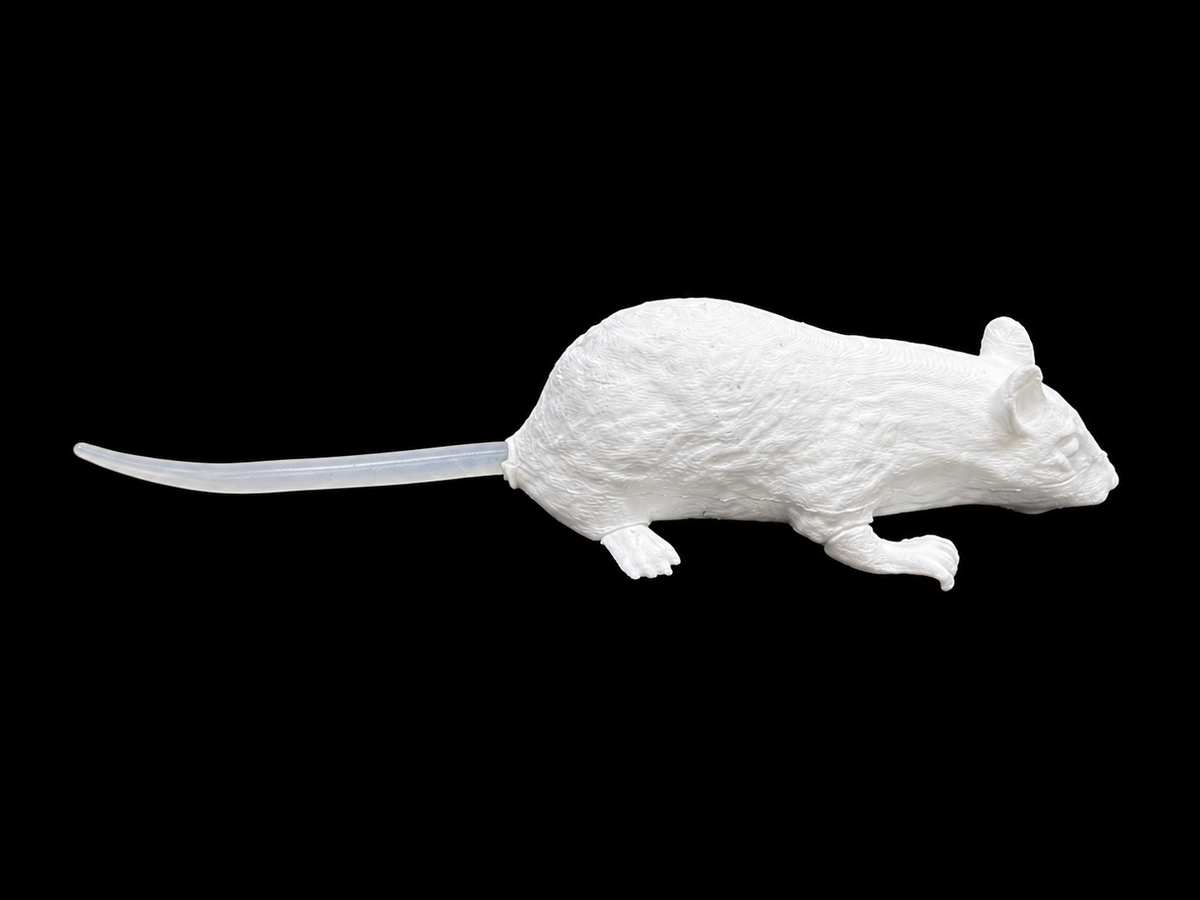
- LaboPal Full-Body Mouse Simulator for handling, oral gavage, IP and subcutaneous injection. Silicone body about 90 mm long and 29 g, with a simulated esophagus, stomach, trachea and lungs. White skin (HW-MSBW) or transparent (HW-MSBT).
- Rodent Tail Vein Simulators for IV injection and blood collection. Mouse in white ICR or black C57BL/6, and rat. Rated at roughly 100 uses.
- Rodent Restraint Devices in six sizes, three for mice (28, 32 and 35 mm) and three for rats (47, 64 and 70 mm). Autoclavable.
- Neonatal Mouse Simulators, three male and three female pups, for sexing.
- Laboratory Needles, 25G blood collection needles and winged infusion sets. The same consumables go on the simulator and later on the animal.
In the handling course
Stations work. Restraint on the LaboPal, then gavage, then IP, then the pups. The transparent LaboPal belongs on the instructor's bench: a needle tip that ended up in the wrong place can be shown, not described. Sexing pups is a skill usually learned on real litters, one wrong call at a time, and the neonatal set takes that off the colony.
The live animals come after, for the part of the course that has to be live. Fewer of them, picked up fewer times.
In onboarding
The harder case is the lab, not the course. A new student who needs tail vein injection on day ten. A postdoc moving to gavage after five years of surgery. A procedure nobody in the group has done since the last student left.
The two PI demonstrations still happen. Before them, the student works on the tail vein simulator with the 25G winged set from the same box, until cannulation succeeds most of the time. Then the animal. In NBT's view this is where the money goes furthest, because one failed tail vein usually means a second and a third attempt on the same mouse.
Where not to spend the money
- A lab that onboards one student every two years, for IP only, does not need the line. The PI demonstration covers it.
- The LaboPal has no tail vein. Buying it for IV training is a mistake; that is the tail vein simulator's job.
- Subcutaneous training on the LaboPal is done with an empty syringe. Liquid under the skin cannot be removed, and repeated punctures slowly enlarge the holes.
- Hundred Medical has not published a use count for the LaboPal. Until a set has been through a few courses, the lifespan is unknown.
- A transparent-only teaching set handles less like an animal. One white, one transparent.
Four short videos from Hundred Medical (restraining, oral gavage, IP and subcutaneous injection) are on the LaboPal page.
Which procedure in the current course still costs the most animals on first attempts?

NEED MORE INFORMATION ABOUT THIS PRODUCT?
Send us your emailFrequently Asked Questions
Can a simulator replace live animals in the basic handling course?
No. The practical exam and the PI demonstrations stay on live animals. A simulator moves the first, worst attempts off the animal, so fewer animals are handled and each one is handled by a student who already has the grip.
Which Humaneway simulator covers tail vein injection?
The Rodent Tail Vein Simulator, in mouse (white ICR or black C57BL/6) and rat. The LaboPal full-body simulator has no tail vein and is used for handling, oral gavage, IP and subcutaneous injection.
Which procedures can be practised on the LaboPal?
Handling (restraining, scruffing, carrying), oral gavage, subcutaneous injection and IP injection, per the Hundred Medical manual. Subcutaneous injection is practised with an empty syringe, because liquid injected under the skin cannot be removed.
What goes into a teaching set for a handling course?
In NBT's view: one white and one transparent LaboPal, a tail vein simulator in the strain the facility actually works with, a restrainer in each size in use, and the neonatal set if the course covers breeding colonies. Quantities follow the number of stations running in parallel.
Is the Humaneway range available in Israel with local support?
Yes. NBT is the Humaneway distributor in Israel, including the needles and infusion sets used with the simulators. The LaboPal is the newest item in the line, so the lead time is worth confirming with NBT before a course date is set.
Still have questions?
Recent Blog Posts


Advance Your Research
Contact NBT today for expert consultation on your neuroscience instrumentation needs.