.svg)
.svg)
Tube Dominance Test
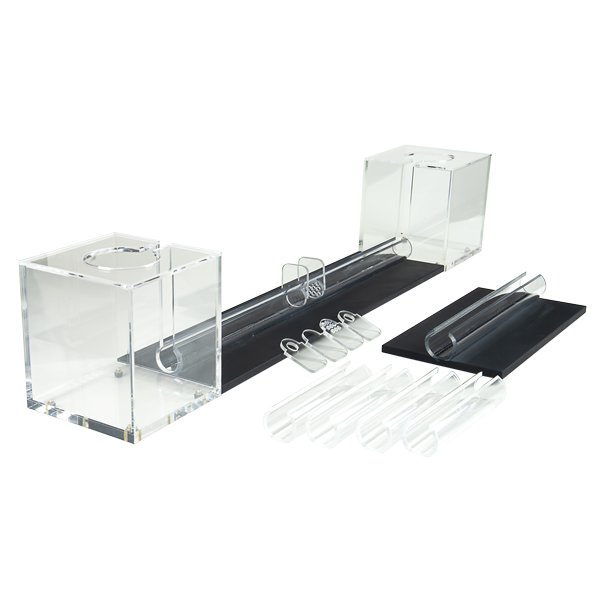
Transparent Perspex tube apparatus for assessing social dominance and hierarchy in rodents. Two animals enter opposing ends and interact centrally; central sliding doors, slotted top section for tethered studies, and modular configurations from 160–600 mm. Magnetic starting box attachment.
What is the Tube Dominance Test?
The Tube Dominance Test is a straightforward and highly reproducible behavioral assay for establishing social hierarchy in laboratory rodents. In a standard trial, two animals are placed at opposite ends of a narrow tube and allowed to meet in the middle. The subordinate animal retreats backward out of the tube while the dominant animal holds its position. Because the tube precludes lateral movement or escape, the outcome is an unambiguous measure of social rank that correlates strongly with home-cage dominance, weight, and testosterone levels.
Key Features
- Silent Automated Doors: Two central sliding doors provide precise experimental control over the moment of animal contact, ensuring standardized trial conditions across all dyadic comparisons.
- Slotted Top Section: The tube includes a slotted opening accommodating cannulae, fiber optic cables, and EEG wires for tethered animal studies, enabling social dominance testing during simultaneous electrophysiology or optogenetics.
- Transparent Perspex: Full-length transparent construction allows continuous visual observation and video recording of both animals throughout the trial.
- Magnetic Starting Boxes: Magnetically attached starting boxes at each end allow rapid animal loading and ensure animals enter the tube simultaneously on release.
- Modular Configurations: Available in 160 mm (4010-16), 300 mm (4010-30), and 600 mm (4010-60) tube lengths, with various door and slot combinations to suit different experimental designs.
.webp)

Technical Specifications
| Catalog Numbers | 4010-16 (160 mm), 4010-30 (300 mm), 4010-60 (600 mm) and slotted/sealed variants |
| Starting Box Dimensions | 150(d) × 150(w) × 150(h) mm |
| Tube Inner Diameter | 30 mm |
| Tube Lengths Available | 160 mm, 300 mm, 600 mm |
| Construction | Transparent Perspex (acrylic) |
| Starting Box Attachment | Magnetic |
| Top Slot Options | 10 mm or 18 mm slots for tethered animals; fully sealed versions available |
| Warranty | 12 months + 12 months post-registration |
Applications
- Social dominance ranking within rodent groups
- ASD mouse models (SHANK3, FMR1, NLGN3)
- Chronic social defeat and social stress research
- Tethered animal optogenetics and fiber photometry during social behavior
Social Behavior
Explore All ProductsMazes Tracking
Explore All ProductsTube Dominance Test Publications
The Tube Dominance Test is referenced in social neuroscience publications as a measure of social hierarchy and dominance behavior in rodents, used to study prefrontal circuits underlying dominance, autism models, and stress-related social withdrawal.
How is dominance scored in the Tube Dominance Test?
The animal that retreats backward and exits the tube is classified as subordinate; the animal that holds its position or advances is classified as dominant. The outcome of each dyadic encounter is binary and unambiguous, allowing linear hierarchies to be established from round-robin competitions across all cage-mates.
What tube configurations are available?
The system offers 160 mm (4010-16), 300 mm (4010-30), and 600 mm (4010-60) tube lengths. Each is available in slotted versions (10 mm or 18 mm top openings for tethered animals) and fully sealed versions, providing 8 distinct configurations in total.
Is the apparatus suitable for both mice and rats?
Yes. The 30 mm inner diameter is appropriate for adult mice. For rats, the 160 mm tube length may be insufficient; longer configurations (300–600 mm) are recommended to allow full body entry and reduce turnaround artefacts.
Can the Tube Dominance Test be used with optogenetics?
Yes. The slotted top section (4010-310, 4010-318, 4010-610, 4010-618) accommodates fiber optic cannulae and EEG cables, enabling simultaneous optogenetic stimulation or neural recording during dominance testing.
How stable are tube test dominance rankings over time?
Dominance rankings established by the tube test are highly stable within established social groups (test-retest reliability r > 0.90 across weeks). Ranking can shift after social disruption, housing changes, or pharmacological intervention, making longitudinal tube testing useful for tracking social hierarchy dynamics.
Still have questions?

Request for Quote
Please fill in as much details as possible and we will take care of your request as soon as possible
Request for Quote
Please fill in as much details as possible and we will take care of your request as soon as possible