.svg)
.svg)
T-Maze
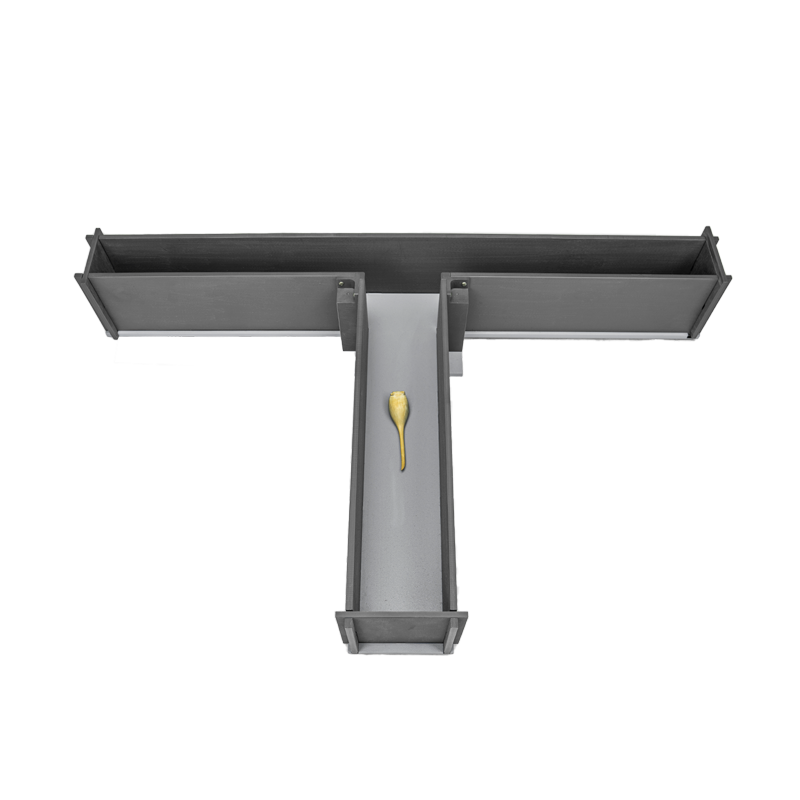
Classic T-shaped spatial memory and preference maze for mice and rats. Non-reflective grey perspex walls in slotted metal base; movable door creates start compartment; rat (40132: 90 cm long arm, 50 cm short arm) and mouse (40133: 65/35 cm) versions. Optimized for video tracking.
What is the T-Maze?
The T-Maze is one of the oldest and most versatile behavioral apparatuses in rodent neuroscience. Its single-choice-point geometry, one start arm leading to a T-junction with two goal arms, makes it ideal for testing spatial preference, reward-based learning, and working memory across a wide range of protocols, from spontaneous alternation (no reinforcement) to discrete trial delayed non-matching-to-place (food or escape-motivated). The Ugo Basile T-Maze is constructed with quick-detach perspex walls in a slotted metal base, optimized for overhead video tracking with non-reflective, anti-glare surfaces.
Key Features
- Versatile Protocol Support: The T-maze accommodates spontaneous alternation, reward-based spatial discrimination, delayed non-matching-to-place, and spatial reversal learning - all in one apparatus by simply adjusting door and reward placements.
- Non-Reflective, Anti-Glare Surfaces: Specially treated grey perspex walls eliminate camera hot spots for uninterrupted video tracking throughout the session.
- Movable Start Door: An included movable door divides the start arm into a holding compartment, allowing the experimenter to control trial initiation without handling-induced stress.
- Quick-Detach Perspex Walls: Walls slot into the metal base and can be removed individually for thorough cleaning between subjects, essential for eliminating odor cues between spatial alternation trials.
- Rat and Mouse Sizes: Cat. 40132 (rats: 90 cm long arm, 50 cm short arm, 10 cm wide) and Cat. 40133 (mice: 65 cm long arm, 35 cm short arm, 5 cm wide) provide species-appropriate dimensions; Cat. 40132-D01 offers higher walls for rats.
.webp)

Technical Specifications
| Catalog Numbers | 40132 (Rats), 40133 (Mice), 40132-D01 (Rats - higher walls) |
| Long Arm Length - Rats | 90 cm |
| Long Arm Length - Mice | 65 cm |
| Short Arm Length - Rats | 50 cm |
| Short Arm Length - Mice | 35 cm |
| Arm Width - Rats | 10 cm |
| Arm Width - Mice | 5 cm |
| Wall Height - Rats | 20 cm (standard), 30 cm (D01 variant) |
| Wall Height - Mice | 15 cm |
| Standard Color | Grey; blue, white, black, custom available |
| Warranty | 12 months + 12 months post-registration |
Applications
- Spontaneous alternation and working memory
- Delayed non-matching-to-place (DNMTP) protocols
- Reward-based spatial discrimination and reversal learning
- Cognitive aging and dementia model screening
Mazes Tracking
Explore All ProductsMemory and Learning
Explore All ProductsT-Maze Publications
The Ugo Basile T-Maze is referenced in spatial working memory and decision-making research, commonly used in spontaneous alternation and rewarded alternation protocols to assess hippocampal and prefrontal function in rodent models of cognition.
What protocols can be run in the T-Maze?
The T-Maze supports: (1) spontaneous alternation (no reinforcement, single session), (2) delayed non-matching-to-place (two-trial with variable delay), (3) reward-based spatial discrimination (baited arm), and (4) spatial reversal learning (switching the rewarded arm after acquisition). Each protocol tests different aspects of spatial memory and executive function.
What catalog numbers are available for the T-Maze?
Cat. 40132 is for rats (90 cm long arm, 50 cm short arm, 10 cm wide) and Cat. 40133 is for mice (65 cm long arm, 35 cm short arm, 5 cm wide). Cat. 40132-D01 provides higher walls (30 cm) for rats requiring additional containment.
How is the T-maze used for delayed non-matching-to-place?
In the sample trial, one goal arm is blocked; the animal explores the open arm and is returned to the start box. After a delay (e.g., 30 s to 24 h), both arms are open. Animals with intact working memory choose the arm not visited during the sample trial. Increasing delays selectively impair performance, revealing temporal aspects of working memory.
How does the T-Maze compare to the Y-Maze for spatial memory testing?
The T-Maze provides more protocol flexibility (supports reinforced and non-reinforced variants, reversal learning, and DNMTP with variable delays) but has a longer start arm that separates the starting position from the choice point more clearly. The Y-Maze is faster for high-throughput spontaneous alternation screens. Researchers often use both in the same test battery.
Can the T-Maze be cleaned efficiently between trials?
Yes. The quick-detach perspex walls can be individually removed and replaced in seconds. All surfaces should be wiped with 70% ethanol or a 0.1% acetic acid solution between each trial to eliminate olfactory cues, and the maze rotated 180° between subjects to counterbalance any residual spatial cues.
Still have questions?

Request for Quote
Please fill in as much details as possible and we will take care of your request as soon as possible
Request for Quote
Please fill in as much details as possible and we will take care of your request as soon as possible