.svg)
.svg)
Porsolt Forced Swim Test
Gold-standard behavioral despair model with automated video-tracking immobility scoring. Available for mice/small rats (Cat. 40123; Ø19 cm, 11 L) and large rats (Cat. 40122; Ø29 cm, 39.5 L), supporting up to 6 simultaneous assessments.
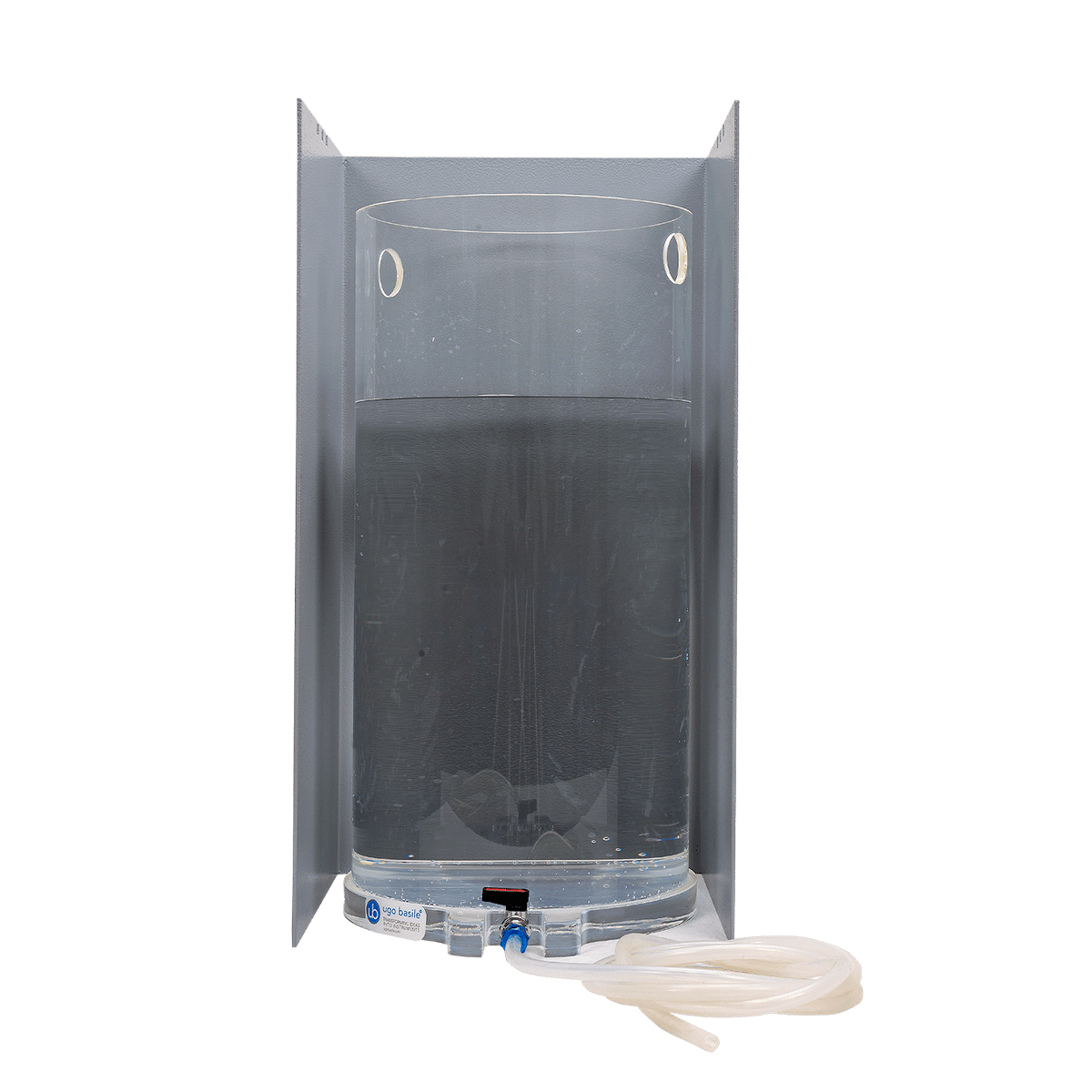
Porsolt Forced Swim Test
The Ugo Basile Porsolt Forced Swim Test (FST), also known as the Behavioral Despair Test, is a gold-standard preclinical model for evaluating depression-like behavior and screening antidepressant compounds. Rodents placed in inescapable water cylinders exhibit characteristic immobility ("despair"), which is automatically quantified via video-tracking - eliminating experimenter scoring bias.
Available for mice and small rats (Cat. 40123) and large rats (Cat. 40122), the system supports up to 6 simultaneous assessments and integrates fully with ANY-maze software (Cat. 60000-FST) for automated immobility detection and scoring.
Key Features
- Automated video-tracking immobility detection
- Mouse (Ø19 cm, 40 cm H) and rat (Ø29 cm, 60 cm H) cylinder sizes
- Up to 6 simultaneous assessments
- High-quality Perspex cylinders with metal dividers
- Compatible with ANY-maze software (60000-FST)
- Compatible with Tail Suspension Test lid accessories
.webp)

Research Applications
The Porsolt Forced Swim Test is the most widely used preclinical model for depression research and antidepressant drug discovery. The behavioral despair readout is sensitive to virtually all clinically effective antidepressant drug classes, and automated video-scoring ensures objective, reproducible measurements across large compound libraries.
- Antidepressant drug discovery: Primary screening for novel antidepressant compounds
- Depression models: Characterizing depressive-like states in stress, genetic, and pharmacological rodent models
- Combination behavioral batteries: Used alongside Tail Suspension Test for multi-model CNS profiling
- Genetic studies: Identifying depression-related gene functions in transgenic and knockout animals
- Neurobiological mechanisms: Studying monoaminergic, glutamatergic, and endocannabinoid contributions to behavioral despair

Technical Specifications
| Catalog Numbers | 40123 (mice/small rats), 40122 (large rats) |
|---|---|
| Mouse Cylinder Diameter | 19 cm |
| Mouse Cylinder Height | 40 cm |
| Mouse Cylinder Volume | 11 L |
| Rat Cylinder Diameter | 29 cm |
| Rat Cylinder Height | 60 cm |
| Rat Cylinder Volume | 39.5 L |
| Max Simultaneous Animals | Up to 6 |
| Scoring Software | ANY-maze (Cat. 60000-FST) |
Memory and Learning
Explore All ProductsPorsolt Forced Swim Test Publications
The Porsolt Forced Swim Test is one of the most cited behavioral paradigms in depression research, used as a primary screen for antidepressant efficacy and to study behavioral despair and stress responses in rodent models.
What is the Behavioral Despair hypothesis underlying the Porsolt FST?
When rodents are placed in inescapable water, they alternate between active swimming and passive floating (immobility). Duration of immobility reflects a despair-like state sensitive to antidepressant treatment.
What catalog numbers are available for the Porsolt FST?
Cat. 40122 is designed for large rats and Cat. 40123 for mice and small rats. Accessory dividers and tail suspension lids are also available.
How is immobility automatically quantified?
Immobility is detected by video-tracking software (compatible with ANY-maze, Cat. 60000-FST), which continuously analyzes movement and distinguishes active swimming from passive floating.
How many animals can be tested simultaneously?
Up to 6 animals can be assessed simultaneously using the multi-cylinder rack system.
Can the Porsolt FST cylinders be used for the Tail Suspension Test?
Yes. Compatible lid accessories (Cat. 40122-321 for large rats, 40123-321 for mice) allow the same cylinders to be used for Tail Suspension Test experiments.
Still have questions?
Request for Quote
Please fill in as much details as possible and we will take care of your request as soon as possible
Request for Quote
Please fill in as much details as possible and we will take care of your request as soon as possible