.svg)
.svg)
PEEK Bubble Remover
Autoclavable PEEK inline bubble trap with replaceable PTFE microporous membrane. Works passively or with vacuum assistance for flow rates up to 60 mL/min. Available in 3 internal volume sizes.
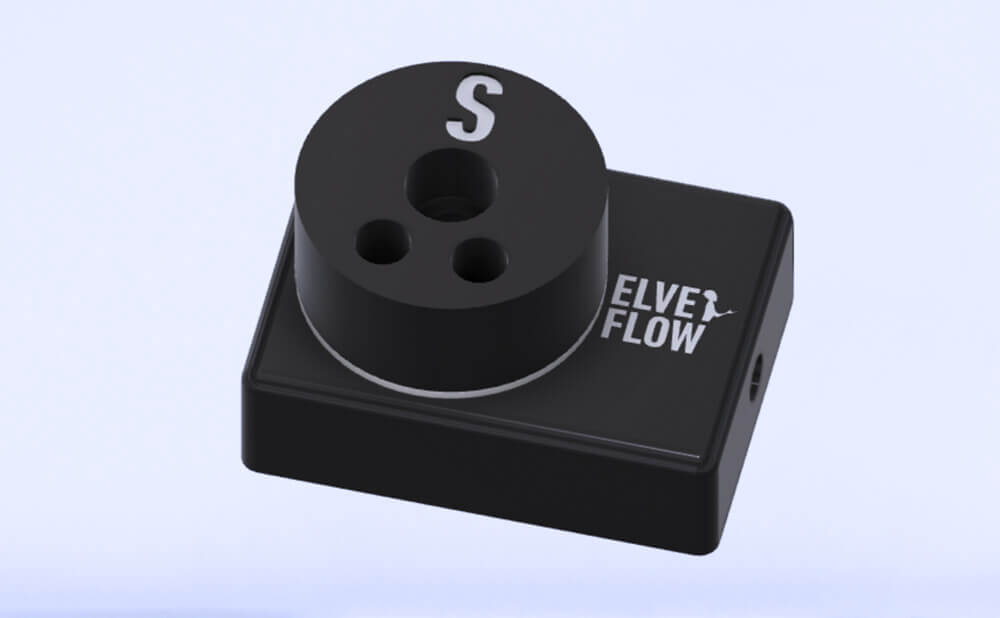
PEEK Inline Microfluidic Bubble Trap
Elveflow's redesigned Bubble Remover is an inline microfluidic bubble trap made from autoclavable PEEK (Polyetheretherketone). Developed in collaboration with engineers and researchers, it features a leak-proof design, PTFE microporous membrane, and optional vacuum-assisted operation for maximum bubble removal efficiency.
Working Principle
The bubble trap uses a microporous PTFE membrane (10 µm pores). As fluid flows through, gas bubbles are expelled through the hydrophobic membrane while aqueous liquid is retained - zero leakage. Operation is passive by default; a vacuum line can be added (e.g., from an OB1 MK4 vacuum outlet) for enhanced performance.
Key Benefits
- Autoclavable PEEK body - biocompatible and chemically resistant
- PTFE membrane - hydrophobic, 10 µm pores, easily replaceable between experiments
- Two operation modes: passive (no vacuum) or active (vacuum-assisted, up to 60 mL/min)
- Typical use range: 0.5–2.0 mL/min (passive); up to 60 mL/min with vacuum
- 3 internal volume options: 23 µL (S), 95 µL (M), 362 µL (L)
- Standard 1/4"-28 threaded ports - compatible with 1/32", 1/16", and 1/8" OD tubing
- Pressure rating: 2 bar (30 psi)
- Compact: 47 × 34 × 28 mm, L-shaped stable footprint
Applications
Recommended for any microfluidic experiment sensitive to air bubbles: cell perfusion, organ-on-chip systems, fluorescence imaging, flow cytometry, and any setup using a pressure controller as the fluid driver.
.webp)

Microfluidics
Explore All ProductsCell Culture Under Flow
Explore All ProductsElveflow Publications
Academic publications and research studies utilizing Elveflow microfluidic instruments, sourced from Google Scholar.
What is the PEEK Bubble Remover and what is it used for?
The PEEK Bubble Remover is Autoclavable PEEK inline bubble trap with replaceable PTFE microporous membrane. Works passively or with vacuum assistance for flow rates up to 60 mL/min. Available in 3 internal volume sizes.
What research applications is the PEEK Bubble Remover suited for?
The PEEK Bubble Remover is suited for researchers in neuroscience, behavioral science, physiology, and related life science fields. It is designed to support experimental workflows that require reliable, high-quality data acquisition and analysis.
What are the key technical features of the PEEK Bubble Remover?
The PEEK Bubble Remover (catalog number: PEEK-BUBBLE) is engineered for precision performance in laboratory settings. It offers user-friendly operation, robust construction, and compatibility with standard laboratory workflows to maximize experimental efficiency and reproducibility.
Is the PEEK Bubble Remover available in Israel with local support?
Yes. NBT Ltd is the exclusive distributor of this product in Israel. Our team of scientific specialists provides full local support including installation, application training, and ongoing technical assistance for the PEEK Bubble Remover.
What accessories or systems is the PEEK Bubble Remover compatible with?
The PEEK Bubble Remover is designed to integrate seamlessly with complementary laboratory instruments and software used in its application domain. NBT Ltd can advise on compatible accessories, consumables, and system configurations to meet your specific research needs.
Still have questions?
Request for Quote
Please fill in as much details as possible and we will take care of your request as soon as possible
Request for Quote
Please fill in as much details as possible and we will take care of your request as soon as possible