.svg)
.svg)
Light/Dark Box
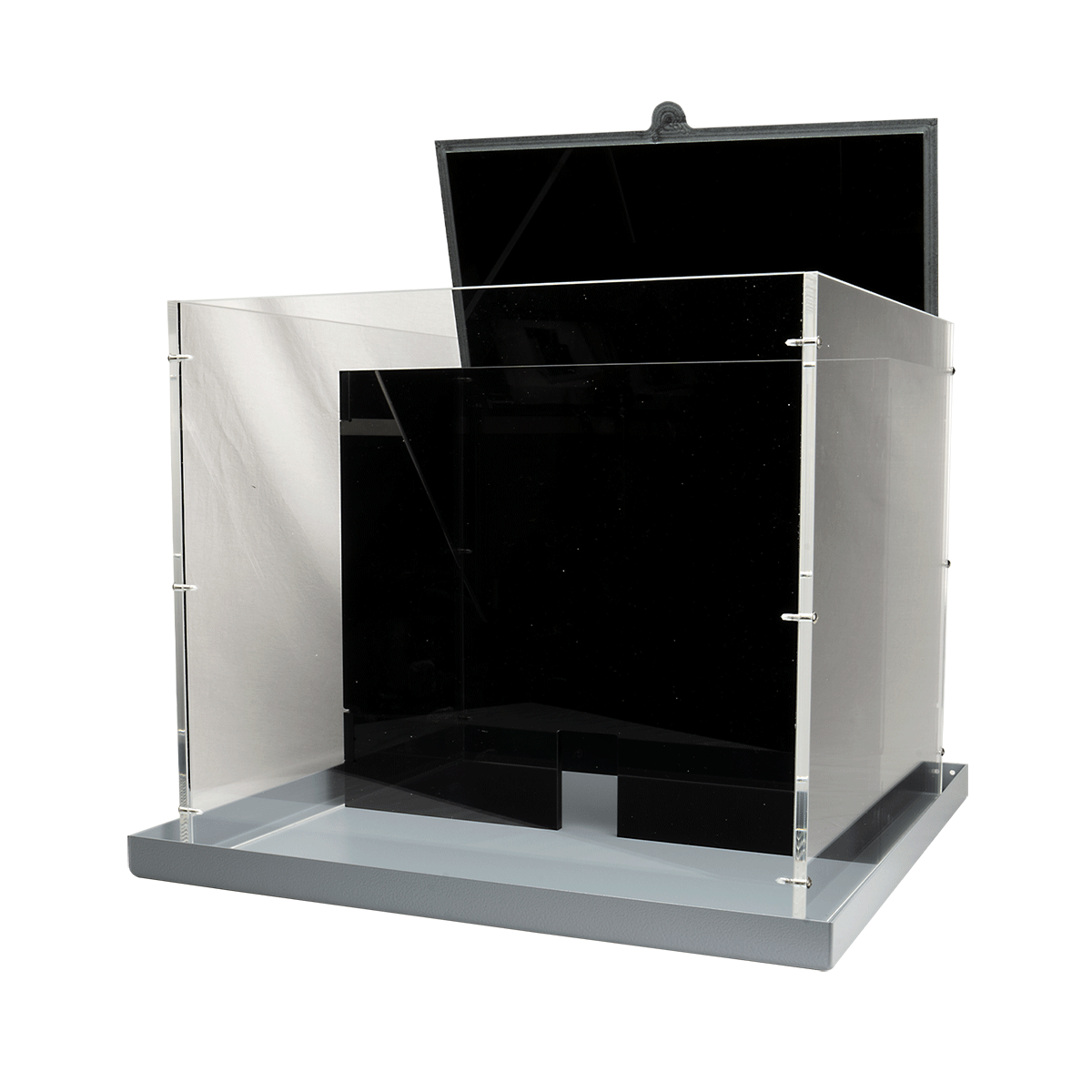
Anxiety assessment apparatus exploiting rodents' natural aversion to brightly lit, open spaces. Two-compartment design (dark/light); high-contrast surfaces; mouse (47442: 44×44 cm) and rat (47443: 50×100 cm) versions; optional opaque white walls (47442-W/47443-W). Compatible with ANY-maze.
What is the Light/Dark Box?
The Light/Dark Box (LDB) test exploits the natural conflict between rodents' tendency to explore novel environments and their innate aversion to brightly lit, open spaces. Animals placed in the brightly lit compartment spontaneously transition to the connected dark chamber; the number of transitions and the proportion of time spent in the light compartment provide validated, pharmacologically sensitive measures of anxiety-like behavior. The LDB is particularly valued for its face validity - the light avoidance response directly parallels the avoidance of exposed, well-lit environments that characterizes anxiety-related states in humans, and for its sensitivity to both acute anxiolytic drugs and chronic stress-induced anxiety changes.
Key Features
- Two-Compartment Design: A dividing wall with a small connecting passage separates the fully enclosed dark chamber from the brightly lit open chamber, creating a sharp contrast that maximizes the conflict-based anxiety response.
- High-Contrast, Non-Reflective Materials: Both compartments use anti-glare materials optimized for video tracking, enabling automatic scoring of transitions, latency to enter the dark compartment, and time in each zone.
- Flexible Wall Options: Standard transparent walls allow overhead and side-view camera recording; opaque white wall variants (Cat. 47442-W, 47443-W) create a higher dark/light contrast for maximal aversion in less anxious or habituated animals.
- Mouse and Rat Sizes: Cat. 47442 (mouse: 44 × 44 cm total, dark chamber 42 × 20 × 40 cm) and Cat. 47443 (rat: 50 × 100 cm total, dark chamber 48 × 48 × 40 cm) provide species-appropriate exploration volumes.
- Open Field Compatible: The transparent-wall mouse version (Cat. 47433) can function as a standard open field when the dark box insert is removed, allowing dual-use for both anxiety and locomotion testing.
.webp)

Technical Specifications
| Catalog Numbers | 47442 (Mouse), 47443 (Rat), 47442-W (Mouse opaque white), 47443-W (Rat opaque white) |
| Overall Dimensions - Mouse | 44 × 44 cm total; dark chamber 42 × 20 × 40(h) cm |
| Overall Dimensions - Rat | 50 × 100 cm total; dark chamber 48 × 48 × 40(h) cm |
| Wall Height | 40 cm (both models) |
| Weight - Mouse | 10 kg |
| Weight - Rat | 26 kg |
| Wall Options | Transparent (standard) or opaque white (-W variant) |
| Software Compatibility | ANY-maze (Cat. 60000) |
| Warranty | 12 months + 12 months post-registration |
Applications
- Anxiolytic and anxiogenic drug screening
- Stress-induced anxiety models (restraint, social defeat, predator)
- Genetic anxiety model characterization (GABAR, CRH, SERT)
- Developmental programming and early-life stress research
Mazes Tracking
Explore All ProductsMotor Functions
Explore All ProductsLight/Dark Box Publications
The Ugo Basile Light/Dark Box is widely cited in anxiety research as a quick, ethologically-valid test of anxiety-like behavior in mice and rats, frequently used to screen anxiolytic compounds and phenotype transgenic animals.
What are the primary behavioral endpoints in the Light/Dark Box test?
Primary endpoints are: (1) latency to first entry into the dark compartment, (2) total time in the light compartment, (3) number of transitions between compartments (activity index), and (4) number of entries into the light compartment. Anxiolytic drugs increase light compartment time and transitions; anxiogenic treatments decrease them.
What catalog numbers are available for the Light/Dark Box?
Cat. 47442 (mouse, transparent walls), Cat. 47443 (rat, transparent walls), Cat. 47442-W (mouse, opaque white walls), and Cat. 47443-W (rat, opaque white walls). The -W variants provide higher dark/light contrast for use with highly anxious or habituated animals.
Does the Light/Dark Box require training before testing?
No. The LDB is an untrained, single-session test. Animals are placed in the light compartment and allowed to explore freely for 5 minutes. No prior habituation, food restriction, or shaping is required, making it one of the fastest anxiety screens available.
How does the LDB compare to the Elevated Plus Maze for anxiety?
The LDB and EPM both measure anxiety-like avoidance behavior but engage slightly different motivational systems. The LDB relies on light aversion (thigmotaxis and brightness avoidance); the EPM relies on height avoidance in addition to open-space anxiety. Both are pharmacologically validated, and using both in the same test battery provides greater confidence in anxiety phenotype characterization.
Can the Light/Dark Box be used as an open field?
Yes. The transparent-wall mouse version (Cat. 47442) can function as a standard open field when the dark box insert and dividing wall are removed, providing a clean 44 × 44 cm arena for locomotion, exploration, and NOR protocols.
Still have questions?
Request for Quote
Please fill in as much details as possible and we will take care of your request as soon as possible
Request for Quote
Please fill in as much details as possible and we will take care of your request as soon as possible