.svg)
.svg)
ibidi µ-Slide VI 0.5 Glass Bottom
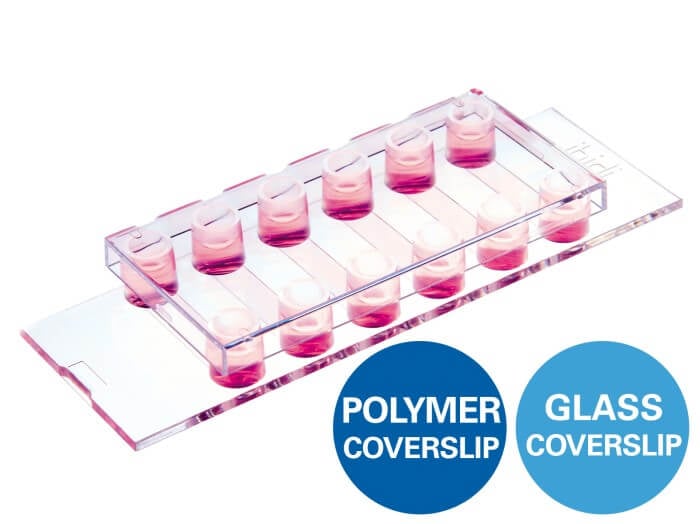
Six channels on a standard slide footprint with a No. 1.5H glass coverslip bottom, 170 µm ± 5 µm. 0.6 cm² of growth area and 40 µl per channel. Note the channel height: 0.53 mm here against 0.4 mm on the polymer version, so a flow protocol carried over from the µ-Slide VI 0.4 needs its shear stress recalculated.
What is the µ-Slide VI 0.5 Glass Bottom?
Six independent channels on a standard 25.5 x 75.5 mm slide footprint. Each channel is 17 mm long and 3.8 mm wide, giving 0.6 cm² of growth area and holding 40 µl, with a further 60 µl in each reservoir. The bottom is No. 1.5H Schott D 263 M borosilicate glass at 170 µm ± 5 µm.
The channel is 0.53 mm, not 0.4 mm
This is the thing to know before you order. The polymer bottom µ-Slide VI 0.4 has a 0.4 mm channel. This one has 0.53 mm. Shear stress at a given flow rate depends on channel height, so a perfusion protocol carried across from the VI 0.4 will not deliver the same shear until you recalculate it. For static culture and immunofluorescence the difference does not matter.
Why glass here
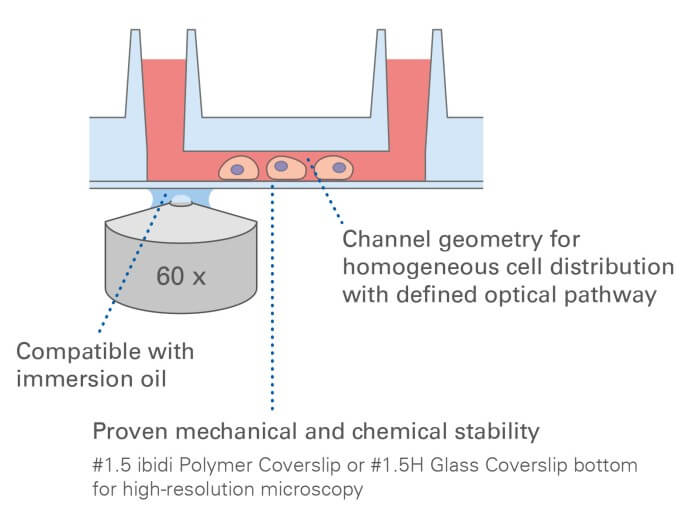
170 µm ± 5 µm is the 1.5H tolerance, tighter than a plain No. 1.5 coverslip and tighter than the 180 µm +10/-5 µm polymer bottom. High NA oil objectives are corrected for a specific coverslip thickness, and TIRF, PALM, STORM and SIM all depend on it. Refractive index 1.523, Abbe number 55.
Where I would not spend the money
If the work is widefield fluorescence, confocal, phase contrast, or flow assays scored at moderate magnification, buy the µ-Slide VI 0.4 instead. It costs less, its polymer optics are good, and it keeps the 0.4 mm channel your existing protocols were written around. Take the glass when a high NA oil objective is going on it and the method depends on coverslip thickness. And if what you actually want is your own substrate under the channels, that is the sticky-Slide VI 0.4, not this.
Key Features
- No. 1.5H glass coverslip bottom, 170 µm ± 5 µm, Schott D 263 M
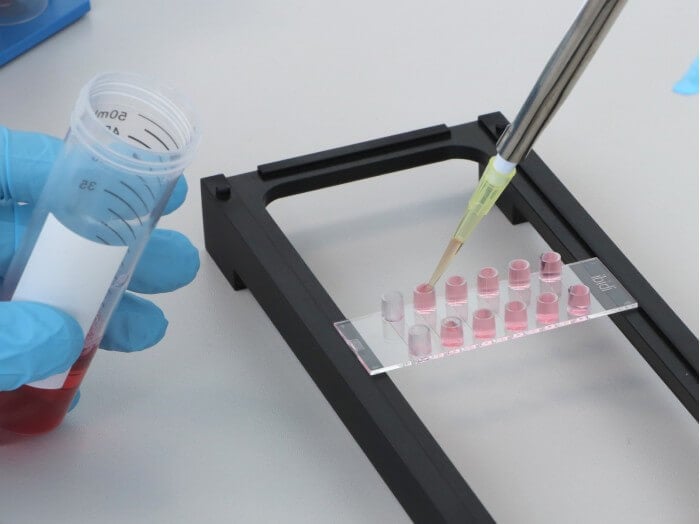
- Six channels, 0.6 cm² growth area and 40 µl each, 60 µl per reservoir
- Channel 0.53 mm high, 17 mm long, 3.8 mm wide
- Standard 25.5 x 75.5 mm slide footprint
- Sterilized, 15 or 90 individually packed, or 120 at 8 per tray
.webp)

| Catalog number | 80607 |
| Number of channels | 6 |
| Channel height | 0.53 mm |
| Channel length | 17 mm |
| Channel width | 3.8 mm |
| Growth area per channel | 0.6 cm² |
| Coating area per channel | 1.2 cm² |
| Volume per channel | 40 µl |
| Volume per reservoir | 60 µl |
| Coverslip bottom | Glass, No. 1.5H, 170 µm ± 5 µm |
| Glass type | Schott borosilicate, D 263 M |
| Refractive index | 1.523 |
| Abbe number | 55 |
| Outer dimensions | 25.5 x 75.5 mm |
| Height with lid | 8.8 mm |
| Height without lid | 7.6 mm |
| Sterilization | Sterilized, sealed in gas permeable packaging |
| Storage | RT (15 to 25 °C) |
| Shelf life | 36 months |
| Pieces per box | 15 or 90 individually packed, or 120 at 8 per tray |
| Polymer bottom version | 80606, µ-Slide VI 0.4, #1.5 polymer, 0.4 mm channel |
| Manufactured | Germany |
Applications
- TIRF microscopy
- Single molecule detection
- Super-resolution microscopy, PALM, STORM and SIM
- Immunofluorescence staining
- Cell culture under flow and perfusion assays

Cell Cultivation and Imaging
Explore All ProductsFluorescence Imaging
Explore All ProductsCell Culture Under Flow
Explore All Productsibidi Labware Publications
Comprehensive collection of peer-reviewed research publications demonstrating the use of ibidi labware including µ-Slides, µ-Dishes, µ-Plates, and specialized microfluidic devices for cell biology, neurobiology, vascular biology, and cancer research.
Why is this called 0.5 when the other one is 0.4?
Channel height. This glass bottom slide has a 0.53 mm channel. The polymer bottom µ-Slide VI 0.4 has 0.4 mm. Shear stress at a given flow rate depends on channel height, so recalculate before you carry a perfusion protocol across from the VI 0.4. For static culture and staining it changes nothing.
What does the 1.5H glass buy me?
170 µm ± 5 µm, a tighter tolerance than a plain No. 1.5 coverslip and tighter than the 180 µm +10/-5 µm polymer bottom. High NA oil objectives are corrected for a specific coverslip thickness, and TIRF, PALM, STORM and SIM all depend on it.
80607 or 80606?
80607 is this glass bottom slide. 80606 is the µ-Slide VI 0.4 on a #1.5 polymer coverslip, which costs less, has good optics for widefield and confocal, and keeps the 0.4 mm channel. Take the glass when a high NA oil objective is going on it and the method depends on coverslip thickness.
Can I run it under flow?
Yes. ibidi lists the µ-Slide VI family as optimised for the ibidi Pump System, and each channel has two female Luer ports. Set the flow rate against the 0.53 mm channel height, not the 0.4 mm figure from the polymer slide.
Is it available in Israel with local support?
Yes. NBT is the ibidi distributor in Israel. We hold labware locally, and we will tell you when the polymer bottom version would have been enough.
Still have questions?
Request for Quote
Please fill in as much details as possible and we will take care of your request as soon as possible
Request for Quote
Please fill in as much details as possible and we will take care of your request as soon as possible