.svg)
.svg)
ibidi µ-Slide 15 Well 3D Glass Bottom
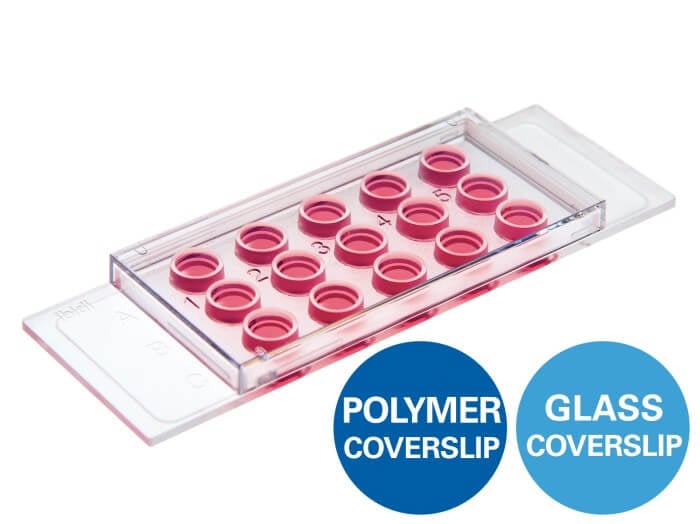
Fifteen wells for 3D culture and tube formation on a No. 1.5H glass bottom. Each well has an inner well 4 mm across and 0.8 mm deep that takes 10 µl of gel, with 50 µl of medium above it. The gel sets flat instead of forming a meniscus, so the cells sit in one focal plane. Sold until recently as the µ-Slide Angiogenesis Glass Bottom.
What is the µ-Slide 15 Well 3D Glass Bottom?
Fifteen wells on a standard slide footprint, each built as an inner well 4 mm across and 0.8 mm deep that takes 10 µl of gel, with an upper well above it holding 50 µl of medium. The bottom is No. 1.5H glass at 170 µm ± 5 µm. It used to be sold as the µ-Slide Angiogenesis Glass Bottom.
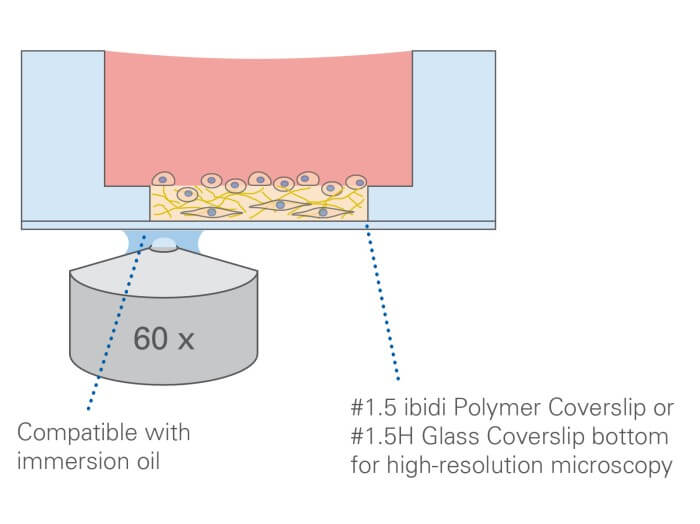
The inner well geometry is the whole design. Ten microlitres of Matrigel, collagen or agarose sets with a flat top rather than a meniscus, so the cells that form tubes on it sit in one focal plane and the whole well is in focus at once.
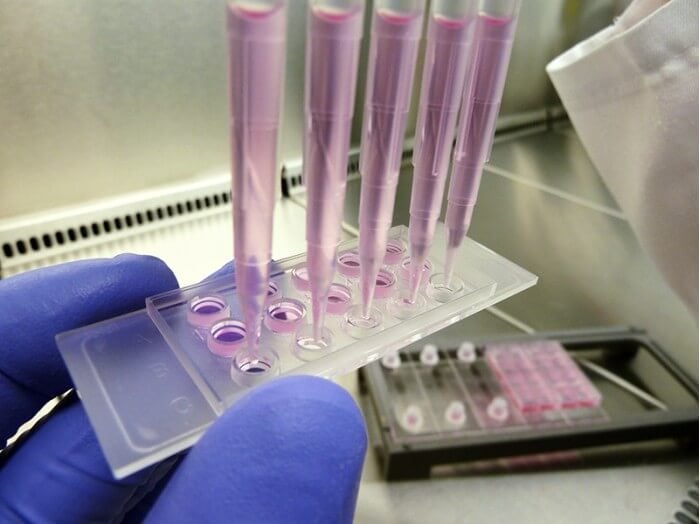
Ten microlitres per well
Gel is the expensive part of a tube formation assay. Fifteen wells at 10 µl is 150 µl of Matrigel for a fifteen condition experiment. Anyone who has run the same assay in a 96 well plate knows what that comparison looks like.
Where I would not spend the money
The polymer bottom version, 81506, is the same slide with a #1.5 polymer coverslip and it is cheaper. Tube formation assays are usually scored at low magnification on brightfield or with a widefield fluorophore, and for that the polymer bottom is enough. Buy the glass when you are also doing TIRF or single molecule imaging on the same samples, or when a high NA oil objective is going onto these wells.
Key Features
- No. 1.5H glass coverslip bottom, 170 µm ± 5 µm, Schott D 263 M
- Fifteen wells, 10 µl of gel and 50 µl of medium each
- Inner well 4 mm across and 0.8 mm deep, no gel meniscus
- Works with Matrigel, collagen and agarose
- Standard 25.5 x 75.5 mm slide footprint, 15, 90 or 120 per box
.webp)

| Catalog number | 81507 |
| Number of wells | 15 |
| Growth area per well | 0.125 cm² |
| Gel volume, inner well | 10 µl |
| Medium volume, upper well | 50 µl |
| Inner well diameter | 4 mm |
| Inner well depth | 0.8 mm |
| Coverslip bottom | Glass, No. 1.5H, 170 µm ± 5 µm |
| Glass type | Schott borosilicate, D 263 M |
| Outer dimensions | 25.5 x 75.5 mm |
| Height with lid | 5.3 mm |
| Height without lid | 3.7 mm |
| Surface | ibiTreat, tissue culture treated |
| Sterilization | Sterilized, sealed in gas permeable packaging |
| Temperature | Stable to 80 °C, not autoclavable |
| Storage | RT (15 to 25 °C) |
| Shelf life | 36 months |
| Pieces per box | 15 or 90 individually packed, or 120 at 8 per tray |
| Polymer bottom version | 81506, #1.5 polymer, 180 µm (+10/-5 µm) |
| Former product name | µ-Slide Angiogenesis Glass Bottom |
Applications
- Tube formation and angiogenesis assays
- 3D cell culture in Matrigel, collagen or agarose
- Spheroid and organoid culture
- Immunofluorescence staining
- Super-resolution and TIRF microscopy

Cell Cultivation and Imaging
Explore All ProductsFluorescence Imaging
Explore All Productsibidi Labware Publications
Comprehensive collection of peer-reviewed research publications demonstrating the use of ibidi labware including µ-Slides, µ-Dishes, µ-Plates, and specialized microfluidic devices for cell biology, neurobiology, vascular biology, and cancer research.
Why does the well have two levels?
The inner well, 4 mm across and 0.8 mm deep, holds exactly 10 µl of gel and holds it flat. Gel poured into an ordinary flat well climbs the wall and forms a meniscus, and the cells then sit at different heights. Flat gel means one focal plane and the whole well in focus at once.
Which gels does it take?
Matrigel, collagen and agarose are the ones ibidi lists. 10 µl per well, 50 µl of medium on top.
How much gel does a full slide use?
150 µl for all fifteen wells. That is the reason to run a tube formation assay here rather than in a 96 well plate.
81507 or 81506?
81507 is the glass bottom, 81506 the polymer. Tube formation is usually scored at low magnification, and for that the polymer bottom is enough and costs less. Buy the glass when a high NA oil objective is going on the same samples, or when you are doing TIRF or single molecule imaging alongside.
Is it available in Israel with local support?
Yes. NBT is the ibidi distributor in Israel. We hold labware locally, and we will tell you when the polymer bottom version would have been enough.
Still have questions?
Request for Quote
Please fill in as much details as possible and we will take care of your request as soon as possible
Request for Quote
Please fill in as much details as possible and we will take care of your request as soon as possible