.svg)
.svg)
ibidi µ-Plate 96 Well Round Glass Bottom
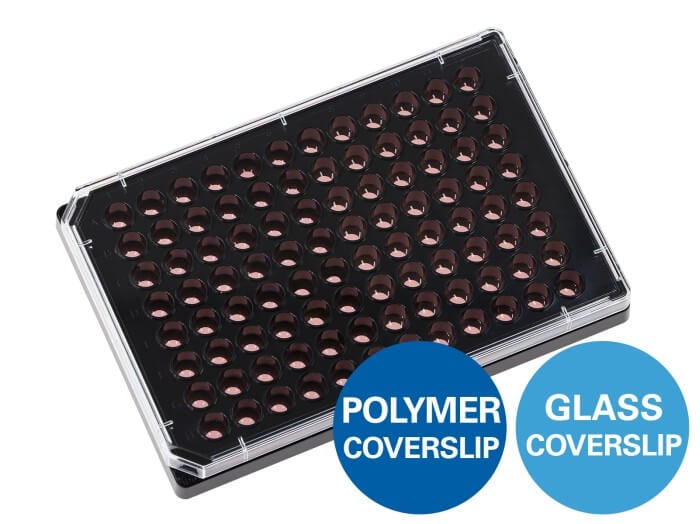
A 96 well plate with black walls, round wells 6.2 mm across, and a flat No. 1.5H glass coverslip bottom of 170 µm ± 5 µm. 0.30 cm² and 200 µl per well, 9.0 mm pitch, ANSI/SLAS footprint. Round wells keep existing protocols, tip racks and liquid handlers working unchanged.
What is the µ-Plate 96 Well Round Glass Bottom?
A 96 well plate with black walls, round wells 6.2 mm across and 12.9 mm deep, and a flat No. 1.5H glass coverslip bottom of 170 µm ± 5 µm in Schott D 263 M borosilicate. Growth area is 0.30 cm² per well and working volume 200 µl. Well to well pitch is 9.0 mm and the footprint follows ANSI/SLAS 1 to 4:2004.
Round wells or square wells
ibidi makes both, and they are not interchangeable. The round wells here are the classic 96 well geometry, so existing protocols, tip racks and liquid handlers transfer without changes, and medium distributes evenly around the well. The square version, 89627, has 0.56 cm² and 300 µl per well, close to twice the growth area, which buys more fields of view per well and a longer unattended live cell run before the medium is exhausted. It also uses more coating reagent per well.
Round for compatibility and lower cost per assay point. Square for area and volume. If your workflow already runs on standard round well plates, do not change it for the sake of area.
Where I would not spend the money
The polymer bottom version, 89606, is the same plate with a #1.5 polymer coverslip and costs less. It is enough for widefield and confocal screening. Buy this glass version for TIRF, single molecule detection and super-resolution. Also note that the glass bottom is fragile, so if the plate is being handled by a robot with a hard deck, weigh that before ordering.
Key Features
- No. 1.5H glass coverslip bottom, 170 µm ± 5 µm, Schott D 263 M
- 96 round wells, 6.2 mm diameter, 0.30 cm² and 200 µl each
- Black walls for low well to well crosstalk
- ANSI/SLAS footprint, 9.0 mm pitch, inner well and whole plate flatness for automated screening
- Sterilized, 15 or 90 per box
.webp)

| Catalog number | 89607 |
| Number of wells | 96 |
| Well geometry | Round |
| Well diameter | 6.2 ± 0.15 mm |
| Well depth | 12.9 ± 0.2 mm |
| Growth area per well | 0.30 cm² |
| Coating area per well | 1.61 cm² |
| Volume per well | 200 µl |
| Well to well distance | 9.0 ± 0.1 mm |
| Coverslip bottom | Glass, No. 1.5H, 170 µm ± 5 µm |
| Glass type | Schott borosilicate, D 263 M |
| Refractive index | 1.523 |
| Abbe number | 55 |
| Outer dimensions | 127.8 ± 0.4 x 85.5 ± 0.4 mm |
| Height with lid | 16.6 ± 0.2 mm |
| Height without lid | 14.4 ± 0.2 mm |
| Footprint standard | ANSI/SLAS 1-2004, 2-2004, 3-2004, 4-2004 |
| Recommended cell concentration | 2 to 5 x 10⁴ cells/ml |
| Sterilization | Sterile, single use, gas permeable packaging |
| Temperature | Stable to 80 °C, not autoclavable |
| Storage | RT (15 to 25 °C), dry, no direct sunlight |
| Shelf life | 36 months |
| Pieces per box | 15 or 90, individually packed |
| Polymer bottom version | 89606, #1.5 polymer, 180 µm (+10/-5 µm) |
Applications
- High throughput and high content screening
- TIRF microscopy
- Single molecule detection
- Super-resolution microscopy
- Live cell imaging and immunofluorescence

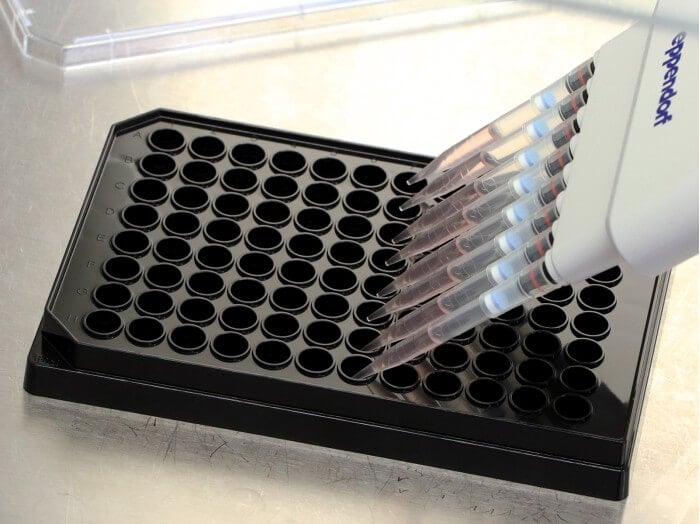
Cell Cultivation and Imaging
Explore All ProductsFluorescence Imaging
Explore All Productsibidi Labware Publications
Comprehensive collection of peer-reviewed research publications demonstrating the use of ibidi labware including µ-Slides, µ-Dishes, µ-Plates, and specialized microfluidic devices for cell biology, neurobiology, vascular biology, and cancer research.
Round wells or the square ones?
Round is the classic 96 well geometry, so protocols, tip racks and liquid handlers carry over unchanged, and it costs less per assay point at 0.30 cm² and 200 µl per well. The square version, 89627, gives 0.56 cm² and 300 µl, close to twice the growth area, more fields of view per well and more medium for a long unattended run. It also uses more coating reagent. If your workflow already runs on round wells, I would not change it just for the area.
Does it fit automated equipment?
The footprint follows ANSI/SLAS 1-2004 through 4-2004, pitch is 9.0 ± 0.1 mm, and inner well and whole plate flatness are held tight enough for an automated microscope to keep focus across the plate.
89607 or 89606?
89607 is the glass bottom, 89606 the polymer. For widefield and confocal screening, 89606 is enough and costs less. Buy 89607 for TIRF, single molecule detection and super-resolution.
What seeding density does ibidi recommend?
2 to 5 x 10^4 cells/ml, 200 µl per well. The plate is compatible with methanol, ethanol, formaldehyde, mineral oil and silicone oil, and not with acetone.
Is it available in Israel with local support?
Yes. NBT is the ibidi distributor in Israel. We hold labware locally, and we will tell you when the polymer bottom version would have been enough.
Still have questions?
Request for Quote
Please fill in as much details as possible and we will take care of your request as soon as possible
Request for Quote
Please fill in as much details as possible and we will take care of your request as soon as possible