.svg)
.svg)
Harvard Apparatus Pump Controller (HAPC)
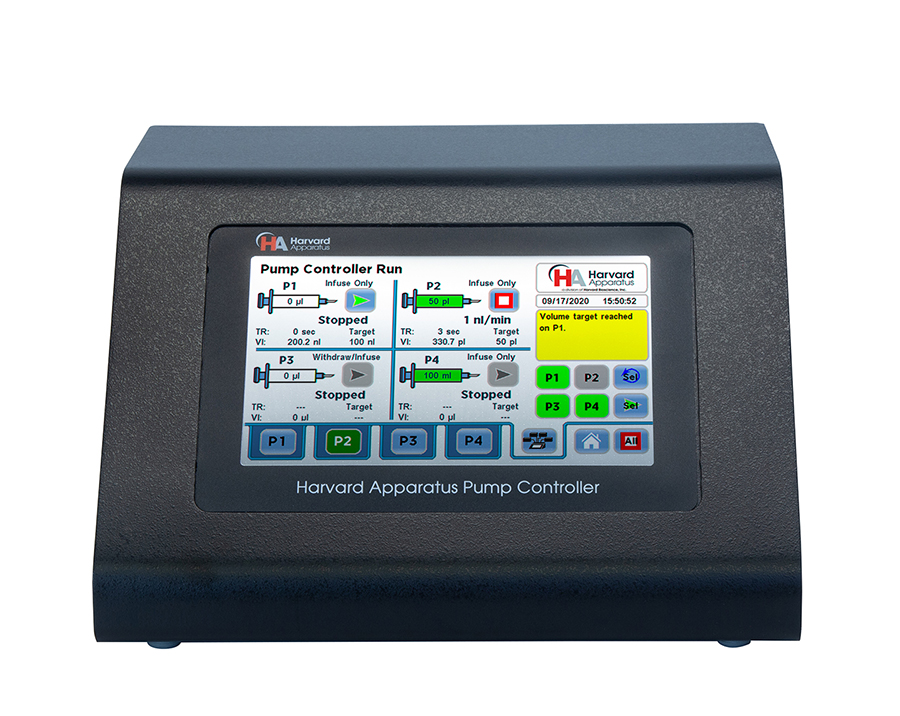
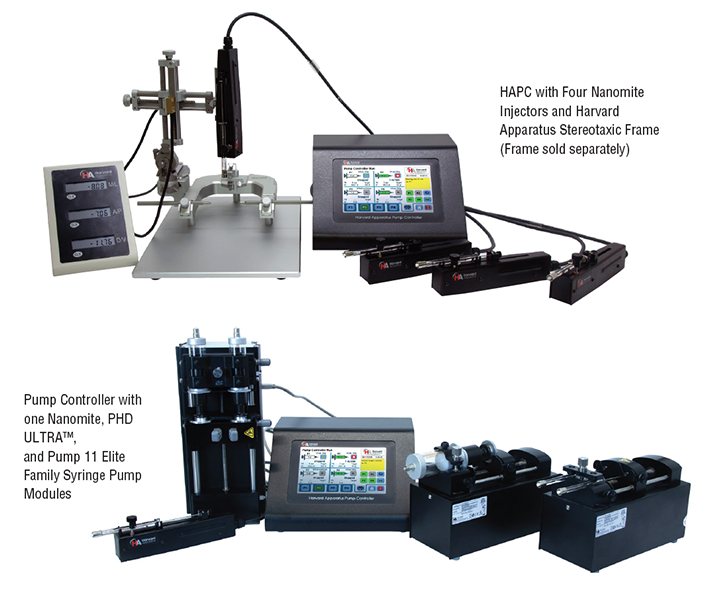
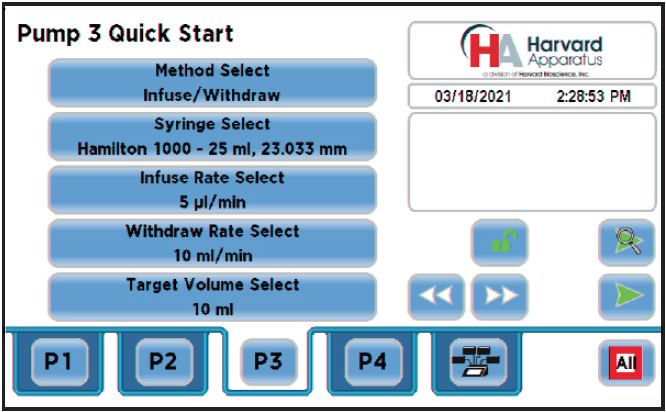
The Harvard Apparatus Pump Controller (HAPC) is a centralized 7" touchscreen controller for managing 1–4 channels of PHD Ultra™ or Pump 11 Elite™ syringe pumps. Designed for complex multi-pump infusion and withdrawal protocols, the HAPC simplifies coordination of parallel drug delivery, push-pull microdialysis, and automated in vivo infusion studies from a single interface.
What is the Harvard Apparatus Pump Controller (HAPC)?
The Harvard Apparatus Pump Controller (HAPC) is a dedicated touchscreen control system designed to operate one to four channels of Harvard Apparatus PHD Ultra™ and Pump 11 Elite™ syringe pumps from a single, centralized interface. Engineered for complex multi-pump infusion and withdrawal protocols, the HAPC eliminates the need to individually program each pump, streamlining experimental workflows in pharmacology, neuroscience, and in vivo research.
With its intuitive 7" WQVGA TFT color touchscreen and non-volatile memory, the HAPC retains all settings between sessions and supports advanced programming modes including conditional control and time-based methods, making it ideal for chronic dosing studies, microdialysis experiments, and precise drug delivery in awake, behaving animals.
Key Features
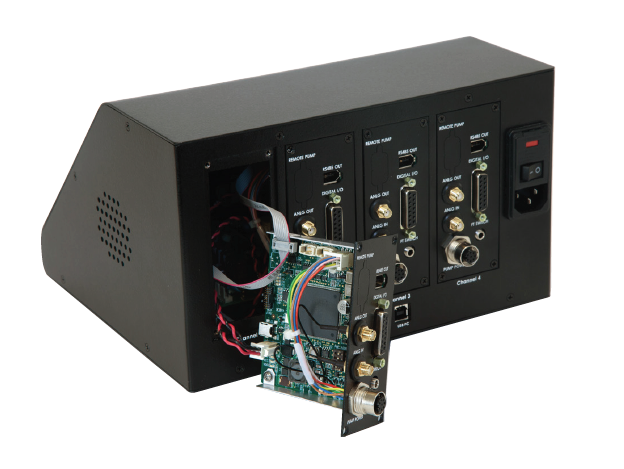
- Multi-Channel Control (1–4 Channels): Control up to four independent syringe pump channels from a single unit. Available in 1-, 2-, 3-, and 4-channel configurations (catalog numbers 704401–704404) to match your experimental setup.
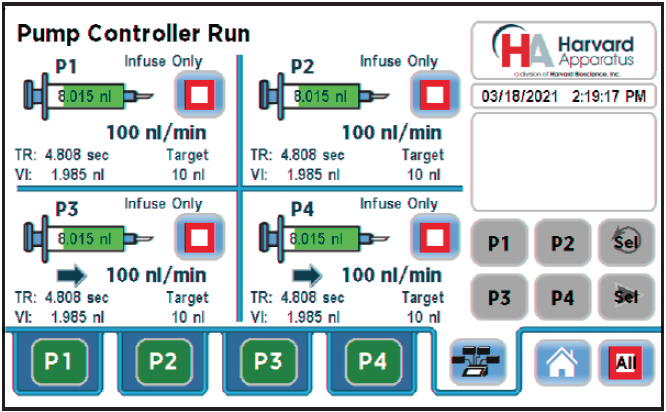
- 7" Touchscreen Interface: The large WQVGA TFT color display provides an intuitive touchscreen interface for programming methods, monitoring pump status, and controlling multiple channels simultaneously.
- Advanced Method Programming: Create and execute complex infusion/withdrawal protocols with conditional logic, relative time clocks, and multi-step programs, without requiring a PC during operation.
- Non-Volatile Memory: All pump settings and methods are stored in non-volatile memory, ensuring protocols are retained even after power cycling, essential for long-running or repetitive experiments.
- Compatible with PHD Ultra™ and Pump 11 Elite™: Designed to work seamlessly with Harvard Apparatus's PHD Ultra and Pump 11 Elite syringe pump families, providing a unified hardware ecosystem for precise fluid control.
- Wide Voltage Range: Operates on 100–240 VAC, 50/60 Hz for global compatibility across research facilities.
.webp)

Technical Specifications
| Catalog Numbers | 704401 (1-channel), 704402 (2-channel), 704403 (3-channel), 704404 (4-channel) |
| Display | 7" WQVGA TFT Color Display with Touchscreen |
| Channels | 1 to 4 (configurable) |
| Compatible Pumps | PHD Ultra™ and Pump 11 Elite™ series |
| Memory | Non-volatile (retains all settings) |
| Power Supply | 100–240 VAC, 50/60 Hz |
| Dimensions | 8.75 × 10 × 6.25 in (22 × 25.4 × 15.87 cm) |
| Weight | 2.3 kg (5 lbs) with 4 channels |
| Operating Mode | Continuous, Method, Conditional |
Applications
- Multi-pump coordination in chronic drug delivery studies
- Microdialysis push-pull perfusion experiments
- In vivo pharmacological infusion in freely-moving animals
- Automated infusion/withdrawal cycling in behavioral neuroscience

Animal Infusion
Explore All ProductsHarvard Apparatus Pump Controller (HAPC) Publications
The HAPC has been used in multi-pump infusion studies across behavioral neuroscience, pharmacology, and in vivo microdialysis research, enabling coordinated drug delivery protocols in freely-moving animal models.
What is the Harvard Apparatus Pump Controller (HAPC) and what is it used for?
The Harvard Apparatus Pump Controller (HAPC) is a centralized 7" touchscreen controller for managing 1–4 channels of PHD Ultra™ or Pump 11 Elite™ syringe pumps. Designed for complex multi-pump infusion and withdrawal protocols, the HAPC simplifies coordination of parallel drug delivery, push-pull microdialysis, and automated in vivo infusion studies from a single interface.
What research applications is the Harvard Apparatus Pump Controller (HAPC) suited for?
The Harvard Apparatus Pump Controller (HAPC) is suited for researchers in neuroscience, behavioral science, physiology, and related life science fields. It is designed to support experimental workflows that require reliable, high-quality data acquisition and analysis.
What are the key technical features of the Harvard Apparatus Pump Controller (HAPC)?
The Harvard Apparatus Pump Controller (HAPC) (catalog number: 704401) is engineered for precision performance in laboratory settings. It offers user-friendly operation, robust construction, and compatibility with standard laboratory workflows to maximize experimental efficiency and reproducibility.
Is the Harvard Apparatus Pump Controller (HAPC) available in Israel with local support?
Yes. NBT Ltd is the exclusive distributor of this product in Israel. Our team of scientific specialists provides full local support including installation, application training, and ongoing technical assistance for the Harvard Apparatus Pump Controller (HAPC).
What accessories or systems is the Harvard Apparatus Pump Controller (HAPC) compatible with?
The Harvard Apparatus Pump Controller (HAPC) is designed to integrate seamlessly with complementary laboratory instruments and software used in its application domain. NBT Ltd can advise on compatible accessories, consumables, and system configurations to meet your specific research needs.
Still have questions?
Related Products:
Request for Quote
Please fill in as much details as possible and we will take care of your request as soon as possible
Request for Quote
Please fill in as much details as possible and we will take care of your request as soon as possible