.svg)
.svg)
Elevated Zero-Maze
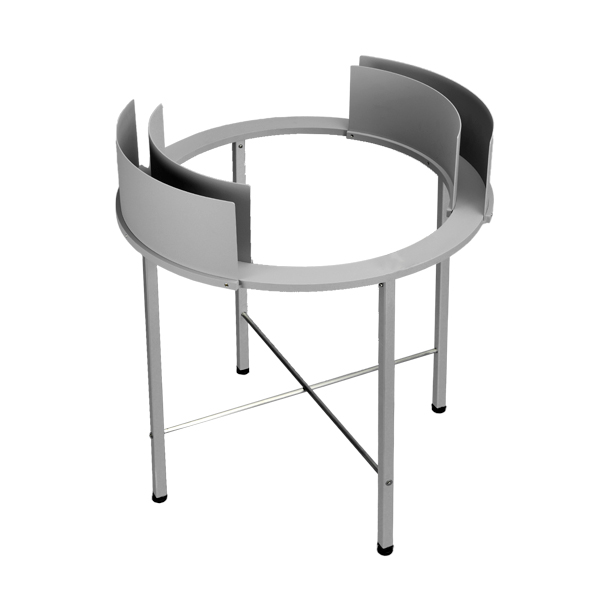
Circular anxiety assessment maze with gradual open-to-enclosed transitions - eliminates the ambiguous center zone of the EPM. High-contrast grey surface; 4 metal legs; rat (40162: 120 cm diameter) and mouse (40163: 60 cm diameter) versions, both elevated 60 cm. Optimized for video tracking.
What is the Elevated Zero-Maze?
The Elevated Zero-Maze (EZM) is a circular refinement of the Elevated Plus Maze designed to address its main methodological limitation: the ambiguous center zone. In the EPM, time spent in the center square cannot be classified as either open or closed arm exposure, creating an unscored behavioral state that can mask true differences in anxiety. The EZM's annular (donut) design eliminates this by creating a continuous track with two open and two closed quadrants in alternating sequence, ensuring every location on the maze is unambiguously classified. This provides cleaner, more sensitive anxiety data, particularly when testing animals that display high center occupancy.
Key Features
- No Center Zone Ambiguity: The annular layout means every point on the maze is either open or closed, eliminating the unclassifiable center zone of the plus maze and providing 100% scorable behavioral data.
- Gradual Open-to-Enclosed Transition: Rather than an abrupt T-junction between open and closed areas, the EZM provides a smooth curved transition that more closely mimics natural environmental gradients and produces more graded anxiety responses.
- Non-Reflective, Anti-Glare Surface: High-contrast grey construction with anti-glare treatment ensures artifact-free video tracking throughout the circular track.
- Metal Leg Stability: Four metal legs at 60 cm provide a vibration-resistant platform appropriate for sensitive behavioral recordings.
- Rat and Mouse Sizes: Cat. 40162 (rats: 120 cm diameter, 10 cm track width) and Cat. 40163 (mice: 60 cm diameter, 5 cm width) are each appropriately scaled for natural locomotion in their respective species.
.webp)

Technical Specifications
| Catalog Numbers | 40162 (Rats), 40163 (Mice) |
| Diameter - Rats | 120 cm |
| Diameter - Mice | 60 cm |
| Track Width - Rats | 10 cm |
| Track Width - Mice | 5 cm |
| Closed Wall Height - Rats | 30 cm |
| Closed Wall Height - Mice | 15 cm |
| Elevation from Floor | 60 cm (both models) |
| Weight - Rats | 27 kg |
| Weight - Mice | 8 kg |
| Standard Color | Grey (RAL 7001); blue, white, black, custom available |
| Warranty | 12 months + 12 months post-registration |
Applications
- Anxiety phenotyping without EPM center-zone artifacts
- Anxiolytic and anxiogenic drug screening
- Sex differences in anxiety and estrous cycle research
- Prenatal stress and early-life adversity models
Mazes Tracking
Explore All ProductsMotor Functions
Explore All ProductsElevated Zero-Maze Publications
The Elevated Zero-Maze is widely cited in anxiety research as a continuous-track alternative to the elevated plus maze, eliminating the ambiguous central platform and improving sensitivity for detecting subtle anxiolytic effects in rodent studies.
How does the EZM improve on the Elevated Plus Maze?
The EPM has an ambiguous center zone where the animal can be located without being in open or closed arms. In a 5-minute test, a highly anxious animal may spend significant time in this unscored zone, artificially compressing the open/closed arm difference. The EZM's annular design eliminates this by ensuring every location is scored as either open or closed.
What are the catalog numbers for the Elevated Zero-Maze?
Cat. 40162 is the rat version (120 cm diameter, 10 cm track width, 30 cm closed walls) and Cat. 40163 is the mouse version (60 cm diameter, 5 cm wide, 15 cm closed walls). Both are elevated 60 cm on 4 metal legs.
Is the EZM pharmacologically validated?
Yes. The EZM responds to benzodiazepines (increased open time), inverse agonists (decreased open time), 5-HT1A agonists, and SSRIs in the same direction as the EPM, confirming pharmacological homology. The EZM often shows higher effect sizes due to the absence of center-zone data loss.
Can the EZM be tracked with video-tracking software?
Yes. The non-reflective circular track is well-suited to overhead camera tracking. ANY-maze (Cat. 60000) can define the open and closed sectors as circular arcs, track the animal's nose position, and automatically calculate all standard EZM endpoints.
What are the primary behavioral endpoints in the EZM?
Primary endpoints are: (1) percentage of time in open sectors, (2) number of transitions between sectors, and (3) total distance traveled. Secondary endpoints include head dips (looking over the edge in open sectors), stretch-attend postures, and grooming events.
Still have questions?

Request for Quote
Please fill in as much details as possible and we will take care of your request as soon as possible
Request for Quote
Please fill in as much details as possible and we will take care of your request as soon as possible