.svg)
.svg)
Elevated Plus Maze
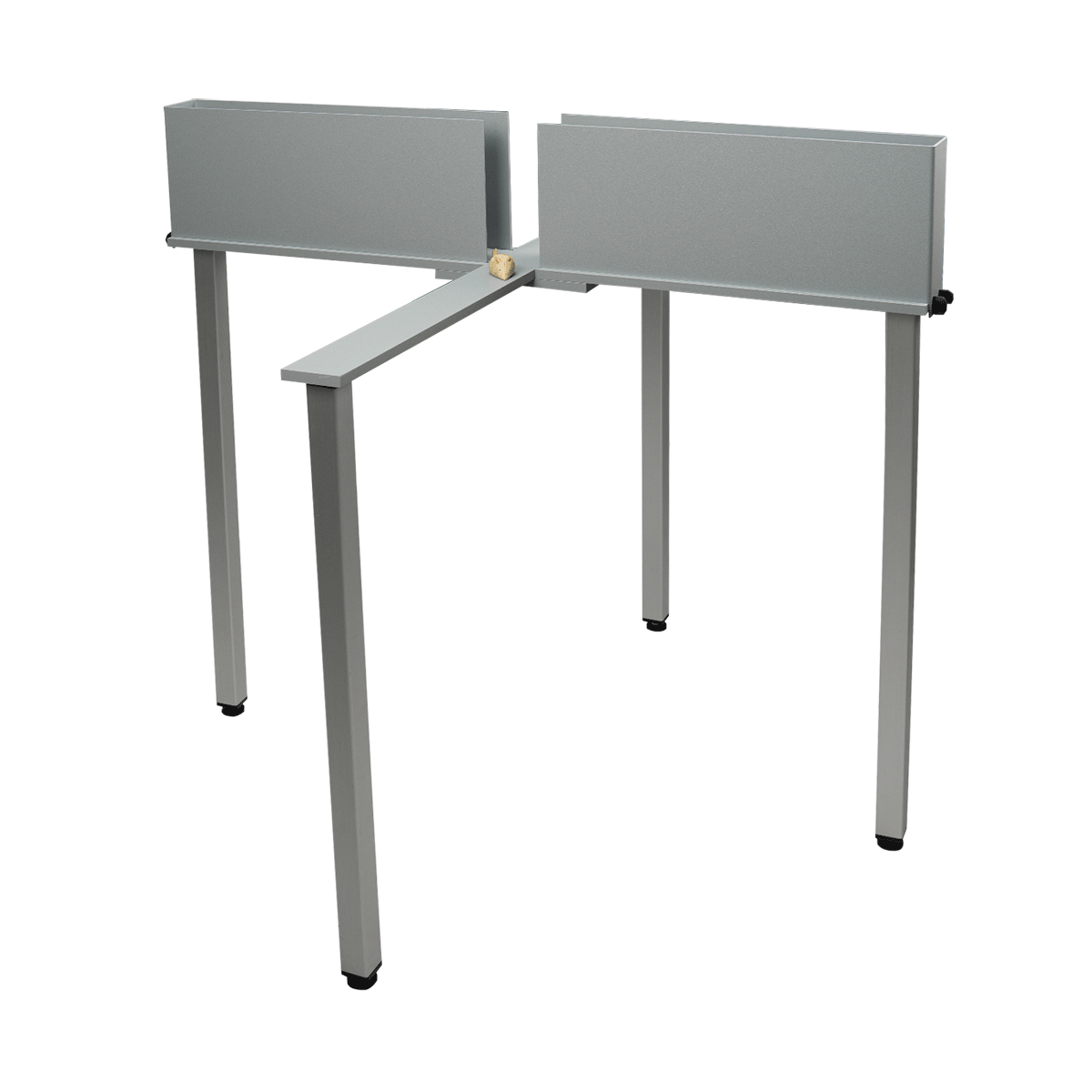
Classic anxiety-assessment maze exploiting rodents' avoidance of elevated, open spaces. High-contrast, non-reflective grey surface; detachable closed-arm walls; metal leg support; rat (40142: 110 cm arms) and mouse (40143: 80 cm arms) versions, both elevated 60 cm from floor.
What is the Elevated Plus Maze?
The Elevated Plus Maze (EPM) is the most widely used model for assessing anxiety-like behavior in rodents. The apparatus consists of two open arms and two enclosed arms arranged in a cross (+) shape, elevated 60 cm above the floor. Rodents naturally prefer the darker, protected closed arms over the exposed, bright open arms - a behavior that is consistently suppressed by anxiolytic drugs and augmented by anxiogenic treatments. Time in open arms and number of open arm entries are the validated primary endpoints, providing a pharmacologically sensitive, ethoexperimental measure of anxiety that requires no prior training.
Key Features
- Non-Reflective, Anti-Glare Surface: The entire maze is treated with a non-reflective coating that eliminates glare and ensures accurate, uninterrupted video tracking without artifact reflections from overhead lighting.
- Textured, Warm Surface: The arm floors use a lightly textured surface that provides natural traction for rodents without causing discomfort, reducing grip-related locomotor confounds.
- Easily Detachable Closed Arms: The enclosing walls of the closed arms are held magnetically and can be removed quickly for cleaning or for creating novel open-arm-only configurations to test exploration drives.
- Metal Leg Support: Four robust metal legs provide a stable, vibration-free platform at the 60 cm standard height, preventing mechanical disturbance from floor movements or nearby equipment.
- Rat and Mouse Sizes: Cat. 40142 (rats: 110 cm open corridor, 10 cm wide) and Cat. 40143 (mice: 80 cm corridor, 5 cm wide) ensure species-appropriate arm dimensions for natural exploratory behavior.
.webp)

Technical Specifications
| Catalog Numbers | 40142 (Rats), 40143 (Mice) |
| Open Corridor Length - Rat | 110 cm |
| Open Corridor Length - Mouse | 80 cm |
| Corridor Width - Rat | 10 cm |
| Corridor Width - Mouse | 5 cm |
| Closed Arm Wall Height - Rat | 40 cm |
| Closed Arm Wall Height - Mouse | 35 cm |
| Elevation from Floor | 60 cm (both models) |
| Weight - Rat | 15 kg |
| Weight - Mouse | 8 kg |
| Standard Color | Grey; blue, white, black, custom available |
| Warranty | 12 months + 12 months post-registration |
Applications
- Anxiety phenotyping and anxiolytic drug screening
- Stress-induced anxiety models (restraint, predator, social defeat)
- Genetic mouse model characterization (GABAAR, CRF, 5-HT1A)
- HPA axis and neuroendocrine regulation of anxiety
Mazes Tracking
Explore All ProductsMotor Functions
Explore All ProductsElevated Plus Maze Publications
The Ugo Basile Elevated Plus Maze is one of the most cited apparatus in anxiety research, used to screen anxiolytic and anxiogenic compounds and to phenotype rodent models of anxiety disorders, stress, and emotional regulation.
What are the primary behavioral endpoints in the Elevated Plus Maze?
The two primary endpoints are (1) percentage of time spent in the open arms and (2) percentage of open arm entries relative to total arm entries. Anxiolytic drugs increase both, while anxiogenic treatments decrease them. Secondary endpoints include total arm entries (activity), stretch-attend postures, and head dips over the open arm edges.
What catalog numbers are available for the EPM?
Cat. 40142 is the rat version (110 cm arm length, 10 cm wide) and Cat. 40143 is the mouse version (80 cm arm length, 5 cm wide). Both are elevated 60 cm from the floor and come in grey as standard; blue, white, and black available on request.
Does the EPM require any training prior to testing?
No. The EPM is a single-session, no-training test. Animals are placed in the center junction and allowed to explore freely for 5 minutes. No conditioning, food restriction, or habituation is required, making it one of the fastest behavioral screens available.
Can the EPM be used with video-tracking software?
Yes. The non-reflective surface is optimized for overhead camera-based tracking. ANY-maze (Cat. 60000) automatically defines arm zones, tracks the animal's trajectory, and calculates all standard EPM endpoints from live or recorded video.
Is the EPM pharmacologically validated?
Yes. The EPM is one of the best-validated anxiety tests in preclinical research. Benzodiazepines (diazepam, chlordiazepoxide), 5-HT1A agonists (buspirone), and SSRIs all reliably increase open-arm time, while inverse benzodiazepine agonists and yohimbine reliably decrease it.
Still have questions?
Request for Quote
Please fill in as much details as possible and we will take care of your request as soon as possible
Request for Quote
Please fill in as much details as possible and we will take care of your request as soon as possible