.svg)
.svg)
Barnes Maze
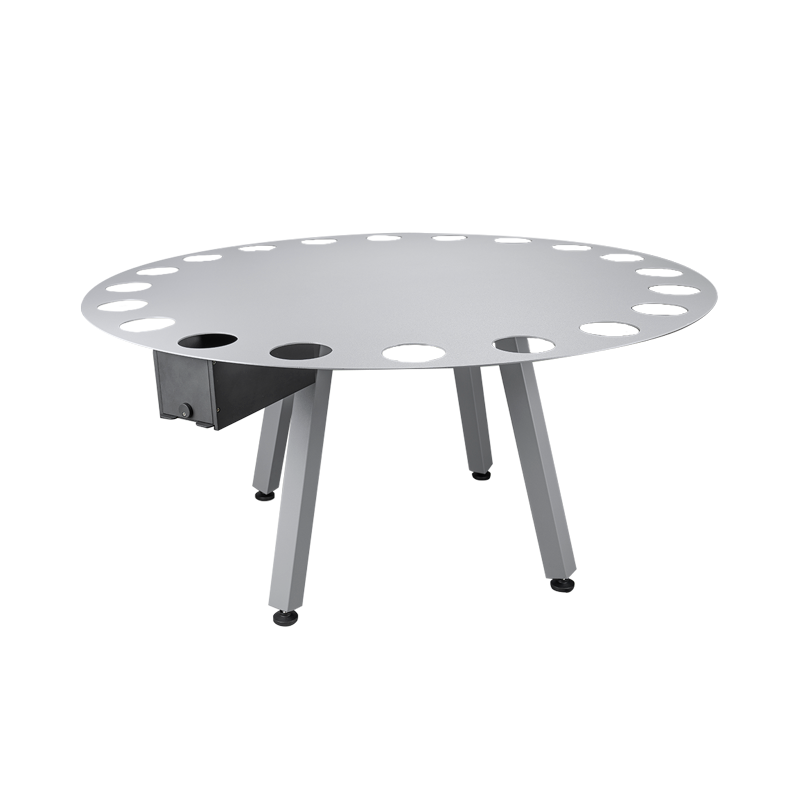
Dry, non-aversive alternative to the water maze for spatial learning and memory. 20 equally spaced holes with magnetic shelter attachment; high-contrast grey surface; rat (40192: 130 cm Ø, 20 × 10 cm holes) and mouse (40193: 100 cm Ø, 20 × 5 cm holes) versions. Randomized-hole mouse version (40196) available.
What is the Barnes Maze?
The Barnes Maze is a validated, non-aversive alternative to the Morris Water Maze for assessing hippocampal-dependent spatial learning and memory in rodents. Originally developed by Carol Barnes in 1979, it exploits the natural motivation of rodents to escape a brightly lit, open, elevated platform by locating a dark escape chamber hidden beneath one of 20 equally spaced holes around the perimeter. Unlike the Morris Water Maze, the Barnes Maze does not require swimming, eliminates hypothermia risk, and produces minimal stress, making it particularly appropriate for aged animals, weak swimmers, and studies where stress hormones are primary endpoints.
Key Features
- 20 Equally Spaced Holes: The circular platform features 20 holes around its perimeter - one leading to the dark escape shelter, the remaining 19 covered with false shelter cups. Error counting and search strategy analysis are both derived from the hole-visit sequence.
- Magnetic Shelter Attachment: The escape shelter attaches magnetically to the underside of the platform, allowing rapid repositioning between trials for counterbalancing or reversal protocols without tools.
- Removable Access Ramp: A detachable ramp provides a gentle pathway for animals to reach the platform surface at the start of each trial, reducing handling stress associated with lifting or lowering.
- Anti-Glare, High-Contrast Surface: Non-reflective treatment of the grey platform surface ensures reliable video tracking without glare artifacts, enabling automated hole-visit counting and swim path analysis.
- Three Catalog Options: Cat. 40192 (rats, 130 cm diameter, 10 cm holes), Cat. 40193 (mice, 100 cm diameter, 5 cm holes), and Cat. 40196 (mice, randomized hole spacing - reducing intramaze cue potential).
.webp)

Technical Specifications
| Catalog Numbers | 40192 (Rats), 40193 (Mice), 40196 (Mice - randomized holes) |
| Diameter - Rats | 130 cm |
| Diameter - Mice | 100 cm |
| Number of Holes | 20 per apparatus |
| Hole Diameter - Rats | 10 cm |
| Hole Diameter - Mice | 5 cm |
| Platform Height | 60 cm from floor |
| Weight - Rats | 35 kg |
| Weight - Mice | 15 kg |
| Standard Color | Grey; blue, white, black, custom available |
| Warranty | 12 months + 12 months post-registration |
Applications
- Hippocampal spatial learning and memory (non-aversive alternative to water maze)
- Aging and Alzheimer's disease models
- Stress-sensitive studies where HPA activation is a variable
- Search strategy analysis and probe trial memory
Mazes Tracking
Explore All ProductsMemory and Learning
Explore All ProductsBarnes Maze Publications
The Ugo Basile Barnes Maze is widely cited in studies of spatial learning, reference memory, and hippocampal function in rodent models of Alzheimer's disease, aging, traumatic brain injury, and cognitive pharmacology.
Why choose the Barnes Maze over the Morris Water Maze?
The Barnes Maze avoids forced swimming, eliminates hypothermia and physical exhaustion, and produces substantially less HPA axis stress hormone activation than the water maze. This makes it preferable for aged animals, physically weak genetic models, and any study where corticosterone levels are a primary variable.
What catalog numbers are available for the Barnes Maze?
Cat. 40192 is for rats (130 cm diameter, 10 cm holes), Cat. 40193 is for mice (100 cm diameter, 5 cm holes), and Cat. 40196 is for mice with randomized hole spacing, useful for studies where equal inter-hole distance might serve as an intramaze spatial cue.
What search strategies are scored in the Barnes Maze?
Three search strategies are identified: (1) spatial, direct path to the target hole area; (2) serial, systematic adjacent-hole checking from a starting point; (3) random - non-sequential hole visits with no directional pattern. Strategy progression from random to spatial across training sessions documents acquisition of a hippocampal place strategy.
How is the probe trial run in the Barnes Maze?
The escape shelter is removed and the animal is placed on the platform for 60–90 seconds of free exploration. The number of visits and time spent near the target hole (and adjacent holes) relative to other zones is measured as spatial memory retention. Chance is 1/20 holes visited; intact animals visit the target area significantly above chance.
Is the Barnes Maze validated for pharmacological studies?
Yes - MK-801 (NMDA antagonist) and scopolamine (muscarinic antagonist) both produce dose-dependent acquisition impairments in the Barnes Maze that are rescued by appropriate cognitive enhancers, confirming its pharmacological sensitivity for CNS drug screening.
Still have questions?

Request for Quote
Please fill in as much details as possible and we will take care of your request as soon as possible
Request for Quote
Please fill in as much details as possible and we will take care of your request as soon as possible