.svg)
.svg)
Active Avoidance Shuttle-Box
Two-way active avoidance system with 8-pole scrambling shocker (0–3 mA), tilting-floor detection, and flexible timeline-based protocol management. Sound stimulus 100–18,000 Hz; light 0–100%; 12-inch touch-screen controller; rat version (40532): 48×20×22 cm internal, mouse (40533): 38×9×17 cm internal.
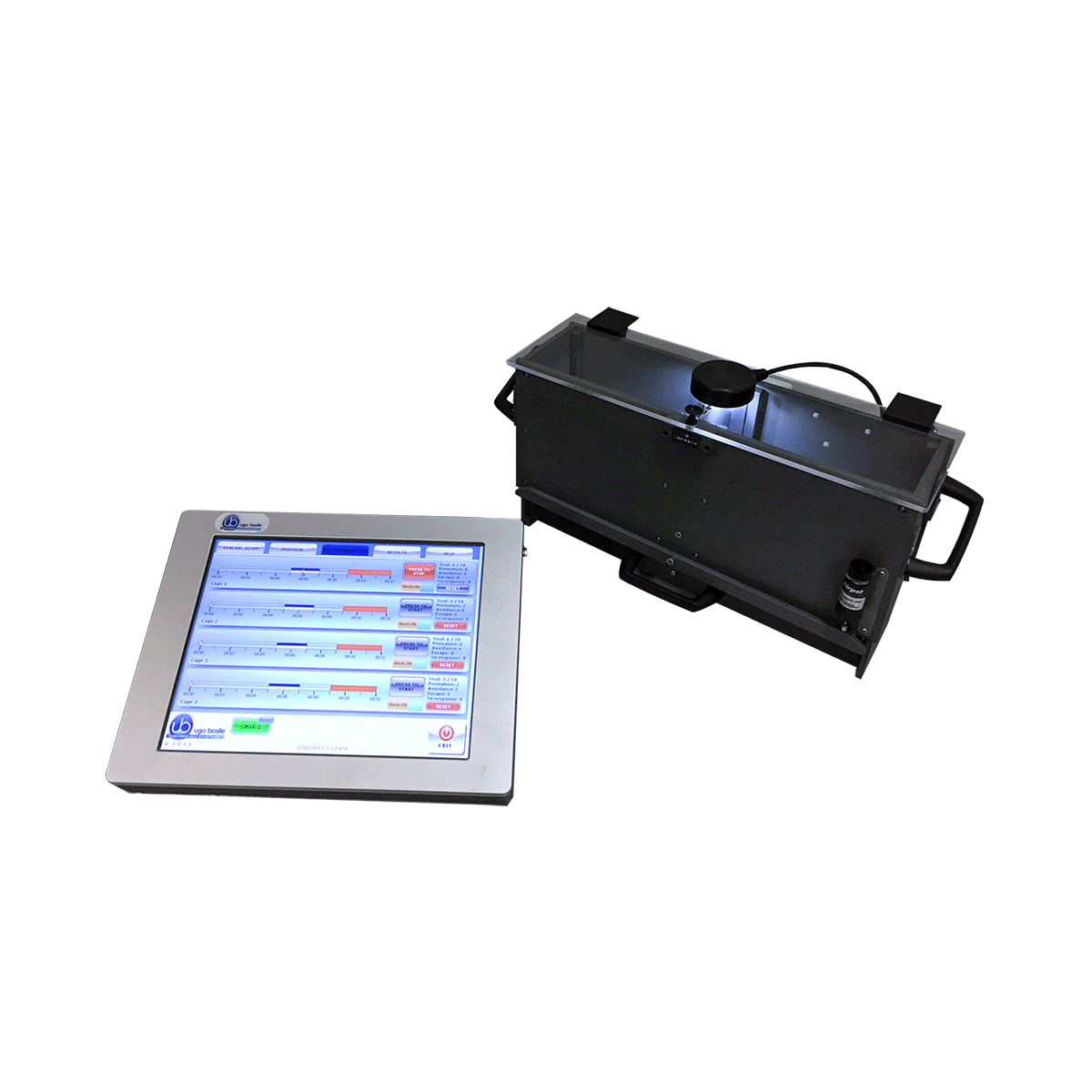
Active Avoidance Shuttle-Box
The Ugo Basile Active Avoidance Shuttle-Box (Cat. 40532 for rats, 40533 for mice) assesses associative fear learning and memory through a classic two-way active avoidance paradigm. Animals learn to escape, and eventually avoid, an aversive foot shock by shuttling to the opposite compartment in response to a predictive conditioned stimulus (light or sound).
Equipped with a constant-current 8-pole scrambling shocker, tilting-floor crossing detection, and a flexible timeline-based protocol manager, the system is driven by a 12-inch touch-screen controller supporting up to 4 simultaneous cages. High-contrast non-reflective surfaces are optimized for optional video-tracking integration.
Key Features
- Two-way shuttlebox for active avoidance learning paradigms
- Tilting-floor detection for precise crossing measurement
- Shock: 0–3 mA, constant current, 8-pole scrambling
- Sound stimulus: 100–18,000 Hz; Light: 0–100%
- Rat (40532): internal 48 × 20 × 22 cm; Mouse (40533): internal 38 × 9 × 17 cm
- 12-inch touch-screen controller for up to 4 cages
.webp)

Research Applications
The Active Avoidance Shuttle-Box is a classic and highly validated test of associative learning and memory, measuring an animal's ability to predict and actively escape or avoid aversive outcomes. It is sensitive to a wide range of compounds affecting memory, anxiety, and motor systems, and is widely used in both drug discovery and transgenic model characterization.
- Associative learning: Measuring acquisition of conditioned avoidance responses
- Memory retention: Assessing long-term retention of avoidance learning across sessions
- Antipsychotic screening: Evaluating effects of antipsychotics on conditioned avoidance response (CAR)
- Cognitive phenotyping: Characterizing learning and memory deficits in transgenic or lesion models
- Neurological drug effects: Assessing impacts of sedatives, anxiolytics, and cognitive enhancers on active avoidance

Technical Specifications
| Catalog Numbers | 40532 (rats), 40533 (mice) |
|---|---|
| Shock Intensity | 0–3 mA, constant current |
| Shocker Type | 8-pole scrambling |
| Sound Stimulus | 100–18,000 Hz in 100 Hz steps |
| Light Stimulus | 0–100% in 5% steps |
| Controller Display | 12-inch LCD resistive touch screen |
| Max Cages per Controller | Up to 4 |
| Rat Cage (internal) | 48 × 20 × 22 cm; 5.3 kg |
| Mouse Cage (internal) | 38 × 9 × 17 cm; 3.5 kg |
| Operating Temperature | 10–40°C |
Memory and Learning
Explore All ProductsActive Avoidance Shuttle-Box Publications
The Ugo Basile Active Avoidance Shuttle-Box is widely cited in behavioral neuroscience for studies on avoidance learning, fear conditioning, anxiety, PTSD models, and the effects of pharmacological or genetic manipulations on conditioned avoidance behavior in rodents.
What is the difference between active and passive avoidance?
In passive avoidance, animals learn to withhold a natural behavior to avoid a shock. In active avoidance, animals must actively shuttle to a safe location when a warning cue is presented.
What catalog numbers are available for the Shuttle-Box?
Cat. 40532 is the rat version and Cat. 40533 is the mouse version of the Active Avoidance Shuttle-Box.
How is the animal's crossing detected?
Crossing between compartments is detected by a tilting-floor mechanism, which registers the precise moment the animal's weight transfers from one compartment to the other.
What stimuli can be used as conditioned stimuli?
The system supports both light (0–100% intensity in 5% steps) and sound (100–18,000 Hz in 100 Hz steps) as conditioned stimuli for flexible protocol design.
What are the primary research applications of the Shuttle-Box?
The Shuttle-Box is used for conditioned avoidance response (CAR) studies in antipsychotic drug screening, memory and learning assessments, cognitive phenotyping in transgenic models, and evaluating effects of sedatives and cognitive enhancers.
Still have questions?
Request for Quote
Please fill in as much details as possible and we will take care of your request as soon as possible
Request for Quote
Please fill in as much details as possible and we will take care of your request as soon as possible