.svg)
Integrating Muscle NIRS & HD-EMG: Gain Advanced Muscle Insights
Portable NIRS and High-Density EMG together give you muscle fatigue, oxygenation and neural recruitment in one recording. Artinis explains where the combination pays off in sports science, rehabilitation and clinical work.
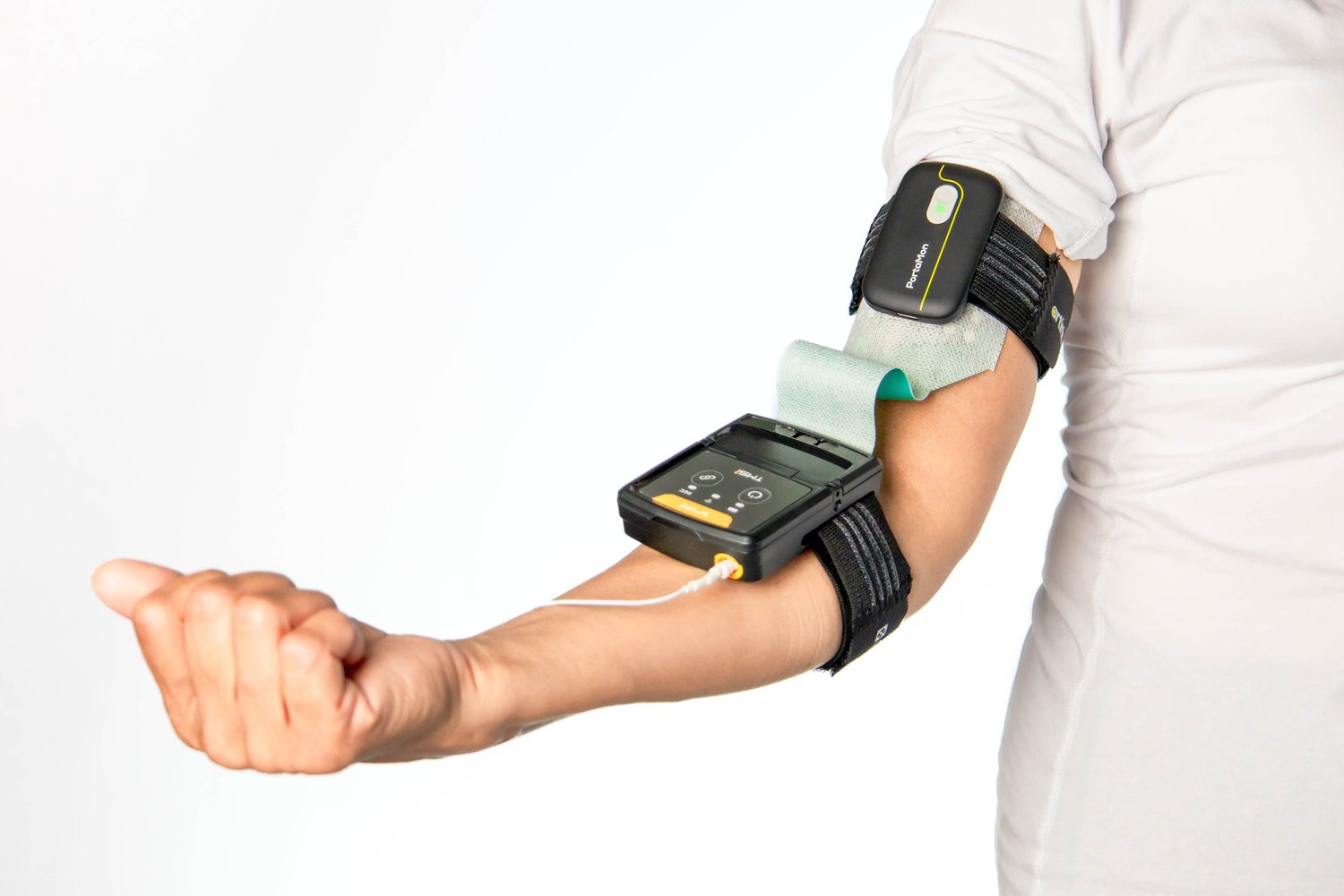
Both NIRS (Near-Infrared Spectroscopy) and HD-EMG (High-Density Electromyography) are non-invasive, portable techniques for muscle measurements. Combining these two methodologies can provide complementary information and enable enhanced insights into muscle activity and metabolism in many applications.
What is Near-Infrared Spectroscopy (NIRS)?
NIRS measures relative concentration changes in oxygenated and deoxygenated hemoglobin in local muscle tissue using Near-Infrared Light. This gives information on local oxygenation and metabolism of any muscle. Most NIRS devices, such as the Artinis PortaMon MKIII, are completely portable, lightweight, and easy to use, enabling measurements in sports sciences, exercise performance, clinical and rehabilitation studies, and hypoxia research.
What is High-Density Electromyography (HD-EMG)?
HD-EMG measures spatial and temporal patterns of muscle activity using EMG signals recorded on the skin surface from at least four electrodes with close inter-electrode distances. Compared to bipolar EMG, HD-EMG provides higher spatial resolution, enabling advanced signal processing such as decomposition and spatial filtering, and allowing precise mapping of motor units and localization of muscle activation.
Why Combine NIRS and HD-EMG?
Combining muscle NIRS and HD-EMG gives a complete picture of the functional, neuromuscular, and metabolic state of a muscle. Both techniques are portable, lightweight, and enable real-time feedback in dynamic studies.
- Fatigue mechanisms: HD-EMG detects changes in motor unit recruitment and firing rates, while NIRS detects oxygen desaturation and recovery dynamics - together providing a comprehensive view of neural and metabolic fatigue.
- Spatial mapping: Combining activation patterns from HD-EMG with local oxygenation from NIRS yields a full spatial picture of muscle activation and metabolic response.
- Training and rehabilitation: Simultaneously monitoring changes in muscle activity and oxygen utilization helps identify whether performance is limited by neural drive or oxygen delivery, and whether improvements over time come from better oxygen support or more efficient recruitment strategies.
Artinis offers integrated NIRS–HD-EMG combinations, such as PortaMon MKIII and SPIRE, making it easy to combine both technologies within a single measurement setup.
Source: Artinis blog.

Shall we chat about this topic?
Contact usRecent Blog Posts

.svg)
Advance Your Research
Contact NBT today for expert consultation on your neuroscience instrumentation needs.