.svg)
Research Spotlight: AMTI Instrumented Treadmill at the Ariel Fischer Lab, Technion
A closer look at how the Ariel Fischer Lab at the Technion – Israel Institute of Technology is using the AMTI Instrumented Treadmill for high-precision gait analysis and biomechanical research.
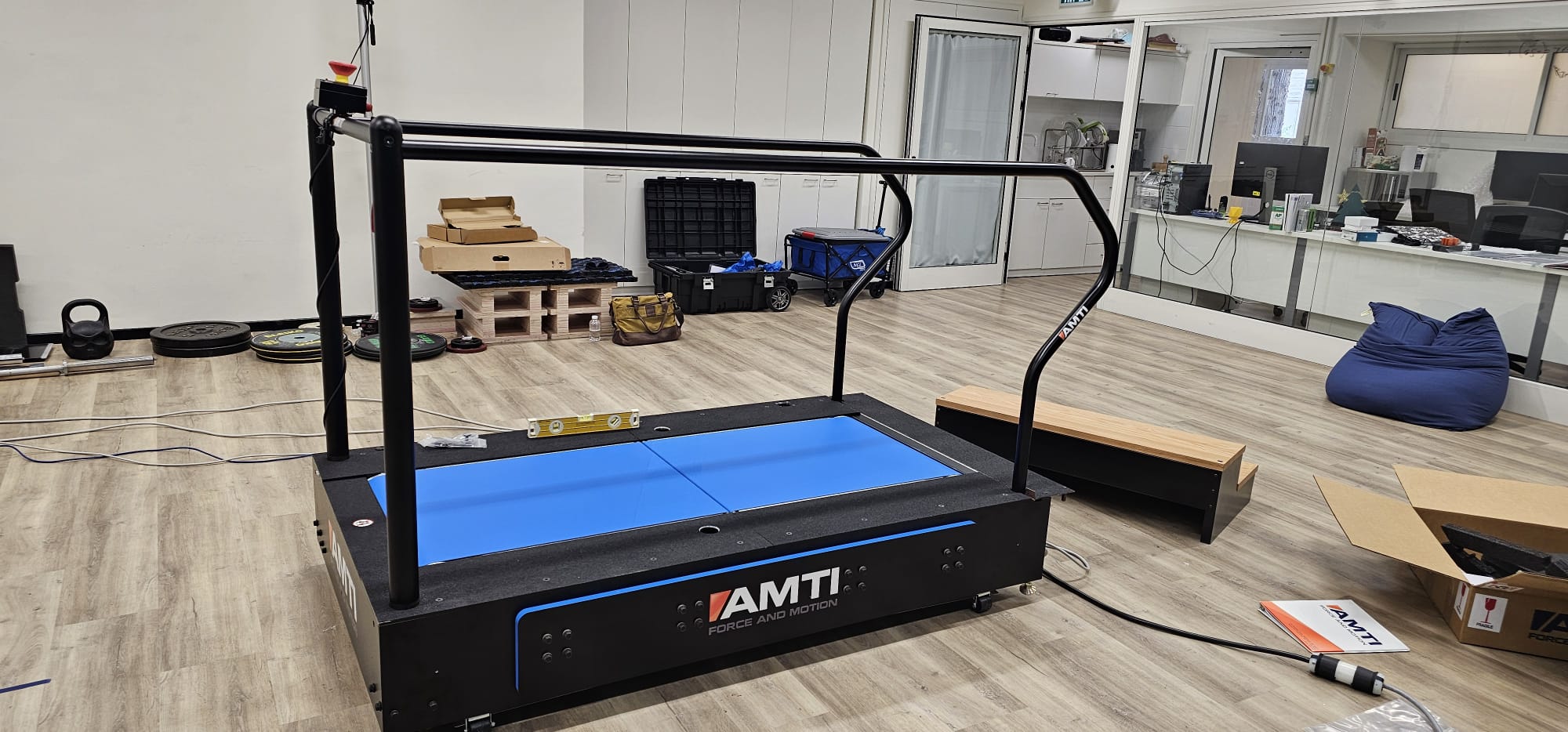
Where Precision Engineering Meets Gait Science
At the Ariel Fischer Lab at the Technion – Israel Institute of Technology, understanding how the human body moves, and why movement goes wrong, demands instrumentation that can keep pace with the complexity of the questions being asked. That's why the lab has integrated the AMTI Instrumented Treadmill into their biomechanics workflow, enabling simultaneous, high-resolution force and kinematic data collection during walking and running.
The AMTI Instrumented Treadmill
AMTI's split-belt instrumented treadmill is a research-grade platform designed specifically for gait analysis, rehabilitation research, and biomechanical assessment. Unlike conventional treadmills, it integrates two independent force plates, one per belt, so researchers can measure the ground reaction forces (GRFs) beneath each foot independently, with every step.
Each force plate measures all six components of ground reaction force and moment: three forces (Fx, Fy, Fz) and three moments (Mx, My, Mz). This enables detailed analysis of propulsion, braking, and medio-lateral forces. Gait symmetry, balance control, and locomotor adaptations all rest on those measurements. The system supports belt speeds from 0 to over 4 m/s, can be configured with incline, and integrates seamlessly with motion capture and EMG systems via analog outputs and hardware sync.
A standout feature of the AMTI treadmill platform is its rigid, low-profile construction, which minimizes mechanical noise and cross-talk between the two belts. Each force measurement therefore reflects the activity of a single limb, even during dynamic tasks at high speeds.
The Ariel Fischer Lab: Decoding Human Movement at the Technion
The Fischer BioMotion Lab at the Technion's Faculty of Biomedical Engineering focuses on the biomechanics of human locomotion, musculoskeletal health, and wearable biomedical devices. Led by Dr. Arielle Fischer, the lab pairs computational modeling with state-of-the-art instrumentation: MRI-based joint mapping, gait analysis, and inertial measurement systems. The questions it addresses are both fundamental and clinical, about how people walk, run, and recover from injury.
A particular focus of the lab is translational orthopedics: understanding soft tissue injuries and joint pathologies such as osteoarthritis in soldiers and young athletes, and developing sensor technologies and wearable devices to improve joint rehabilitation and prevent long-term damage. Dr. Fischer is also a member of the Israel Olympic Research Committee, applying biomechanical analysis to support elite athletic performance.
The AMTI instrumented treadmill is central to this mission. It enables continuous, steady-state gait analysis under controlled and perturbed conditions, and it does that without the spatial constraints of a fixed force plate walkway. This makes it ideal for long-duration protocols, bilateral asymmetry studies, and perturbation-based balance training experiments that require many consecutive strides of high-quality force data.
.jpeg)
Supporting Israeli Biomechanics Research
The installation of the AMTI treadmill at one of Israel's leading biomedical engineering faculties reflects the growing demand for precision instrumentation in human movement research. Experimental protocols keep getting more ambitious, spanning split-belt adaptation, fatigue analysis, and real-time biofeedback paradigms, and the tools have to rise to meet them. NBT is proud to support this work at the Technion and looks forward to following the science that emerges from the Fischer BioMotion Lab.

NEED MORE INFORMATION ABOUT THIS PRODUCT?
Send us your emailRecent Blog Posts

.svg)
Advance Your Research
Contact NBT today for expert consultation on your neuroscience instrumentation needs.