.svg)
.svg)
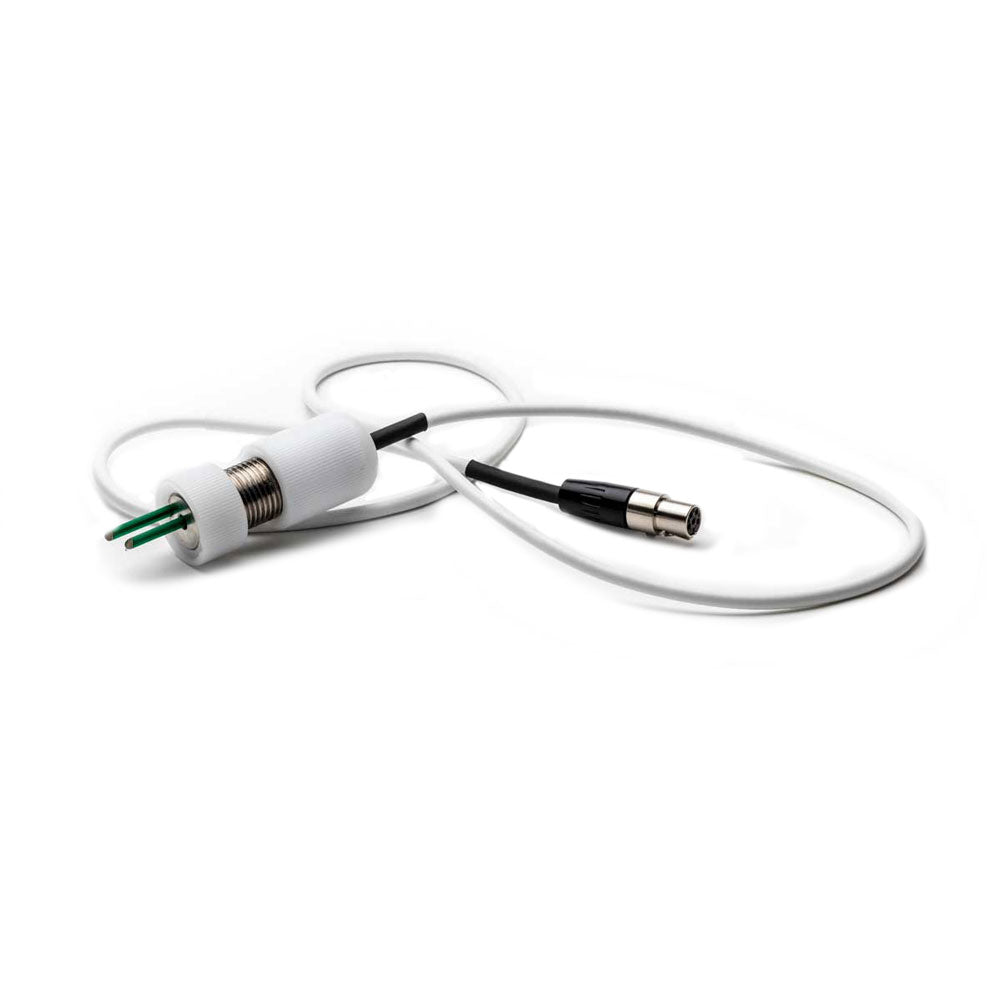
STX4 EVOM™ Electrode for TEER in 6.5 mm Inserts
WPI's newest hands-free chopstick electrode for TEER and transepithelial potential measurement on 6.5 mm hanging transwells. Replaceable blades, no chloriding required, and a fixed-geometry design that delivers reliable single-shot readings on EVOM™ Manual / EVOM3 (and on EVOM2 / Millicell® ERS-2 via the EVM-AC-02-01-01 adapter).
What is the STX4 EVOM™ Electrode?
The STX4 is World Precision Instruments' newest-generation chopstick-style electrode for measuring transepithelial electrical resistance (TEER) and transepithelial potential (PD) of cellular layers grown on permeable membrane inserts. Designed for 6.5 mm inserts in 12- and 24-well plates, it connects directly to the EVOM™ Manual and EVOM3, and works with the EVOM2 or Millicell® ERS-2 via the EVM-AC-02-01-01 adapter cable.
Unlike older STX2 / STX2-PLUS electrodes, the STX4 hangs vertically inside the well for true hands-free operation, drastically reducing the positional variability that has historically limited TEER reproducibility. The specially coated sensing tip eliminates the chloriding maintenance step entirely, and replaceable blade assemblies extend the functional life of the electrode by years rather than months.
Key Features
- Replaceable electrode blades: Swap out aged blades instead of replacing the entire electrode - lower long-term cost of ownership.
- No chloriding required: The proprietary tip coating delivers stable readings without the routine bleach / sodium hypochlorite maintenance that previous models demanded.
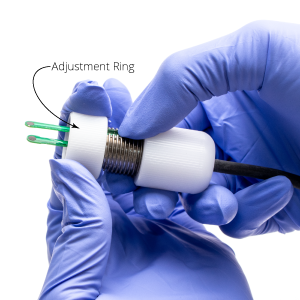
- Hands-free operation: The electrode body sits on top of 24-well hanging transwells (e.g. Corning 3470), with an adjustment ring locking the blades at the correct depth.
- Greater measurement precision: Fixed blade geometry removes the operator-induced tilt and spacing variability that plagues handheld STX2 / STX3 designs - single-shot readings replace averaged multi-reads.
- Lower liquid volume requirements: The shorter, coated sensing region keeps tips immersed at just 150 µL apical / 500 µL basolateral on Corning 3470 transwells, saving media and reagents.
- RFI-shielded cable and body: Shielded construction eliminates cell-phone and electrical interference, keeping read-outs stable.
- Backwards compatible: Works with EVOM™ Manual and EVOM3 directly; uses with EVOM2 / Millicell ERS-2 / ERS via the EVM-AC-02-01-01 adapter cable (sold separately).
.webp)

STX4 vs. STX2-PLUS - Why Researchers Are Upgrading
The STX4 is a direct upgrade path from the STX2-PLUS, designed to remove three pain points researchers have lived with for years: chloriding maintenance, throwaway-electrode economics, and operator-introduced variability.
What Changes With STX4
- Save resources: Up to ~50% less apical and basolateral media volume needed per measurement compared to STX2-PLUS.
- Save time: No chloriding routine. The coated sensing region is unaffected by chloriding and never requires the 10-minute hypochlorite immersion that the STX2-PLUS demanded for daily use.
- Cost-effective long term: When blades age, replace just the blades - not the whole electrode. The body, cable, and electronics stay in service.
- Cleaner data: The fixed-geometry design removes electrode-tilt variability, making single-shot measurements reliable and dramatically reducing within-sample variance.
Compatibility At a Glance
| Direct connection | EVOM™ Manual, EVOM3 |
| Via EVM-AC-02-01-01 adapter | EVOM2, EVOM, Millicell® ERS-2, ERS |
| Insert format | 6.5 mm hanging transwells in 12- and 24-well plates (e.g. Corning 3470) |
| Replacement blade kit | EVM-AC-03-01-01 (Electrode Blades for STX4, 3 sets) |
Notes on Tip Cosmetics
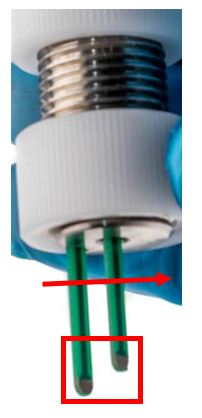
STX4 sensing tips will darken over time, and the outer face of each blade typically darkens more than the inner face - this is normal and a consequence of how the EVOM applies current vs. measures voltage across the two blades. Cosmetic darkening does not affect electrode function or measurement accuracy. WPI individually conditions every blade and verifies functionality before shipping.

Technical Specifications
| Catalog Number | EVM-EL-03-03-01 |
| Electrode Type | Dual-blade chopstick electrode for TEER & PD measurement |
| Insert Compatibility | 6.5 mm hanging transwell inserts (12-well and 24-well plates) |
| Reference Insert | Corning 3470 24-well hanging transwell |
| Minimum Apical Volume | 150 µL (Corning 3470) |
| Minimum Basolateral Volume | 500 µL (Corning 3470) |
| Tip Coating | Specially coated - no chloriding required |
| Replaceable Blades | Yes. Replacement blade kit EVM-AC-03-01-01 (3 sets) |
| Hands-Free Operation | Yes. Adjustment ring rests on top of well |
| Cable | Shielded against RF / electrical interference |
| Direct Connection | EVOM™ Manual, EVOM3 |
| Adapter-Based Connection | EVOM2 / EVOM / Millicell ERS-2 / ERS via EVM-AC-02-01-01 adapter (sold separately) |
Applications
- TEER measurement of epithelial and endothelial barrier integrity (gut, lung, skin, blood-brain barrier models)
- Caco-2 and other intestinal epithelium permeability studies
- In vitro tight-junction assembly and disruption assays
- Drug permeability and absorption screening on transwell-cultured cells
- Toxicology screening of compounds affecting cell-layer integrity
- Co-culture barrier models for inflammation, infection, and disease research

Cell Cultivation and Imaging
Explore All ProductsElectro-Physiology
Explore All ProductsSTX4 EVOM Electrode Publications
Browse published studies that have used the WPI STX4 EVOM electrode for TEER and transepithelial potential measurements on epithelial and endothelial barrier models grown on permeable membrane inserts.
Which inserts and transwells are compatible with the STX4 electrode?
The STX4 works ideally with commonly used 24-well hanging inserts (Corning, Millipore, Greiner). It also works with most other 24-well and 12-well inserts - for 12-well inserts the electrode needs to be supported by hand during measurement. The full compatible plate/insert list lives in the downloadable Plate Compatibility Chart and in Appendix B of the STX4 instruction manual.
Are electrical resistance and TEER the same thing?
No. TEER (transepithelial electrical resistance) is the measured resistance multiplied by the membrane surface area. Example: a 6.5 mm 24-well insert measuring 565 Ω has a TEER of 565 Ω × 0.33 cm² = 186.45 Ω·cm². (Use 0.33 cm² for 24-well 6.5 mm inserts and 1.13 cm² for 12-well 12 mm inserts - always confirm the exact area from the insert manufacturer's spec sheet.)
Why am I getting dashes or unstable readings even though the STX4 is inside the sample?
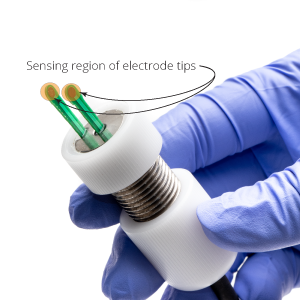
Dashes and instability almost always mean the sensing region of the electrode tips isn't fully immersed in conductive liquid. Check that both apical and basolateral volumes are sufficient to keep both blade tips submerged, and rotate the length adjustment ring clockwise to lower the blades deeper into the well so the sensing region stays fully immersed.
Does the electrode need to be cleaned daily?
Yes. Clean the electrode after every day of use, let it air dry, and store it dry. Daily cleaning is critical for the functional longevity of the electrode blades. Refer to the MAINTENANCE section in the STX4 instruction manual for the recommended cleaning protocol.
The STX4 blade tips have darkened, and the outer side looks darker than the inner side - is this a problem?
No. Tip darkening over time is cosmetic and does not affect electrode performance. The outer face typically darkens more than the inner face because the outer electrodes apply current while the inner electrodes detect voltage, so current passes through the outer side. WPI conditions and verifies every blade individually before shipping, so a difference in tip color between inner and outer sides is normal.
Still have questions?
Request for Quote
Please fill in as much details as possible and we will take care of your request as soon as possible
Request for Quote
Please fill in as much details as possible and we will take care of your request as soon as possible