.svg)
.svg)
RFLSI-ZW Laser Speckle Contrast Imaging System
Flagship laser speckle contrast imaging system for non-invasive, real-time visualization and quantification of blood perfusion in any exposed tissue. Built around a CMOS global shutter camera with 10× motorised zoom, the RFLSI-ZW delivers up to 100 fps full-field acquisition and 3.9 μm/pixel resolution - powering cerebral blood flow, MCAO, hindlimb ischemia, and dermatological microcirculation research at over 200 institutions worldwide.

What is the RFLSI-ZW Laser Speckle Contrast Imaging System?
The RFLSI-ZW (also marketed as LSCI-ZW) is RWD Life Science's flagship blood perfusion imager based on Laser Speckle Contrast Imaging (LSCI) technology. It enables researchers to non-invasively visualize and quantify blood perfusion across any exposed tissue or organ, from cerebral cortex to skin to hindlimb, in real time, without contrast agents or contact with the sample.
Built on an advanced optical design with an improved image processing algorithm, the RFLSI-ZW delivers larger imaging field, higher full-field frame rates, finer optical resolution, and sharper image quality than its predecessors. Since 2019, the system has been adopted by more than 200 research institutions worldwide - including Stanford University School of Medicine, Yale University, Duke University, University College London, and Korea University, and has contributed to more than 200 publications in journals such as Nature Neuroscience, Nature Communications, Brain, Blood, Circulation Research, and Diabetes.
Key Features
- High-Resolution HD Imaging: Built-in CMOS global shutter camera captures 2064 × 1544 high-resolution images with optimal optical resolution of 3.9 μm/pixel, revealing fine vascular structures and vessel endings.
- Large Field of View with 10× Optical Zoom: Motorised 10× optical zoom and autofocus deliver image sizes from 0.57 × 0.75 cm up to 22.5 × 30 cm in a single all-in-one imager, covering applications from microvasculature to full-body perfusion.
- Full-Field Frame Rate up to 100 fps: High-speed acquisition captures rapid hemodynamic changes such as MCAO occlusion, cortical spreading depression, and reactive hyperemia.
- Non-Contact, No Contrast Agent Required: LSCI requires no dye, tracer, or physical contact, eliminating perturbation of the tissue under study and enabling chronic, repeated measurements.
- Class 1 Laser Safety: Both measurement and indicating lasers are Class 1 per IEC 60825-1:2014 - safe to operate without eye protection equipment.
- Stable Laser Output for Reliable Data: Laser stabilization hardware ensures consistent measurement over minutes, hours, or days, with self-calibration available at any time via the supplied calibration box.
- Quantified Multi-Output: Generates perfusion images and videos plus quantitative data for perfusion units, vessel diameter, vessel angle, and ROI-based blood flow graphs, with offline state analysis available.
- Flexible Integration: Trigger In/Out BNC connections allow synchronization with external stimulators, electrophysiology rigs, or behavioral systems. Software can be installed on unlimited analysis PCs.
.webp)

Technical Specifications
| Model | RFLSI-ZW / LSCI-ZW |
| Technology | Laser Speckle Contrast Imaging (LSCI) |
| Camera | CMOS global shutter, 2064 × 1544 resolution |
| Max Frame Rate (Full Field) | Up to 100 fps |
| Optical Resolution | Up to 3.9 μm/pixel |
| Imaging Field Size | 0.57 × 0.75 cm to 22.5 × 30 cm |
| Optical Zoom | Motorised 10× with autofocus and fine manual focus |
| Wavelength | 785 nm (typical LSCI) |
| Laser Safety Class | Class 1 per IEC 60825-1:2014 (no eye protection required) |
| Data Interface | USB 3.0 |
| External Synchronization | Trigger In/Out BNC connectors |
| Calibration | Self-calibration with supplied calibration box |
| Software Licensing | Unlimited PC installations for analysis |
| Output Data | Blood perfusion images and videos, perfusion units, vessel diameter, vessel angle, ROI-based blood flow graphs, offline analysis |
Applications
- Cerebral blood perfusion monitoring
- MCAO (middle cerebral artery occlusion) stroke model assessment
- Cortical spreading depression observation
- Hindlimb ischemia research
- Skin burn and skin flap transplantation studies
- Organ microcirculation observation (mesentery, kidney, liver)
- Skin allergies and dermatological research
- Septic shock and sepsis models
- Chicken chorioallantoic membrane (CAM) assay
- Diabetic foot and peripheral neuropathy research
- Photothrombotic stroke models
- Wound healing and angiogenesis


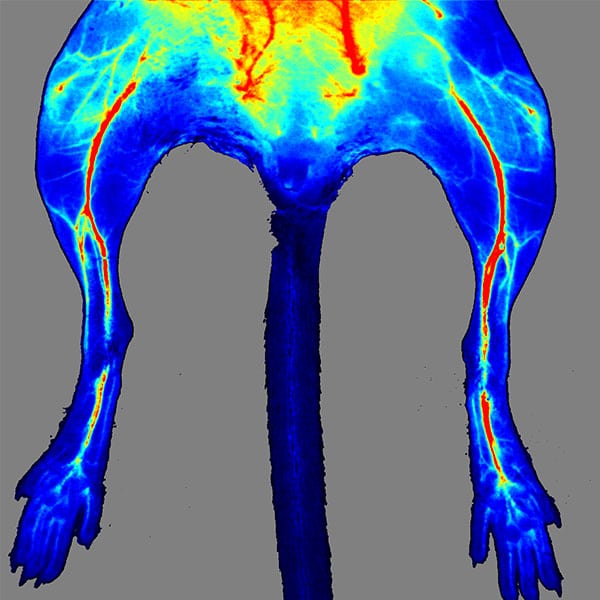


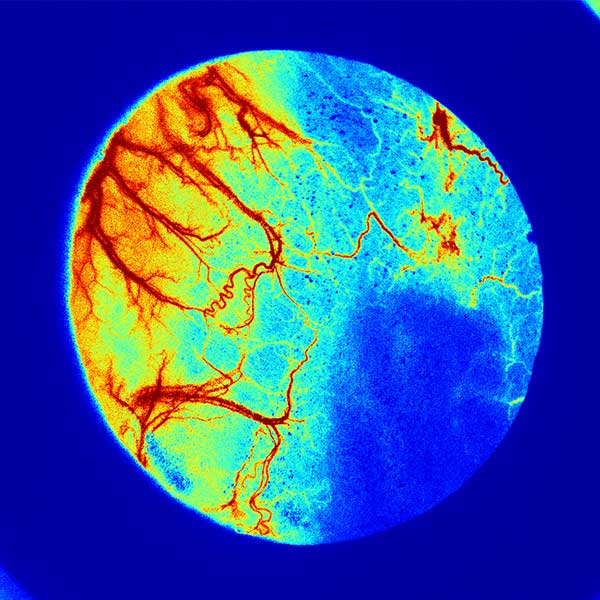
In Vivo Recording
Explore All ProductsDermatology
Explore All ProductsRFLSI-ZW Laser Speckle Imaging Publications
The RFLSI-ZW Laser Speckle Contrast Imaging System has been cited in more than 200 peer-reviewed publications across stroke, cerebrovascular biology, diabetes, dermatology, and wound healing research. Papers using LSCI for cerebral blood flow, MCAO models, and microcirculation appear in Nature Communications, Nature Neuroscience, Circulation Research, Brain, and Diabetes.
What is laser speckle contrast imaging (LSCI), and how is it different from laser Doppler?
LSCI captures the entire field of view in a single shot by analyzing the speckle pattern produced when coherent laser light scatters off moving red blood cells. Laser Doppler measures point-by-point and must be scanned to build a 2D map, so LSCI is significantly faster for full-field, real-time imaging of vascular dynamics across regions like the rodent cortex.
Is the RFLSI-ZW suitable for both mice and rats, or only one species?
Both, and more. The motorised 10× zoom delivers imaging field sizes from 0.57 × 0.75 cm (small mouse cortical window) up to 22.5 × 30 cm (full-body or large-animal exposure), supporting cerebral imaging in mice, hindlimb ischemia in rats, dermatology in larger animals, and CAM assay imaging - without changing optics.
Do I need to inject a contrast agent or dye?
No. LSCI is entirely non-contact and contrast-free - it measures the intrinsic motion of red blood cells. This makes it especially well-suited to chronic and repeated-measurement protocols where injecting tracers would confound longitudinal data.
Is the laser safe to use without eye protection?
Yes. Both the measurement and indicating lasers are Class 1 per IEC 60825-1:2014, meaning they are eye-safe under normal operating conditions and do not require protective equipment for the user.
How does the RFLSI-ZW compare to the older RFLSI III?
The RFLSI-ZW replaces the discontinued RFLSI III with an upgraded CMOS global shutter camera (2064 × 1544), a larger maximum field of view (up to 22.5 × 30 cm vs. 9 × 9 cm), better optical resolution (3.9 μm/pixel), and improved image processing algorithms. RWD no longer ships the III.
Still have questions?
Request for Quote
Please fill in as much details as possible and we will take care of your request as soon as possible
Request for Quote
Please fill in as much details as possible and we will take care of your request as soon as possible