.svg)
.svg)
Passive Avoidance Step Down
Classic step-down memory test for mice with a precision 8-pole constant-current shocker and silent automated sliding door. Manages up to 4 cages via a 12-inch touch-screen controller with tilting-floor detection for reliable crossing measurement.
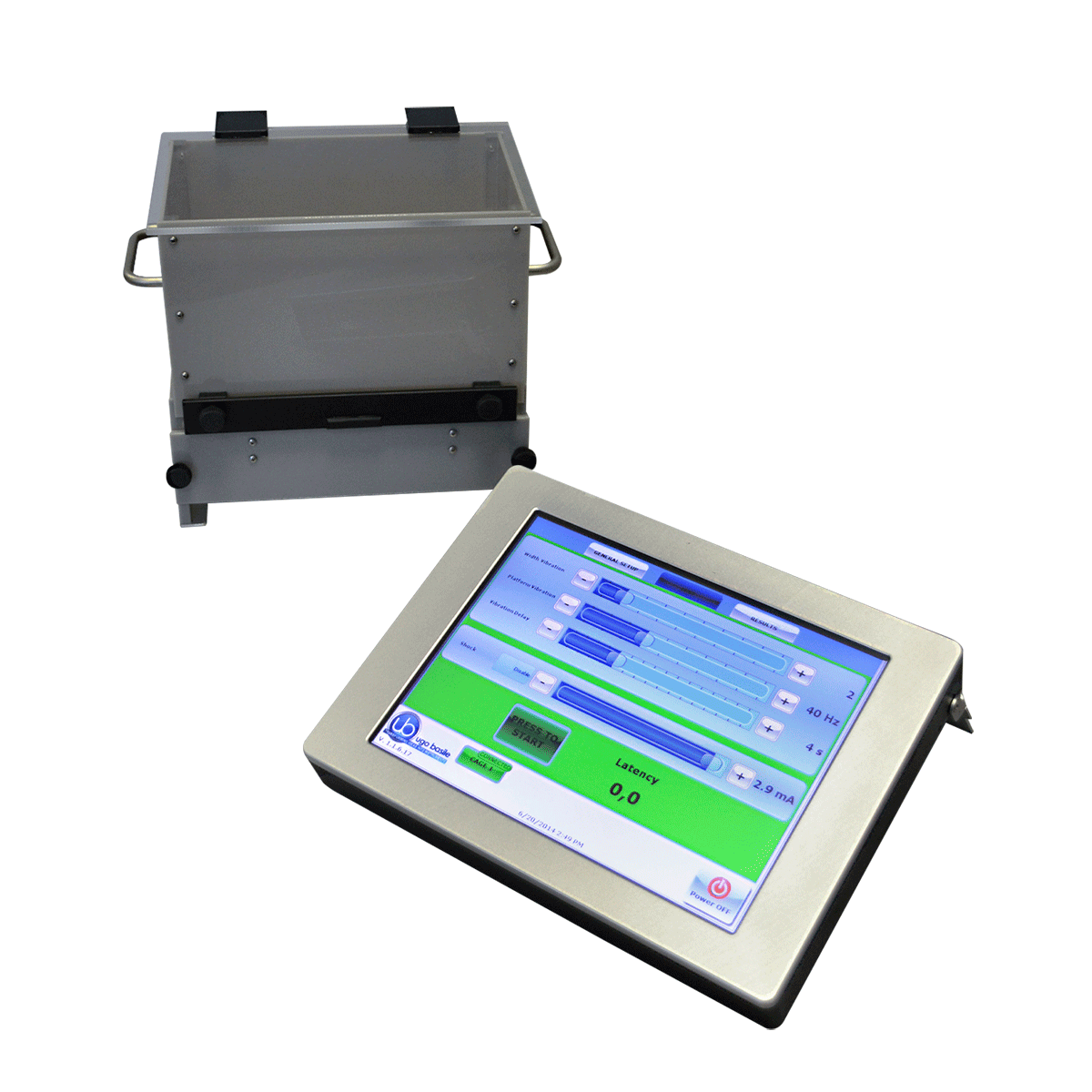
Passive Avoidance - Step Down
The Ugo Basile Passive Avoidance Step Down apparatus (Cat. 47573) is a classic test for short- and long-term memory in mice using a fear-motivated avoidance paradigm. Animals placed on an elevated platform learn to avoid stepping down onto a floor that delivers a mild foot shock - retention latency serves as the memory index.
The system features an automated silent sliding door, a precision 8-pole constant-current shocker, and a tilting-floor detection mechanism. The 12-inch touch-screen controller manages up to 4 cages and integrates with the optional Beehive expansion system.
Key Features
- Classic step-down memory test for mice
- Silent automated sliding door
- Precision 8-pole constant-current shocker
- Tilting-floor detection mechanism
- 12-inch touch-screen controller for up to 4 cages
- Expandable via optional Beehive expansion box
.webp)

Research Applications
Passive Avoidance Step Down is a time-honoured memory assessment tool particularly well-suited to mice. Its compact format and high sensitivity to classical amnestic agents make it valuable for both drug screening and cognitive phenotyping studies.
- Short- and long-term memory: Assessing memory retention at 1 h, 24 h, and 72 h post-training
- Cognitive phenotyping: Characterizing memory function in transgenic and knockout mouse models
- Amnestic drug testing: Evaluating scopolamine-, ethanol-, or benzodiazepine-induced memory impairment
- Cognitive enhancers: Screening for compounds that improve or protect fear-motivated memory
- Aging research: Monitoring age-related memory decline in longitudinal rodent studies

Memory and Learning
Explore All ProductsPassive Avoidance Step Down Publications
The Step-Down Passive Avoidance apparatus is cited in learning and memory research as a one-trial associative learning task used to assess retention, amnesia, and pharmacological effects on memory consolidation in rodents.
How does the Passive Avoidance Step Down test work?
Mice placed on an elevated platform learn to avoid stepping down onto a floor that delivers a mild foot shock. On the retention trial, the latency to step down is measured as an index of memory.
What catalog number is the Step Down apparatus?
The Passive Avoidance Step Down for mice is catalog number 47573.
Is the Step Down designed specifically for mice?
Yes. The Step Down apparatus is optimized for mice, using a vibrating platform design and a compact chamber suited to mouse-scale behavior.
What type of shocker does the system use?
The system incorporates a precision 8-pole constant-current shocker, ensuring consistent, species-appropriate shock delivery with minimal variability.
What cognitive endpoints can be assessed?
The Step Down measures initial step-down latency (baseline behavior), acquisition (shock-induced avoidance), and both short-term (1 h) and long-term (24–72 h) memory retention.
Still have questions?

Request for Quote
Please fill in as much details as possible and we will take care of your request as soon as possible
Request for Quote
Please fill in as much details as possible and we will take care of your request as soon as possible