

LMD – Lesion Making Device
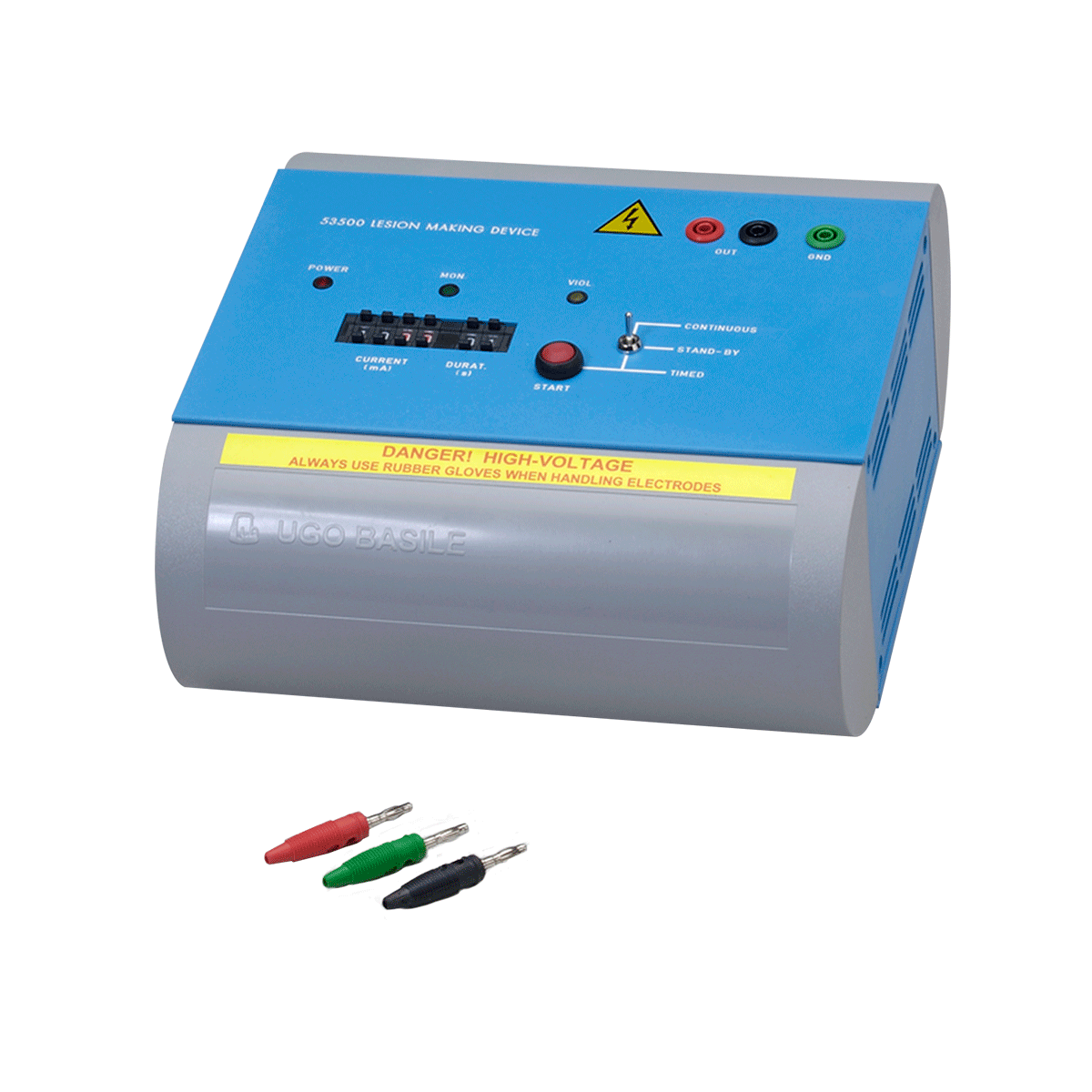
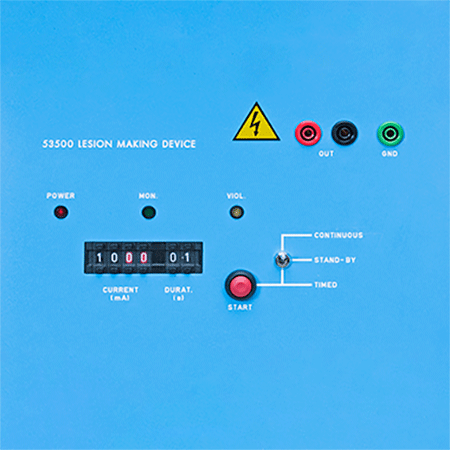
A compact DC lesion maker for electrolytic lesions in the mouse and rat brain. Isolated, regulated output from 10 µA to 99 mA for 1 to 99 s, with a violation LED when the electrode resistance is too high for the set current.
What is the Lesion Making Device?
A compact DC lesion maker for localized electrolytic lesions in the mouse and rat brain. The output is isolated and regulated, adjustable from 10 µA to 99 mA, for 1 to 99 s.
Ugo Basile uses direct current, which it prefers over radio frequency for small animals. Placement comes from the stereotaxic frame, so the LMD sits next to one.
Key Features
- Current 10 µA to 99 mA DC
- Duration 1 to 99 s
- Continuous, Timed and Stand-by modes
- Operator-selectable preset patterns
- Short-circuit protected current generator
- Violation LED when compliance limits are exceeded
- 27 × 25 × 13 cm, 1.4 kg
Electrolytic or excitotoxic?
An electrolytic lesion destroys everything at the electrode tip, cell bodies and fibres of passage alike. When the question is about the neurons in a region and not the axons running through it, an excitotoxic lesion by infusion is the cleaner tool.
Any lesion also brings secondary changes: degeneration, sprouting, neurochemical shifts, vascular effects. They belong in the interpretation of the behavioural result.
Which structure is being lesioned, and does it carry fibres of passage?


Technical Specifications
| Catalog Number | 53500 |
| Species | Mouse, rat |
| Current Range | 10 µA to 99 mA DC |
| Output Voltage | 200 V DC ±20 V |
| Max Electrode Resistance | 20 MΩ at 10 µA, down to 2 kΩ at 100 mA |
| Modes | Continuous, Timed |
| Duration | 1 to 99 s |
| Indicators | Power (red), current (green), violation (yellow) |
| Power | 115 or 230 V, 50/60 Hz, 25 W max |
| Operating Temperature | 10 to 40 °C |
| Sound Level | Max 45 dB |
| Dimensions | 27 × 25 × 13 cm |
| Weight | 1.4 kg (3.7 kg shipping) |
| Packing | 45 × 34 × 26 cm |
| Warranty | 12 months, plus 12 months on product registration |
Part Numbers
| 53500 | Lesion Making Device, complete with standard accessories |
| 53500-310 | Set of 3 output plugs |
| E-AU 041 | USB pen drive with instruction manual |
| 53500-325 | Option: 2 FHC stainless steel microelectrodes, banana plugs, 1 m cable |
| UE(KK1) | Option: FHC stainless steel microelectrode, no wires |
Applications
- Electrolytic lesions of subcortical structures
- Lesion studies in memory and learning
- Motor function and Parkinson's models
- Anxiety, fear and stress circuits

Stereotaxic Surgery
Explore All ProductsLesion Making Device Research Publications
Published lesion studies using the Ugo Basile 53500 DC lesion maker for electrolytic lesions in the mouse and rat brain.
DC or RF lesions?
The LMD is DC. Ugo Basile prefers direct current over radio frequency for small animals. A lab with an RF protocol already validated should keep that protocol.
Which electrodes does it take?
Standard output plugs are included. Optional FHC stainless steel microelectrodes are offered with banana plugs and a 1 m cable, or without wires.
How is lesion size controlled?
Through current and duration: 10 µA to 99 mA, 1 to 99 s, in Continuous or Timed mode. The lesion a given setting produces depends on the electrode and the tissue, so a pilot with histology comes before the study.
When is an electrolytic lesion the wrong tool?
When fibres of passage run through the target. An electrolytic lesion destroys them along with the cell bodies. An excitotoxic lesion by infusion spares the axons.
Is it available in Israel with local support?
Yes. NBT distributes Ugo Basile in Israel. Installation, training and service are local.
Still have questions?
Request for Quote
Please fill in as much details as possible and we will take care of your request as soon as possible
Request for Quote
Please fill in as much details as possible and we will take care of your request as soon as possible