.svg)
.svg)
76316 LED Fiber Optic Illuminator
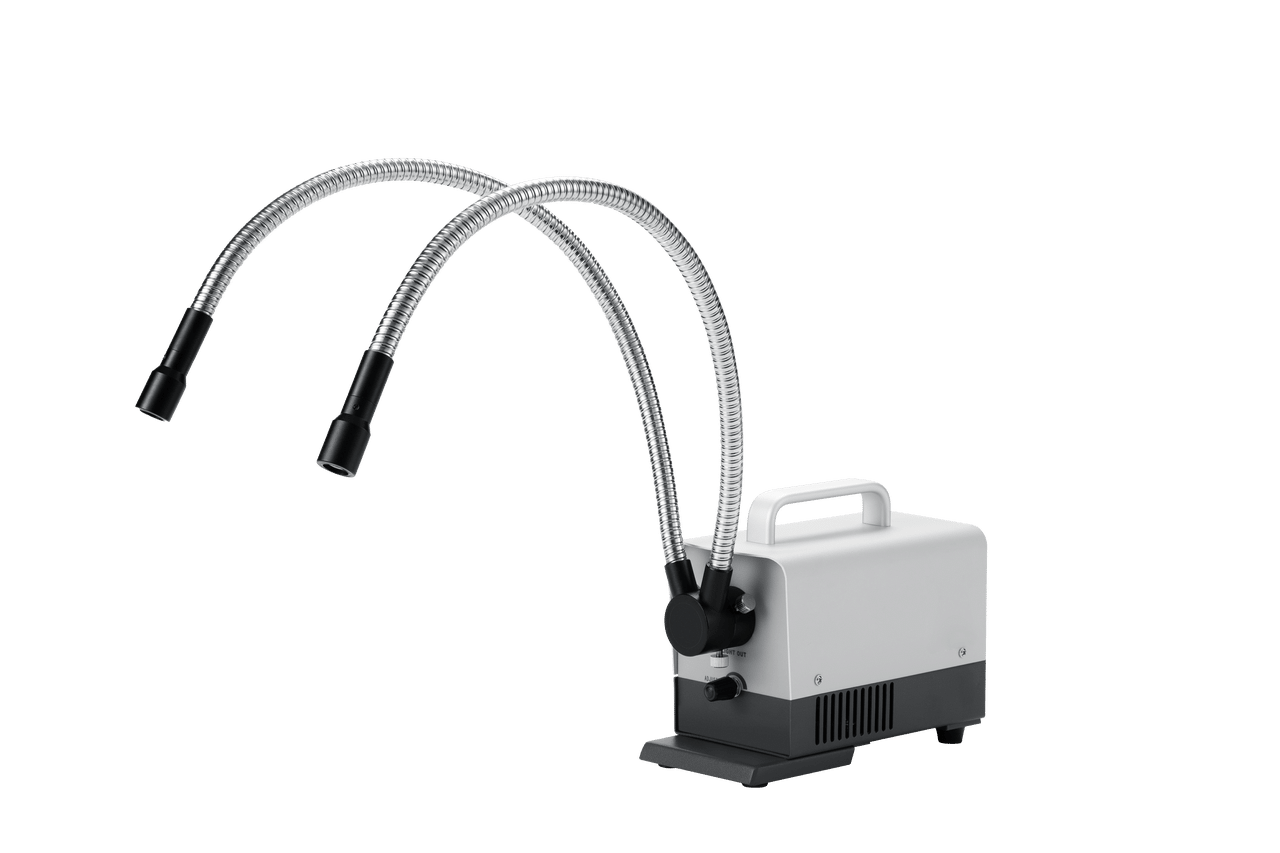
A 20 W LED cold light source that delivers shadow-free illumination through fiber optic guides, keeping heat and electronics away from the specimen. Use it with an annular ring guide for stereo-microscope surgery, or with Y-type and single rigid fibers for directional lighting. Linear continuous dimming with no stroboscopic effect makes it camera-ready.
What is the 76316 LED Fiber Optic Illuminator?
The RWD 76316 is a 20 W LED cold-light source built for microscopy and precision benchwork. Rather than lighting the sample directly, it couples its output into a fiber light guide, so the heat and the electronics stay in the housing while only light reaches the specimen - the defining advantage of a fiber-optic illuminator over a lamp mounted at the stage.
The unit accepts a Y-type (bifurcated) guide or a single rigid fiber for directional lighting on a compound microscope or an inspection station, and an annular ring guide for shadow-free, all-round illumination under a stereo microscope. That last configuration is the one most rodent-surgery and micro-dissection labs will care about: even light across the surgical field, no thermal load on the tissue, and a continuous dimmer to set exposure without touching the camera.
Key Features
- 20 W high-power white LED: High luminous efficiency and high illumination from a compact head, with a 5000–6000 K colour temperature and a colour rendering index above 80% for accurate tissue and specimen colour.
- Linear continuous dimming, no stroboscopic effect: Smooth intensity control across the full range, important when the microscope is coupled to a camera, where flicker would otherwise beat against the sensor's frame rate.
- Cold-light delivery: Because the light travels down a fiber guide, no heat is delivered to the sample. Live tissue, cultures, and anaesthetised animals stay at temperature during long procedures.
- Engineered heat dissipation: A fan-and-chassis heat release design pulls waste heat away from the LED quickly, protecting output stability and the rated 20,000-hour LED lifespan.
- Low-noise operation: Overall noise level below 55 dB, keeping the illuminator quiet enough for behavioural and surgical suites.
- Wide voltage input, low voltage output: Accepts 100–240 V AC at 50/60 Hz, so the unit runs safely and stably on Israeli mains without a step-down transformer.
- Compact and portable: Small and light-weight, easy to move between benches or carry between rooms in a shared facility.
.webp)

Choosing the Right Fiber Guide
The illuminator ships as a main unit with dual optical fibers, and the guide you attach determines what the light does:
- Annular (ring) fiber: Mounts around the objective of a stereo microscope and produces even, shadow-free illumination of the whole field. This is the standard choice for stereotaxic surgery, craniotomy, cannula implantation, and micro-dissection.
- Y-type (bifurcated) fiber: Two independently positioned arms let you place light from two directions, useful for raking illumination that reveals surface topography, or for filling shadows cast by instruments and the stereotaxic frame.
- Single rigid fiber: A focused, directional beam for spot illumination in compound microscopy and industrial electronic testing.
Why a Cold Light Source Matters in the Lab
Halogen illuminators radiate a substantial fraction of their input power as infrared. Over a procedure lasting an hour or more, that energy desiccates exposed tissue, drifts the temperature of a perfusion bath, and shortens the working window for live-cell imaging. Separating the emitter from the specimen with a fiber guide removes the problem entirely, and the LED source removes the second problem too: no bulb to replace mid-experiment, no colour temperature drift as a filament ages.
Where It Fits in an NBT Setup
The 76316 pairs naturally with a stereo zoom microscope and a stereotaxic frame for rodent neurosurgery, and with a warmed surgical platform for procedures where core temperature has to be held. If you already run RWD stereotaxic instruments, this is the illuminator designed to sit alongside them.

Technical Specifications
| Model / Catalog Number | 76316 |
| Description | LED Fiber Optic Illuminator, 20 W, 100–240 V |
| Supplied With | Main unit and dual optical fibers |
| Input Voltage | AC 100–240 V, 50/60 Hz |
| Input Power | 30 W |
| Light Source | High-power white LED, 20 W |
| Dimming | Linear continuous dimming, no stroboscopic effect |
| Colour Temperature | 5000–6000 K |
| Colour Rendering Index | >80% |
| LED Lifespan | 20,000 hours |
| Cooling Method | Low-noise fan |
| Noise Level | <55 dB |
| Fuse | F3AL 250 V |
| Security Type | Class 1 |
| Compatible Fiber Guides | Y-type (bifurcated), single rigid fiber, annular ring |
Applications
- Shadow-free illumination of the surgical field during rodent stereotaxic surgery
- Micro-dissection and microsurgery under a stereo microscope
- Cannula, fiber, and electrode implantation procedures
- Cold-light illumination for live-tissue and live-cell work where thermal load must be avoided
- Specimen inspection and photomicrography on compound microscopes
- Industrial electronic testing and inspection

Stereotaxic Surgery
Explore All ProductsIn Vivo Recording
Explore All ProductsMicro-Surgery
Explore All Products76316 LED Fiber Optic Illuminator Publications
Fiber-optic cold light sources are standard equipment in rodent stereotaxic surgery, craniotomy, and micro-dissection protocols, where shadow-free illumination of the surgical field is required without delivering heat to exposed tissue. The literature below covers surgical and micro-dissection methods in which annular and bifurcated fiber illuminators are used alongside stereo microscopes and stereotaxic frames.
What is the 76316 LED Fiber Optic Illuminator used for?
The RWD 76316 is a 20 W LED cold light source that couples into fiber optic light guides. It is used for stereo-microscope illumination during rodent surgery and micro-dissection, for directional lighting on compound microscopes, and for industrial electronic testing and inspection.
Which fiber guides can be connected to the 76316?
The 76316 works with a Y-type (bifurcated) fiber or a single rigid fiber for directional microscope and inspection lighting, and with an annular ring fiber for shadow-free stereoscopic microscope illumination. The unit ships as a main unit with dual optical fibers.
What are the key technical specifications of the 76316?
The 76316 uses a 20 W high-power white LED with 30 W input power, running on AC 100–240 V at 50/60 Hz. Colour temperature is 5000–6000 K with a colour rendering index above 80%, LED lifespan is rated at 20,000 hours, cooling is by low-noise fan below 55 dB, and the fuse is F3AL 250 V. It is a Class 1 device with linear continuous dimming and no stroboscopic effect.
Why use a fiber optic cold light source instead of a direct lamp?
Because the LED sits inside the housing and only light travels down the fiber guide, no heat reaches the specimen. This protects exposed tissue from desiccation during long surgeries, keeps perfusion baths and live-cell preparations at temperature, and avoids the colour temperature drift and bulb replacement associated with halogen sources.
Is the 76316 LED Fiber Optic Illuminator available in Israel with local support?
Yes. NBT Ltd distributes RWD Life Science instruments in Israel. The 76316 accepts 100–240 V mains directly, so no transformer is needed, and our team provides local support and guidance on pairing it with stereo microscopes, stereotaxic frames, and surgical platforms.
Still have questions?
Request for Quote
Please fill in as much details as possible and we will take care of your request as soon as possible
Request for Quote
Please fill in as much details as possible and we will take care of your request as soon as possible