.svg)
A Personal Journey in Behavioral Analysis: Thigmotaxis with DanioFlow
Dr. Monica Torres-Ruiz built DanioFlow, a free open-source tool that automates EthoVision data analysis for zebrafish thigmotaxis studies. It came out of her own experimental problems on a neurotoxicity project.
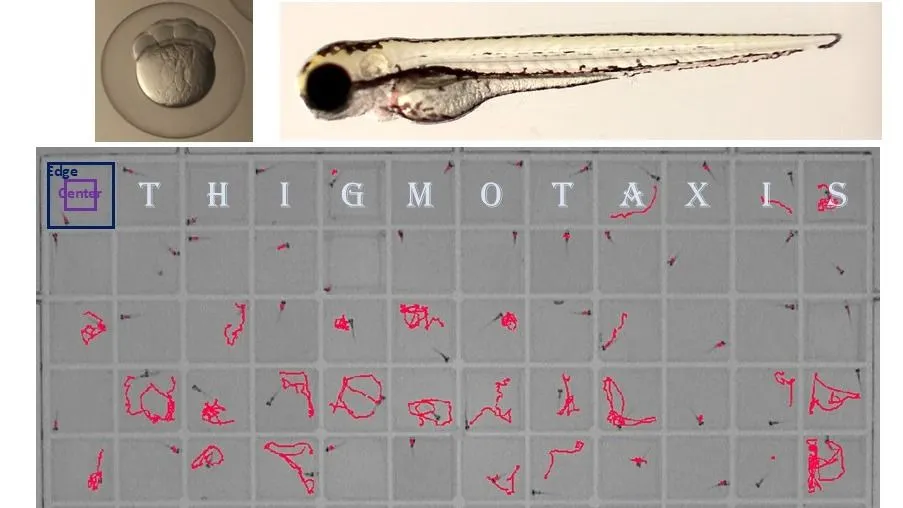
Studying thigmotaxis in zebrafish larvae taught Dr. Monica Torres-Ruiz that collecting behavioral data is only half the battle. This is the story of how a PARC project challenge led to the development of DanioFlow - a free tool to simplify and harmonize EthoVision data analysis.
Discovering Thigmotaxis as a Powerful Readout
Thigmotaxis, an organism's tendency to stay close to walls, has long been used as a proxy for anxiety-like behavior. In zebrafish larvae, it is a conserved and quantifiable response, but one that has been applied very inconsistently across labs. Comparing studies often felt like comparing apples to oranges: different plate formats, different analysis strategies, different controls.
Within the PARC (Partnership for the Assessment of Risks from Chemicals) project, Dr. Torres-Ruiz was tasked with developing a robust, high-throughput thigmotaxis assay for use in a neurotoxicity battery. This meant moving from traditional 24-well round plates to 96-well square plates to increase throughput, combining visual and acoustic stimuli to probe different neural circuits, and standardizing controls.
When Analysis Becomes the Bottleneck
All experiments were conducted in the DanioVision chamber and tracked using EthoVision. However, once raw data is exported, researchers are largely on their own. For large studies encompassing multiple plates, multiple stimuli, multiple endpoints, and multiple substances, the analysis burden becomes overwhelming.
The same steps had to be repeated manually for every experiment: cleaning files, normalizing controls, separating light/dark or sound/silence periods, analyzing significant differences, and preparing outputs for statistics and benchmark dose modeling.
Why DanioFlow Was Created
DanioFlow was born out of necessity. Starting as a personal workflow in Excel, it gradually became a structured tool that collects metadata, automates data curation and analyses, applies consistent zone separation, distinguishes between light and sound stimuli, creates graphs, and outputs a clear Word report traceable back to the original EthoVision data.
Dr. Torres-Ruiz made a deliberate decision to make DanioFlow free and openly available. Built under PARC, a project funded with public money, the tool embodies the principle that methods developed with public funding should help as many researchers as possible.
A Tool for the Community
Although currently designed for a 96-well plate format examining thigmotaxis and general locomotion for light and sound stimuli, DanioFlow can be adapted to different plate formats, different behaviors, or even different species. The tool is expected to grow and improve as others use it, question it, and modify it.
DanioFlow is freely available via Zenodo. As Dr. Torres-Ruiz reflects: "If it helps even a few labs spend less time struggling with spreadsheets and more time thinking about biology, then it has already done its job."
Originally published on noldus.com.
Source: Noldus blog.

NEED MORE INFORMATION ABOUT THIS PRODUCT?
Send us your emailRecent Blog Posts


.svg)

Advance Your Research
Contact NBT today for expert consultation on your neuroscience instrumentation needs.