.svg)
Beyond the Petri Dish: Four Organoid MEA Studies Worth Reading
Organoids that survive multi-day shipping, retinal organoids with real light responses, APOE4 reshaping development decades before Alzheimer's, and cerebral tissue turned into a live musical composition. Four MEA studies from the past year.
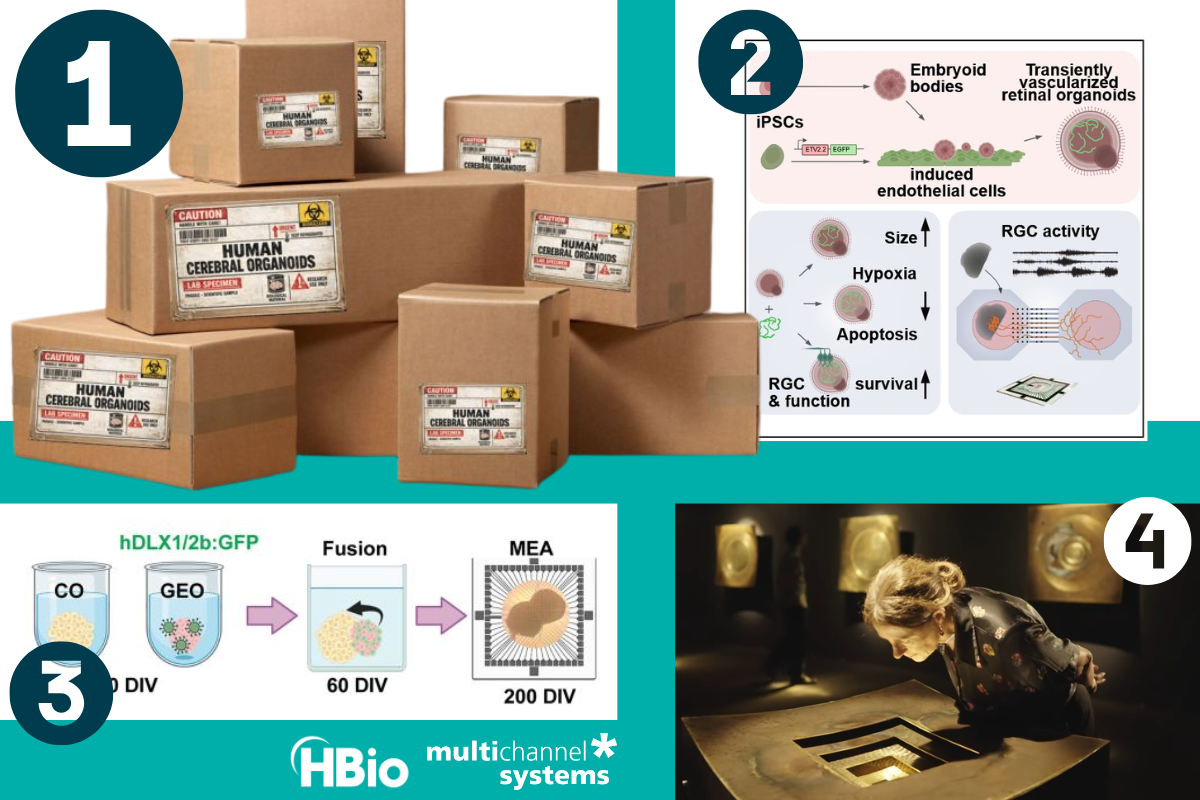
Organoids have moved past being promising models of human biology. A round-up by Marie Westerhof on the Harvard Bioscience blog collects three publications and one exhibition from the past year, all of which used multielectrode array technology from Multi Channel Systems to read out function rather than just structure.
They are worth reading together, because the common thread is that electrophysiology answers questions imaging cannot.
1. Organoids survive the post
The first study asks a deceptively mundane question: can human cerebral organoids survive multi-day ground and air shipping? The answer was yes, with the right conditions, organoids maintain both structural integrity and functional viability through transit.
That matters more than it sounds. It means organoid work does not have to be confined to a single facility, which changes what collaborative and multi-site studies can look like. Multiwell MEAs from Multi Channel Systems were used to assess functional health after shipping, confirming the tissue was not merely intact but that neurons were still firing.
2. A retinal organoid that responds to light
The second group engineered transient vascular networks into human retinal organoids, reducing hypoxic stress and improving retinal ganglion cell survival and maturation - healthier tissue producing better neurons.
With that improved environment, MEAs equipped with microfluidic axon guidance let the team record RGC activity over weeks. They saw higher firing rates, tighter network synchrony and reliable light-driven responses. As the tissue matured, recordings began showing classic ON, OFF and ON–OFF responses - the signature of real functional circuits rather than a collection of disconnected cells.
Here the MEAs were not passive sensors. They were the window into when and how organoid neurons started working together.
3. APOE4 acts long before Alzheimer's
Alzheimer's research tends to look at ageing brains. This group asked whether the risk starts in development instead.
Using brain organoids carrying APOE4, the strongest known genetic risk factor for Alzheimer's, they found the variant reshapes neuronal and glial development from the earliest stages, pushing certain neuron types such as GABAergic cells to mature faster and driving heightened network synchrony. Recordings on the MEA2100-Mini System and 3D MEAs captured hyper-synchronous firing patterns linked to APOE4, tying genetic risk directly to network behaviour.
These are measurable effects on neural circuitry well before typical disease onset, and they are the kind of finding that only electrophysiology surfaces.
4. Revivification: when neural activity makes music
The fourth entry is an exhibition rather than a paper, and it is worth the detour. In a collaboration between artists and neuroscientists, stem-cell derived cerebral organoids grown on a Mesh MEA were sourced from the cells of the late composer Alvin Lucier. Neural signals from the living tissue were translated in real time into sound across twenty sculptural brass plates - a composition that evolves moment to moment.
It is functional electrophysiology as sensory experience. The Mesh MEA platform provided the stable, long-term interface needed to translate organoid activity into audio, which is a fair demonstration of what long-duration recording from inside a 3D structure can support.
Why they matter together
From surviving multi-day shipping to reading out functional responses in complex circuits, these studies point the same direction: combining organoids with advanced MEA platforms gives access to data that was previously out of reach. MEA technology has stopped being a tool for counting spikes and become a bridge between biology, function and development.
NBT supplies Multi Channel Systems in Israel - including Mesh MEA, 3D MEAs, the MEA2100 family, Multiwell MEA systems and the Incub8 multiwell platform. Contact us to discuss electrophysiology for organoid and 3D culture work.
Source: Harvard Bioscience blog.
NEED MORE INFORMATION ABOUT THIS PRODUCT?
Send us your emailRecent Blog Posts

.svg)

Advance Your Research
Contact NBT today for expert consultation on your neuroscience instrumentation needs.