.svg)
Pattern Recognition
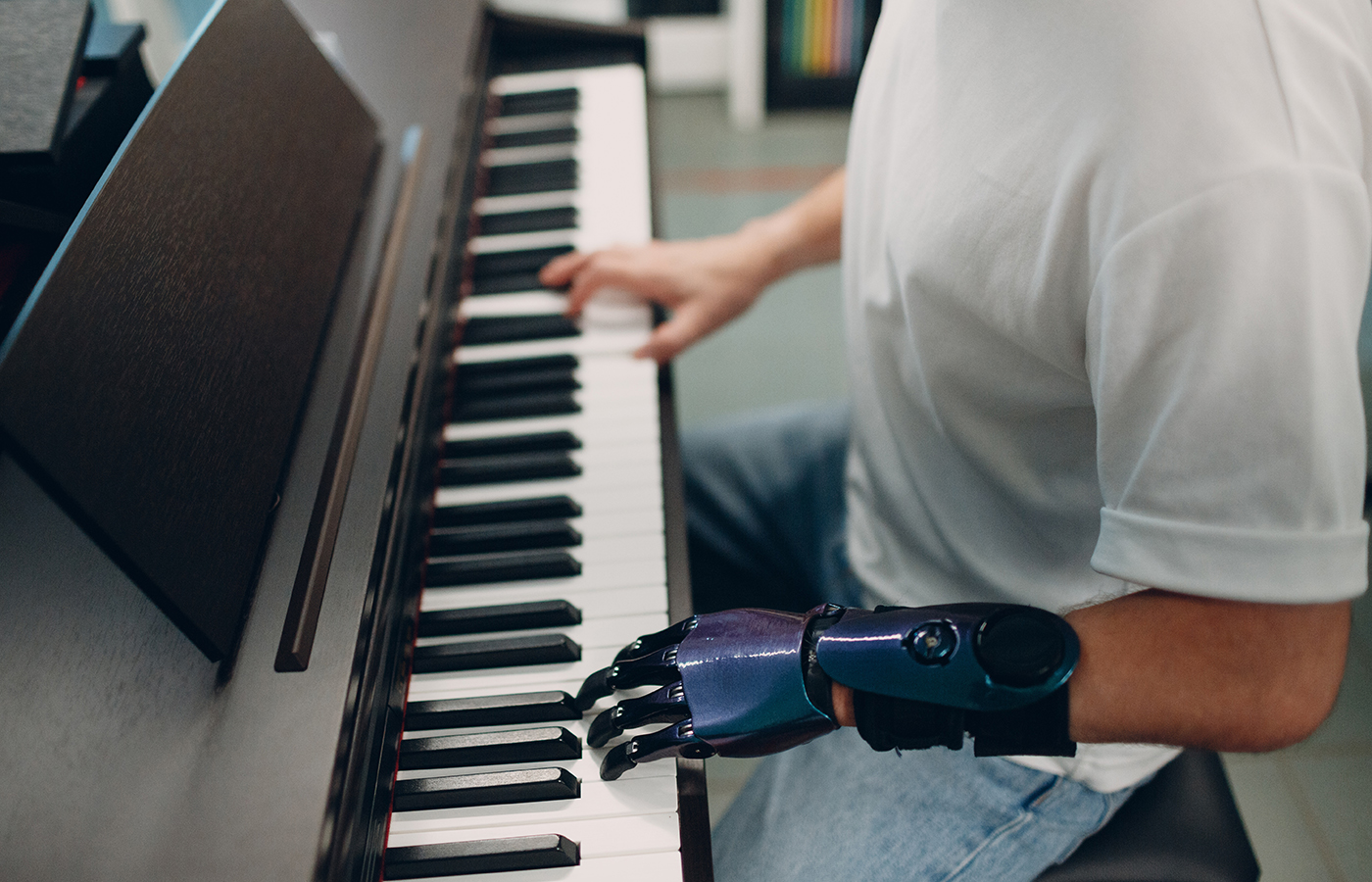
EMG pattern recognition translates muscle signals into prosthetic movements, enabling more natural limb function for patients with upper-limb deficiencies. Two recent studies demonstrate how input data quality and type significantly improve actuation accuracy in myoelectric prosthetics.
Key Takeaways
- Pattern Recognition utilizes sEMG signals as input data to recognize intended movement patterns. These movement patterns are classified and applied to prosthetic actuation, giving the prosthetic a higher degree of functionality.
- Adding kinematic data to EMG data as inputs (feature fusion) enhanced pattern recognition accuracy to 96.43%, outperforming EMG-only approaches.
- Muscle signals from patients with unilateral congenital below-elbow deficiency (UCBED) are detectable and usable as pattern recognition input data, opening the door to advanced control prosthetics for these patients.
What is EMG Pattern Recognition?
Pattern recognition refers to the use of surface electromyography (sEMG) to recognize human movements algorithmically. Once these movements are recognized, they are translated into distinguishable motion carried out by a prosthetic. EMG pattern recognition helps patients regain a higher degree of functionality - yet approximately 35–45% of pediatric upper-limb prosthetics are discarded due to inconsistency and inaccurate movement performance.
Approximately 17 million people globally suffer from strokes every year, of which 80% experience upper-limb motor impairment. In addition, congenital upper-limb deficiencies appear in every 1 in 500 births.
Study 1: Kinematic Data Fusion
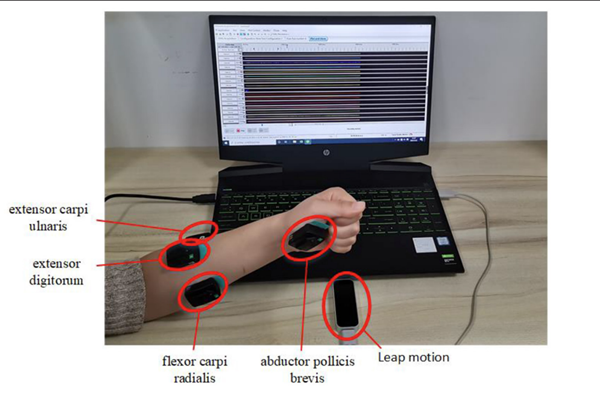
Hui Zhou and his team from Nanjing University of Science and Technology proposed improving sEMG pattern recognition by pairing it with a Leap Motion controller to provide kinematic data. Two methods were tested: feature fusion (combining EMG and kinematic features before classification) and decision fusion (separate classification with superimposed outputs). The feature fusion method displayed a pattern recognition accuracy of 96.43%, outperforming EMG-only and kinematic-only approaches.
Study 2: UCBED Patient Viability
Marcus Battraw and his team from the University of California, Davis studied whether muscle signals from pediatric patients with unilateral congenital below-elbow deficiency (UCBED) could serve as pattern recognition input. Using seven sEMG electrodes on both affected and unaffected limbs, they found that the affected sides produced detectable and consistent muscle activity - confirming that congenital one-handed pediatric patients retain some degree of control over their affected muscles.
Conclusion
Both studies highlight that the integrity of input data processed for pattern recognition is vital. While there is still much research needed to improve accuracy, these findings demonstrate that combining modalities and using patient-specific data leads to more reliable prosthetic actuation. EMG remains central to advancing this technology.
Source: Delsys blog.

Shall we chat about this topic?
Contact usRecent Blog Posts


.svg)

Advance Your Research
Contact NBT today for expert consultation on your neuroscience instrumentation needs.