.svg)
A Personal Journey in Behavioral Analysis: Thigmotaxis with DanioFlow
Dr. Monica Torres-Ruiz explains how a problem on a large neurotoxicity project led her to build DanioFlow, a free open-source tool that simplifies and harmonises EthoVision data analysis for zebrafish thigmotaxis studies.
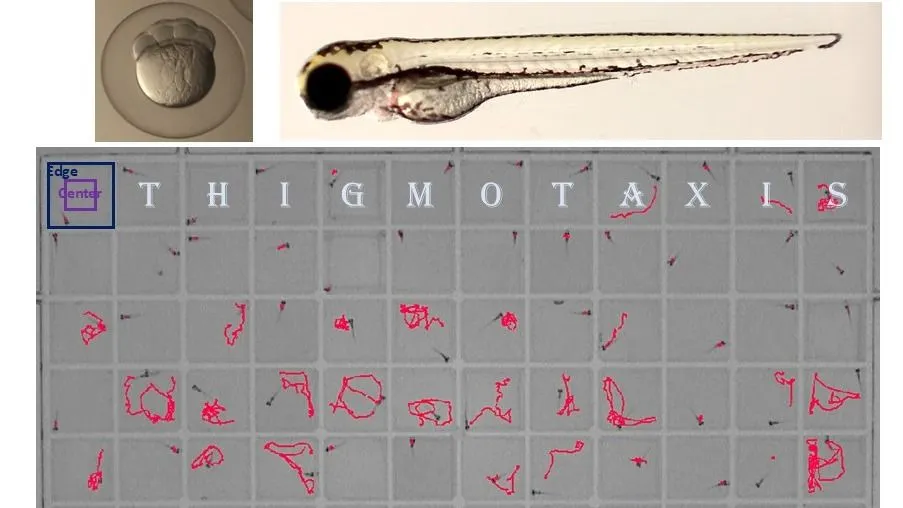
About DanioFlow
Studying thigmotaxis in zebrafish (ZF) larvae taught Dr. Monica Torres-Ruiz that collecting behavioral data is only half the battle. DanioFlow was born from a real research challenge: the need to simplify and harmonize EthoVision data analysis across a large multi-site project.
When Dr. Torres-Ruiz first joined the PARC (Partnership for the Assessment of Risks from Chemicals) project, the goal was ambitious - help modernize neurotoxicity testing by developing new, ethical, and scalable behavioral methods for zebrafish larvae. What she didn’t anticipate was that the data analysis process itself would become a significant bottleneck.
What is Thigmotaxis?
Thigmotaxis refers to the tendency of an animal to stay close to the walls of an arena - a well-established measure of anxiety-like behavior in zebrafish larvae. It is widely used in neurotoxicology and pharmacology research to assess the effects of chemical exposure or genetic manipulation on behavioral phenotypes.
EthoVision XT by Noldus is the standard video tracking software used to measure thigmotaxis and other locomotion parameters in zebrafish. However, when working with large datasets across multiple labs and experimental conditions, differences in analysis settings and data formats can introduce variability that undermines reproducibility.
DanioFlow: What It Does
DanioFlow is a free, openly available tool developed to process and harmonize EthoVision XT output data for zebrafish thigmotaxis studies. Key features include:
- Standardized processing: Applies consistent analysis parameters across batches of EthoVision data files
- Harmonized output: Produces a unified dataset regardless of minor differences in acquisition settings
- Open source: Freely available for the research community to use, adapt, and improve
- PARC-validated: Developed and validated within the context of a large-scale European neurotoxicity assessment project
Why It Matters
As behavioral neuroscience increasingly relies on automated tracking and large-scale data collection, tools that ensure reproducibility and harmonization across labs are critically important. DanioFlow addresses a practical gap - the challenge of comparing zebrafish behavioral data across sites, timepoints, and experimental conditions. By making this tool freely available, Dr. Torres-Ruiz and her team contribute to the broader goal of open and reproducible neuroscience.

Shall we chat about this topic?
Contact usRecent Blog Posts


.svg)


Advance Your Research
Contact NBT today for expert consultation on your neuroscience instrumentation needs.