.svg)
Gait Research Outside the Lab: What Wearable Motion Capture Changes
The walking you want to characterise often happens outside the camera volume. Xsens sets out what wearable inertial capture adds to gait research, how to evaluate a system, and where the accuracy numbers actually sit against optical reference.
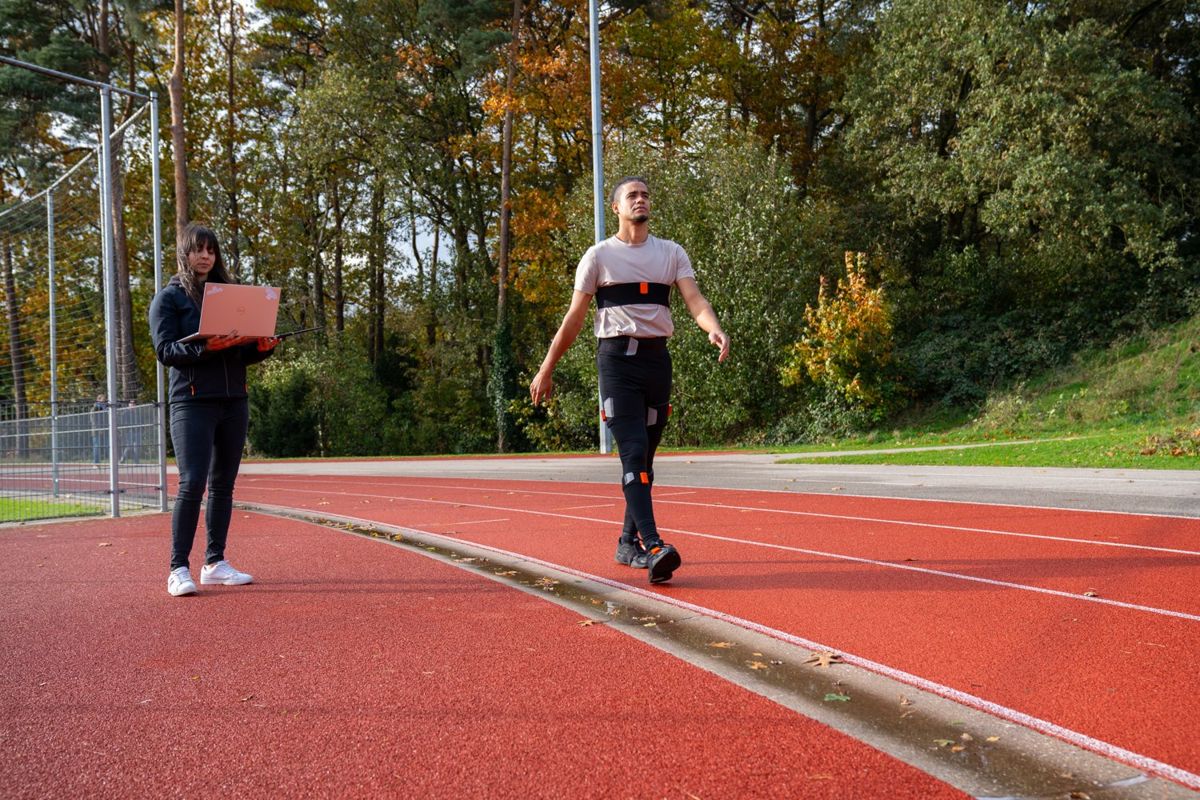
Gait research has a recurring tension. The most controlled data comes from a calibrated camera volume, but the walking you actually want to characterise often happens somewhere else - a hospital corridor, a training facility, uneven ground outdoors. A recent article on the Xsens site makes the case for wearable inertial systems on the grounds that they let the method stay constant while the environment changes.
What gait studies actually need to produce
Most gait workflows share one goal: quantify how the body moves during walking, in metrics comparable across trials, conditions and participants. In practice that means four families of output:
- Kinematics - joint angles, segment orientation, range of motion, velocity
- Spatiotemporal metrics - step length, cadence, step width, stride timing
- Symmetry and coordination - left-right differences, inter-joint coordination
- Task-specific outcomes - trunk contribution, pelvic range of motion, movement variability
Computing these consistently requires three-dimensional analysis, and full-body capture rather than isolated joint measurement.
The three stages
The workflow the article describes is straightforward. First, capture movement in 3D - inertial systems use IMUs to measure linear acceleration and angular velocity at each body segment, which is especially practical when setup speed, portability or capture outside a fixed volume matter to the design. Second, convert signals into gait variables: a biomechanical model and sensor fusion algorithm estimate segment orientations and joint angles, then compute the kinematic and spatiotemporal outputs. Third, visualise, quantify and report, with most teams moving to MATLAB, Python or a specialist biomechanics platform downstream.
What wearable capture adds
Four things, according to the article: repeatability through standardised protocols across sessions, operators and sites; real-world measurement in clinics, community settings, sports facilities and outdoors; time efficiency in setup and turnaround; and full-body context rather than isolated joint measures.
The framing that lands is about methodology rather than convenience - if your work spans multiple environments or populations, wearable capture lets you keep one consistent method instead of confining the study to a single space or running two incompatible protocols.
How to evaluate a system
Four criteria are offered, and the first is the one most often skipped:
- Accuracy and consistency. Look for independent peer-reviewed validation across walking speeds and populations, not manufacturer specifications alone.
- Software quality. 3D visualisation, detailed kinematic outputs, and export formats that fit the toolchain the team already runs.
- Workflow fit. Setup time and portability. In clinical settings especially, participant time is limited and friction compounds across a study.
- Validation and support. A peer-reviewed publication record makes methodology easier to justify to reviewers and easier to cite.
The numbers, and the integrations
Xsens reports that joint angle accuracy for major lower limb joints during walking typically falls within 1 to 3 degrees compared with optical reference systems, and that it is among the most cited wearable motion capture systems in peer-reviewed biomechanics and gait literature. Validation studies are collected in a dedicated research and validation hub, which is genuinely useful when writing a methods section.
On the software side, exports run to AnyBody, OpenSim, C-Motion Visual3D and MATLAB in C3D, BVH and MVNX formats. The article also flags combining full-body kinematics with Delsys EMG for neuromuscular gait studies - a pairing we see fairly often in Israeli labs, and one worth planning for at purchase rather than retrofitting later.
NBT supplies Xsens motion capture in Israel alongside Delsys EMG, AMTI force plates and Qualisys optical systems. Contact us if you are specifying a gait lab or extending an existing one into the field.
Source: Xsens blog.

NEED MORE INFORMATION ABOUT THIS PRODUCT?
Send us your emailRecent Blog Posts
_quality(80).webp)

.svg)

Advance Your Research
Contact NBT today for expert consultation on your neuroscience instrumentation needs.