.svg)
The First 100% Accurate Real-Time BCI: How Common Spatial Patterns Changed Neurotechnology
How Common Spatial Patterns produced the first 100%-accurate real-time motor imagery BCI in Graz in 1998, 160 consecutive error-free decisions, and why CSP is still a benchmark for EEG decoding.
.jpg)
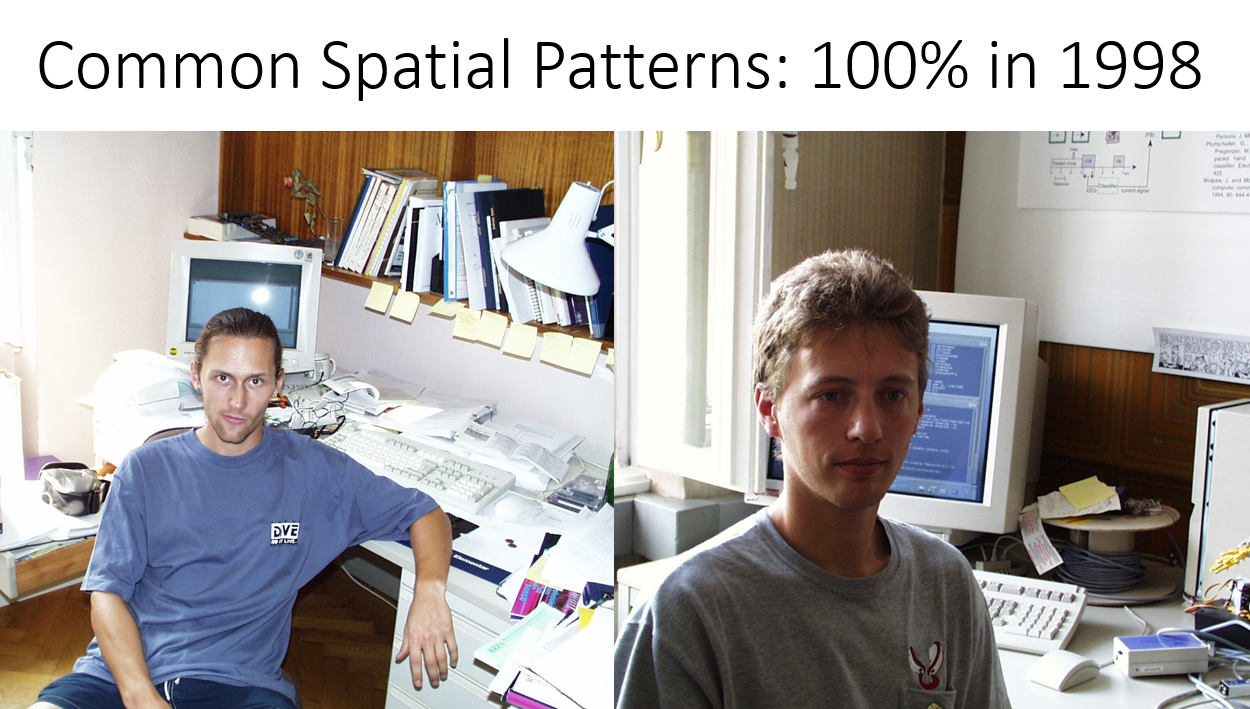
Today, researchers take many Brain-Computer Interface (BCI) technologies for granted. Real-time EEG processing, machine-learning-based classification, motor imagery decoding, and closed-loop BCIs have become standard tools in neuroscience labs around the world. In the late 1990s, the situation was very different. Researchers could record brain signals, analyze data offline, and demonstrate promising results, but achieving highly reliable real-time control remained one of the greatest challenges in BCI research. Then a breakthrough occurred that would help shape the future of brain-computer interfaces, EEG signal processing, and neurotechnology.
The discovery that changed motor imagery BCI
The story began in Graz, Austria, where Professor Gert Pfurtscheller's research group was pioneering EEG-based BCIs. In 1998, Johannes Müller-Gerking visited the laboratory and was given an existing 64-channel motor-movement EEG dataset to evaluate a mathematical approach known as Common Spatial Patterns (CSP). CSP is a signal-processing method that identifies spatial filters capable of maximizing the differences between brain states; in motor imagery it helps distinguish neural activity associated with imagined left-hand and right-hand movements. The classification accuracy achieved with CSP significantly exceeded previous approaches, demonstrating that EEG-based motor imagery contained far more usable information than researchers had been able to extract. Soon afterward, Herbert Ramoser applied CSP to additional datasets and achieved similarly remarkable improvements.
Bringing CSP into real-time BCI systems
Impressive offline results raised an important question: could CSP work in real time? Real-time BCI systems required solving data acquisition, filtering, feature extraction, classification, feedback generation, and system latency simultaneously, and a highly accurate offline algorithm is not automatically suitable for real-time use. To find out, the CSP algorithm was implemented into a real-time BCI system and tested during live experiments. The results exceeded all expectations.
The first perfect real-time BCI experiment
One of the laboratory's most experienced participants, known as "g3", was invited to test the new system. After only a few training sessions, a historic milestone was achieved: the participant successfully moved a cursor 80 times to the left and 80 times to the right without a single classification error - 160 consecutive correct decisions in real time. For the first time, a motor imagery BCI reached 100% accuracy during a live experiment, demonstrating that high-performance BCIs were achievable when signal acquisition, signal processing, and real-time system engineering were optimized together.
Why this breakthrough still matters today
Nearly three decades later, Common Spatial Patterns remains one of the most widely used algorithms in motor imagery BCI research. Although modern BCIs now employ deep learning, adaptive classifiers, and multimodal signal processing, CSP continues to serve as a benchmark for EEG-based motor imagery decoding. The reason is simple: CSP demonstrated that remarkable BCI performance is not achieved through algorithms alone, but through the entire ecosystem - high-quality EEG acquisition, reliable hardware, low-noise amplifiers, real-time processing, robust software architectures, accurate machine-learning methods, and immediate feedback loops. This philosophy ultimately inspired the creation of g.tec medical engineering in 1999.
Source: g.tec medical engineering blog.
NEED MORE INFORMATION ABOUT THIS PRODUCT?
Send us your emailRecent Blog Posts

.svg)
%3Aquality(100).webp)
Advance Your Research
Contact NBT today for expert consultation on your neuroscience instrumentation needs.