.svg)
.svg)
Running Wheels
Ugo Basile Running Wheels (Cat. 1800 for rats, Cat. 1850 for mice) provide a reliable, low-maintenance method for measuring voluntary locomotor activity over extended periods. Housed in clear polycarbonate cages with stainless steel wheels and Teflon bearings for minimal friction, they support long-duration circadian rhythm studies, aging research, energy balance experiments, and pain-related exercise assessments, with optional PC connectivity for up to 12 simultaneous units.
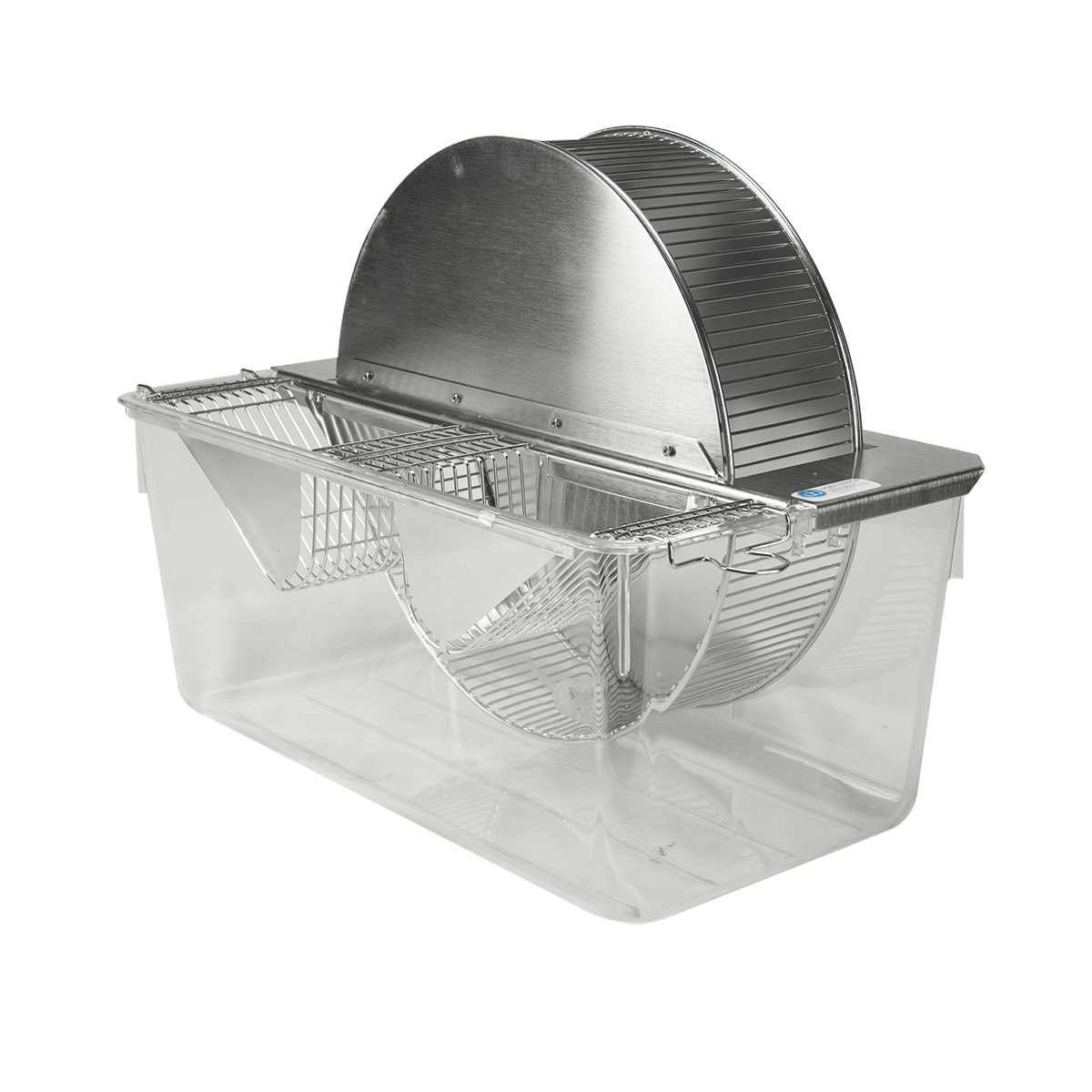
What are the Ugo Basile Running Wheels?
The Ugo Basile Running Wheels (catalog numbers 1800/1850) provide a low-stress, non-invasive method for measuring spontaneous voluntary motor activity in rodents over extended time periods - from single nights to weeks of continuous recording. Because running wheel activity is self-initiated rather than forced, it provides a naturalistic measure of an animal’s intrinsic motivation to exercise, making it ideal for circadian rhythm research, pain-related activity, aging studies, and energy balance investigations.
Available in mouse (1850) and rat (1800) versions, the wheels feature stainless steel construction with a Teflon bushing for ultra-low friction running. Optional PC connectivity via the Multifunction Interface supports up to 12 simultaneous wheels, with data transferred directly to ANY-maze for chronobiological analysis.
Key Features
- Voluntary Activity Measurement: Running wheel activity is self-motivated, providing a naturalistic measure of locomotor drive unaffected by experimenter intervention or forced exercise stress.
- Mouse and Rat Models: Dedicated size-appropriate wheels for both species, 23 cm internal diameter for mice (1850) and 33 cm for rats (1800), ensure comfortable, natural running biomechanics.
- Stainless Steel & Teflon Construction: The stainless steel running surface with Teflon bushing provides low friction, long-term durability, and easy sterilisation between animals.
- LCD Counter (Standard): Each wheel includes an integrated LCD revolution counter for standalone use without a PC.
- PC Connectivity (up to 12 wheels): The optional Multifunction Interface connects up to 12 wheels to a single PC, enabling high-throughput circadian and longitudinal activity recording.
- ANY-maze Compatible: Direct data export to ANY-maze supports detailed chronobiological analysis including actograms, activity bouts, and period estimation.
- Clear Polycarbonate Housing: The transparent cage allows direct visual observation and video recording of the animal at all times.
.webp)

Research Applications
Running wheels are uniquely suited to studies requiring long-term, voluntary, minimally-stressful activity recording. Because the animal chooses when and how much to run, wheel running data reflect intrinsic motivation and physiological capacity rather than forced compliance, making it especially informative in pain, aging, and disease models where motivation itself is the variable of interest.
- Circadian Rhythm Research: Wheel running is the gold-standard non-invasive assay for circadian period, phase, and amplitude in rodents. Light-dark entrainment, free-running period, and jet-lag recovery are all readily characterised from wheel revolution actograms.
- Pain & Analgesia: Pain-related reductions in voluntary running are used as a sensitive, non-reflex measure of ongoing pain. Recovery of wheel activity after injury or drug treatment provides a functional analgesia endpoint.
- Aging & Sarcopenia: Age-associated declines in spontaneous running distance and bout duration are well-characterised, making wheel running a sensitive longitudinal marker of physical fitness and musculoskeletal integrity.
- Neurological Disease Models: Hypoactivity in Parkinson’s, ALS, and ataxia models is captured as reduced wheel running well before overt motor impairment is apparent on the RotaRod.
- Energy Balance & Obesity: Voluntary running distance correlates with energy expenditure, making wheels an important tool in metabolic studies of obesity, diabetes, and diet interventions.
- Neuroplasticity & Cognitive Enhancement: Voluntary wheel running induces hippocampal neurogenesis and enhances cognitive performance, making it a popular intervention in learning and memory studies.

Mouse Running Wheel (Cat. 1850 / 1850-S)
| Parameter | Specification |
|---|---|
| External Cage Dimensions | 14(H) × 20.7(W) × 36.5(D) cm |
| Wheel Interior Diameter | 23 cm |
| Wheel Width | 79 mm |
| Bar Diameter / Spacing | 2 mm bars, 7 mm apart |
| Weight | 5 kg (7 kg shipping) |
Rat Running Wheel (Cat. 1800 / 1800-S)
| Parameter | Specification |
|---|---|
| External Cage Dimensions | 21(H) × 26.7(W) × 48.2(D) cm |
| Wheel Interior Diameter | 33 cm |
| Wheel Width | 96 mm |
| Bar Diameter / Spacing | 2 mm bars, 9 mm apart |
| Weight | 7 kg (11 kg shipping) |
System
| Parameter | Specification |
|---|---|
| Connectivity | Optional PC connection via 52610 Multifunction Interface |
| Max Simultaneous Wheels | 12 |
| Counter | LCD counter (1800 / 1850); counter-free versions for external interface (1800-S / 1850-S) |
| Housing Material | Clear polycarbonate cage, stainless steel wheel with Teflon bushing |
| Software Compatibility | ANY-maze (60000-IO) |
Anxiety, Fear, and Stress Responses
Explore All ProductsMotor Functions
Explore All ProductsRunning Wheels Publications
Running wheels from Ugo Basile are cited across circadian rhythm, aging, energy balance, and exercise recovery studies. Models 1800 (rat) and 1850 (mouse) enable long-term voluntary exercise monitoring with optional PC data logging, supporting chronobiology and metabolic research.
What are the Ugo Basile Running Wheels and what are they used for?
Running Wheels (Cat. 1800 for rats, Cat. 1850 for mice) are voluntary exercise and activity monitoring devices. They measure spontaneous locomotor activity over extended timeframes, making them essential for circadian rhythm research, aging studies, energy balance and obesity investigations, exercise recovery monitoring, and pain-related exercise assessments.
What are the key differences between the mouse (1850) and rat (1800) models?
The mouse wheel (Cat. 1850) features a 23 cm interior diameter wheel (79 mm wide, 7 mm bar spacing) housed in a 14×20.7×36.5 cm polycarbonate cage weighing 5 kg. The rat wheel (Cat. 1800) has a 33 cm interior diameter wheel (96 mm wide, 9 mm bar spacing) in a 21×26.7×48.2 cm cage weighing 7 kg. Both share the same Teflon-bushing low-friction design and LCD counter.
Can Running Wheel data be collected on a PC, and how many wheels can run simultaneously?
Yes. Counter-free versions (Cat. 1800-S, 1850-S) connect to a PC via the optional 52610 Multifunction Interface, supporting up to 12 wheels simultaneously for continuous automated logging. Standard LCD-counter models (Cat. 1800, 1850) operate standalone.
Are Ugo Basile Running Wheels available in Israel with local support?
Yes. NBT Ltd is the exclusive distributor of Ugo Basile products in Israel and provides full local support including setup, training, and technical assistance for Running Wheels.
Are Running Wheels compatible with ANY-maze video tracking software?
Yes. Running Wheels can be used alongside ANY-maze software (Cat. 60000-IO) to combine wheel-based activity logging with video tracking data, enabling comprehensive behavioral profiling including position, distance traveled, and voluntary activity in the same animal.
Still have questions?
Request for Quote
Please fill in as much details as possible and we will take care of your request as soon as possible
Request for Quote
Please fill in as much details as possible and we will take care of your request as soon as possible