.svg)
.svg)
Y-Maze
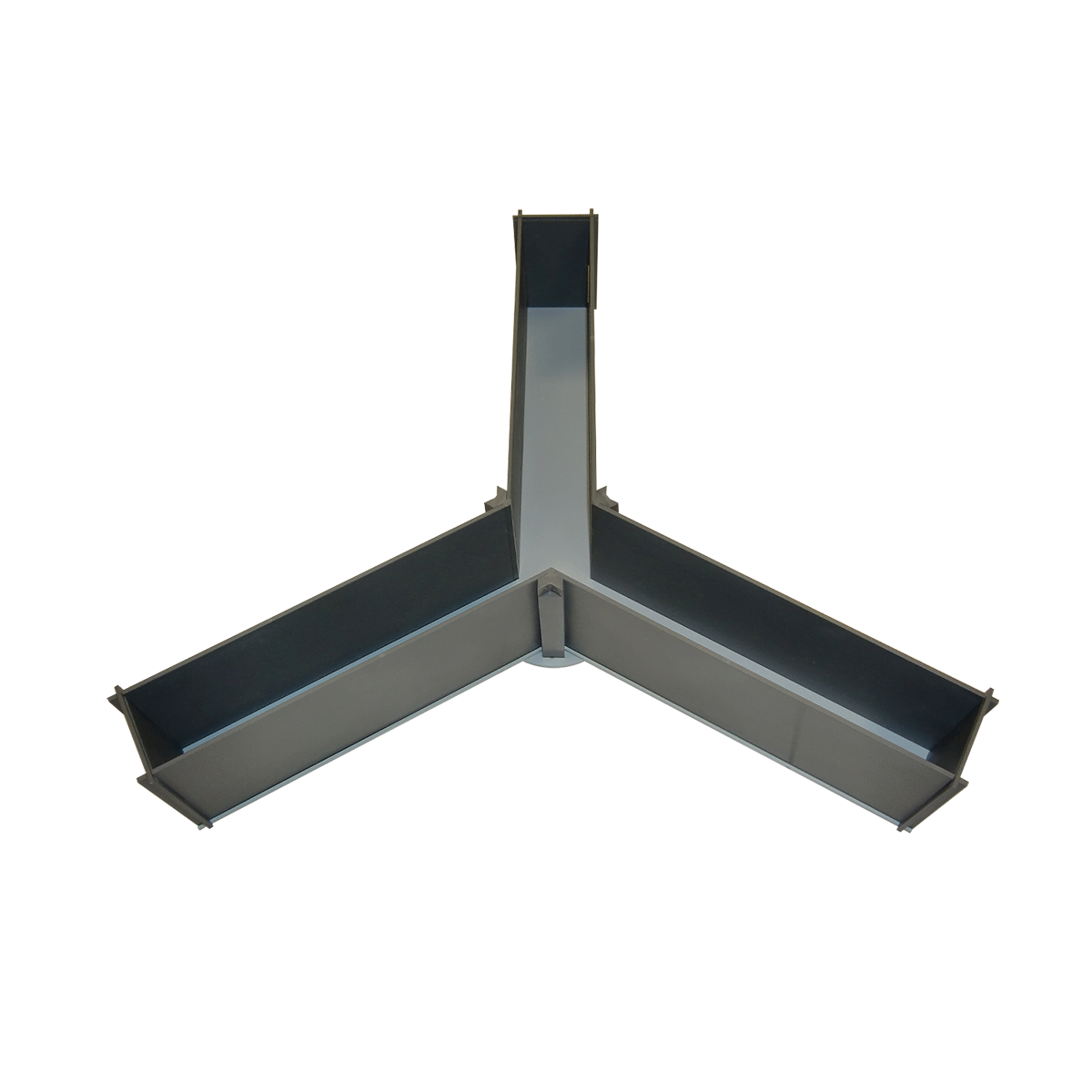
Three-arm maze for spontaneous alternation and spatial working memory testing. Non-reflective grey surface with detachable perspex walls; optional arm door; rat (40172: 50 cm arms) and mouse (40173: 35 cm arms). Compatible with ANY-maze for automated alternation scoring.
What is the Y-Maze?
The Y-Maze is a three-arm spatial maze used to test spontaneous alternation - the natural tendency of rodents to explore a new arm rather than revisit one just entered. Because alternation does not require reinforcement or training, the Y-maze provides a rapid, stress-minimal measure of hippocampal-dependent spatial working memory within a single 5–8 minute session. The spontaneous alternation percentage (SAP = three-arm entries with no repeat / total possible alternations) is a sensitive and well-replicated index of spatial short-term memory impaired by hippocampal lesions, amyloid accumulation, muscarinic blockade, and aging.
Key Features
- Non-Reflective, Anti-Glare Surfaces: High-contrast grey walls and floor with anti-glare treatment ensure reliable overhead video tracking without hotspot artifacts.
- Quick-Detach Perspex Walls: Slotted into a metal base frame, the perspex walls can be removed and replaced in seconds for efficient inter-subject cleaning, preventing odor cue carryover.
- Optional Arm Door: An optional movable door can block one arm to create a forced-choice version (two-trial Y-maze memory test), converting the apparatus to a delayed non-matching-to-place task.
- Rat and Mouse Versions: Cat. 40172 (rats: 50 cm arms, 10 cm wide, 25 cm walls) and Cat. 40173 (mice: 35 cm arms, 5 cm wide, 15 cm walls) provide species-appropriate dimensions.
- ANY-maze Compatible: Three-arm zone definitions are automatically recognized by ANY-maze (Cat. 60000), enabling automated arm entry counting, alternation sequence analysis, and path recording.
.webp)

Technical Specifications
| Catalog Numbers | 40172 (Rats), 40173 (Mice) |
| Arm Length - Rats | 50 cm |
| Arm Length - Mice | 35 cm |
| Arm Width - Rats | 10 cm |
| Arm Width - Mice | 5 cm |
| Wall Height - Rats | 25 cm |
| Wall Height - Mice | 15 cm |
| Weight - Rats | 13 kg |
| Weight - Mice | 6 kg |
| Standard Color | Grey; blue, white, black, custom available |
| Warranty | 12 months + 12 months post-registration |
Applications
- Spontaneous alternation and spatial working memory
- Alzheimer's disease models (APP/PS1, 3×Tg-AD)
- Cholinergic memory research (scopolamine, AChEI)
- Cognitive aging and longitudinal memory tracking
Mazes Tracking
צפו בכל המוצריםMemory and Learning
צפו בכל המוצריםY-Maze Publications
The Ugo Basile Y-Maze is widely cited in cognitive neuroscience using the spontaneous alternation paradigm to measure spatial working memory and exploratory behavior in rodent models of Alzheimer's disease, aging, and pharmacological cognition enhancement.
What is spontaneous alternation and how is it measured?
Spontaneous alternation is the tendency of rodents to enter the least recently visited arm of a Y-maze. Spontaneous Alternation Percentage (SAP) = (number of alternations / total possible alternations) × 100. An SAP > 60–65% is considered intact; values near 50% (chance) indicate memory impairment.
What catalog numbers are available for the Y-Maze?
Cat. 40172 is designed for rats (50 cm arm length, 10 cm wide, 25 cm walls) and Cat. 40173 is designed for mice (35 cm arm length, 5 cm wide, 15 cm walls). Both come in grey as standard.
Is training required before Y-Maze testing?
No — the spontaneous alternation version requires no training, food restriction, or shaping. Animals are placed in the maze and explore freely for 5–8 minutes while entries are recorded. The forced-choice version (novel arm) requires a single 5-minute habituation trial, followed by a delayed test trial.
How does the Y-Maze compare to the Radial Maze for working memory?
The Y-maze is faster (5–8 minutes, no training) and less stressful (no food restriction, no shock) than the radial maze. However, the radial maze provides a more demanding test with larger capacity (8 choices) and distinguishes working from reference memory. The Y-maze is recommended as a high-throughput screen; the radial maze for detailed spatial memory characterization.
Can the Y-Maze be used to test long-term spatial memory?
Yes — by using the arm door accessory to block one arm during a habituation trial, then reopening it after a delay (1 hour to 24 hours) for a test trial, the Y-maze can measure long-term spatial memory as the preference for the novel arm (novel arm exploration / total exploration time).
יש לכם שאלות נוספות?
בקשה להצעת מחיר
אנא מלאו כמה שיותר פרטים ואנו נטפל בבקשתכם בהקדם האפשרי
בקשה להצעת מחיר
אנא מלאו כמה שיותר פרטים ואנו נטפל בבקשתכם בהקדם האפשרי