.svg)
.svg)
Multi-Maze
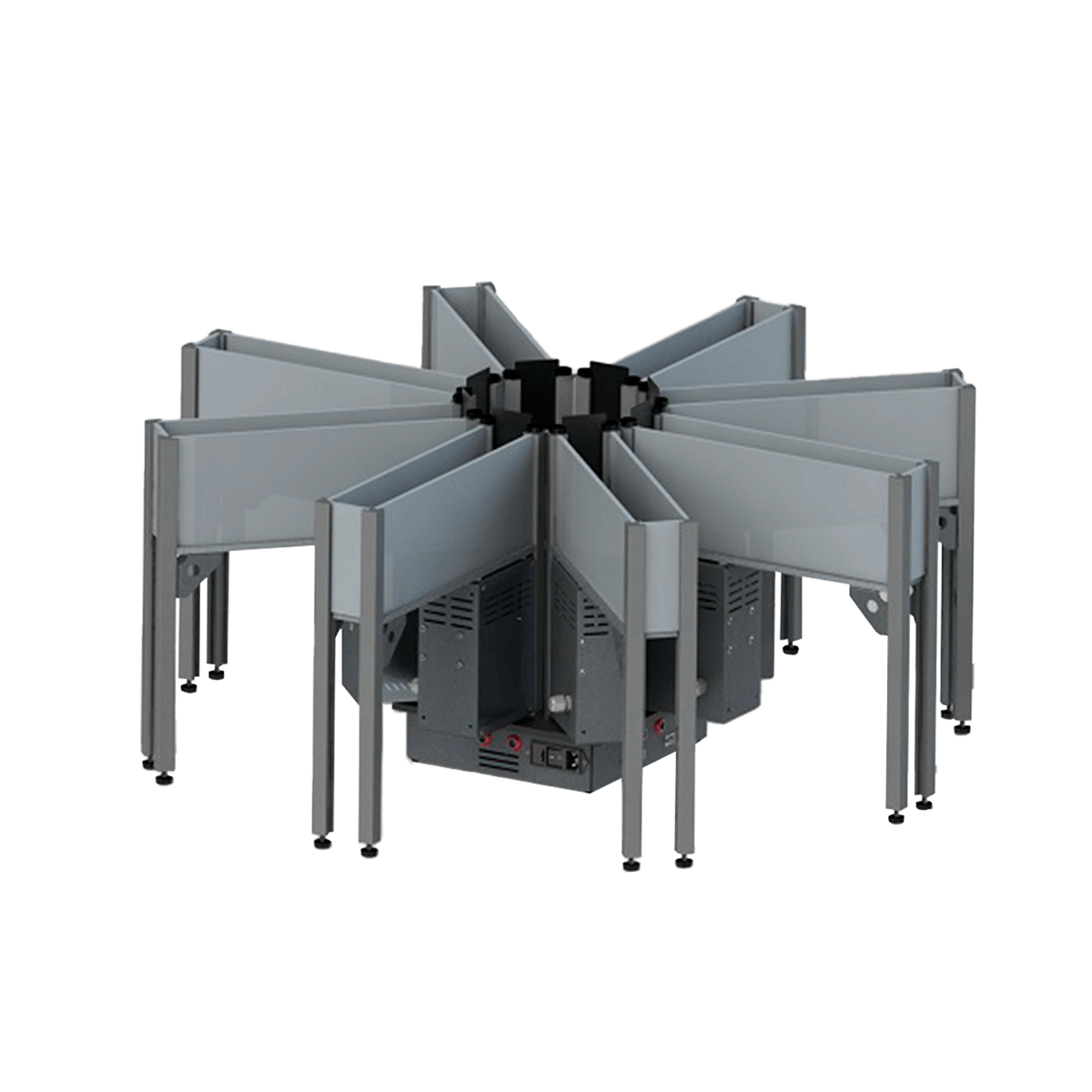
Fully automated modular maze system configurable as Y-maze, T-maze, or 8-arm radial maze. Below-floor silent sliding doors; individual arm motors; TTL/USB or manual control; mouse (41503: 35 cm arms) and rat (41513: 60 cm arms) versions; 85–264 VAC. Ideal for complex automated spatial protocols.
What is the Multi-Maze?
The Multi-Maze is a versatile, fully automated modular maze system that can be reconfigured between a 3-arm Y-maze, a T-maze, and an 8-arm radial maze by adding or removing arm modules without tools. Its defining feature is a system of motorized below-floor sliding doors on each arm, identical in principle to the Delta Maze, that retract silently beneath the maze surface rather than protruding upward, providing an unobstructed overhead view for video tracking and eliminating cable entanglement for tethered animal experiments. The modular architecture, combined with PC-driven TTL control and individual arm motors, enables complex automated spatial protocols that would require manual intervention in conventional mazes.
Key Features
- Configurable Architecture: Standard kits are available as 3-arm (Y-maze/T-maze) in mouse (Cat. 41503/41504) and rat (Cat. 41513/41514) versions, and as 8-arm radial maze (Cat. 41508/41518). Arms can be added or removed using the modular connection system.
- Below-Floor Silent Sliding Doors: Each arm has its own motor driving a door that slides beneath the floor, providing a clear, unobstructed overhead view for video tracking and eliminating upright barriers that entangle fiber optic cables or EEG leads.
- Individual Arm Motor Control: Each arm door is controlled independently via TTL or USB, enabling asymmetric protocols (e.g., force-choice by opening only one arm), sequential arm release, and event-synchronized door control.
- TTL and USB/PC Control: Compatible with all major behavioral control systems via TTL; full PC automation via USB enables custom protocol scripting for delayed alternation, reversal, and multi-step spatial tasks.
- Mouse and Rat Versions: Mouse arms: 35 cm length, 20 cm central arena; Rat arms: 60 cm length, 30 cm central arena - both providing species-appropriate dimensions for natural foraging behavior.
.webp)

Technical Specifications
| Catalog Numbers | 41503 (3-arm Mouse), 41504 (3-arm Mouse + Start), 41508 (8-arm Mouse), 41513 (3-arm Rat), 41514 (3-arm Rat + Start), 41518 (8-arm Rat) |
| Mouse Arm Length | 35 cm |
| Rat Arm Length | 60 cm |
| Mouse Central Arena | 20 cm diameter |
| Rat Central Arena | 30 cm diameter |
| Door Mechanism | Below-floor sliding (silent); individual motor per arm |
| Control Modes | Manual, TTL, USB/PC |
| Power Supply | Universal 85–264 VAC, 50–60 Hz, max 40 W |
| Operating Temperature | 10–40°C |
| Sound Level | Negligible |
| Warranty | 12 months + 12 months post-registration; UB-Care extension available |
Applications
- Automated spontaneous alternation and spatial working memory
- Delayed non-matching-to-place with variable computer-controlled delays
- 8-arm radial maze working and reference memory
- Optogenetics and fiber photometry with tethered animals during spatial tasks
Mazes Tracking
צפו בכל המוצריםMemory and Learning
צפו בכל המוצריםMulti-Maze Publications
The Multi-Maze is referenced in behavioral neuroscience studies requiring flexible reconfiguration of maze geometry (T, Y, plus, radial), enabling comparative studies of working memory, spatial navigation, and decision-making across protocols.
What configurations is the Multi-Maze available in?
The Multi-Maze is available in: 3-arm mouse (Cat. 41503 standard; 41504 with start box), 8-arm mouse (Cat. 41508), 3-arm rat (Cat. 41513 standard; 41514 with start box), and 8-arm rat (Cat. 41518). All share the same modular arm connector system, and additional arm units can be purchased separately.
How do the below-floor doors improve over standard maze doors?
Standard upright doors obstruct the camera view (creating tracking dead zones), and can entangle implanted cannulae, fiber optic cables, or EEG wires. Below-floor doors retract into the maze body, providing a completely clear, unobstructed overhead view and a cable-friendly corridor, enabling tethered animal behavioral studies.
Can the Multi-Maze be controlled by external behavioral hardware?
Yes — all arm doors are accessible via TTL inputs, compatible with Med Associates, ANY-maze, Ethovision, custom Arduino setups, and any other TTL-capable behavioral control system. USB connection also enables full Python/PC scripting for custom automated protocols.
Is the Multi-Maze suitable for tethered animal experiments?
Yes — the below-floor door mechanism and open-ceiling design allow animals to carry fiber optic cannulae, EEG headstages, or microdialysis tubing through all arm configurations without entanglement, making the Multi-Maze one of the most tethered-animal–compatible automated maze systems available.
How does automated reversal learning work in the Multi-Maze?
Via USB/PC control, researchers can program protocol scripts that automatically change which arm is rewarded after a preset number of correct trials, number of sessions, or performance criterion. Door opening sequences are logged with millisecond timestamps, enabling full behavioral history reconstruction alongside neural recording data.
יש לכם שאלות נוספות?

בקשה להצעת מחיר
אנא מלאו כמה שיותר פרטים ואנו נטפל בבקשתכם בהקדם האפשרי
בקשה להצעת מחיר
אנא מלאו כמה שיותר פרטים ואנו נטפל בבקשתכם בהקדם האפשרי