.svg)
Is It OK to Infuse Several Animals at Once with a Multi-Syringe Pump?
Multi-syringe pumps look economical, but for live-animal infusion in rodents the tradeoffs - no occlusion alarm, awkward dead volumes, forced synchronization, and a single point of failure - usually make one small pump per animal the safer and cleaner choice.

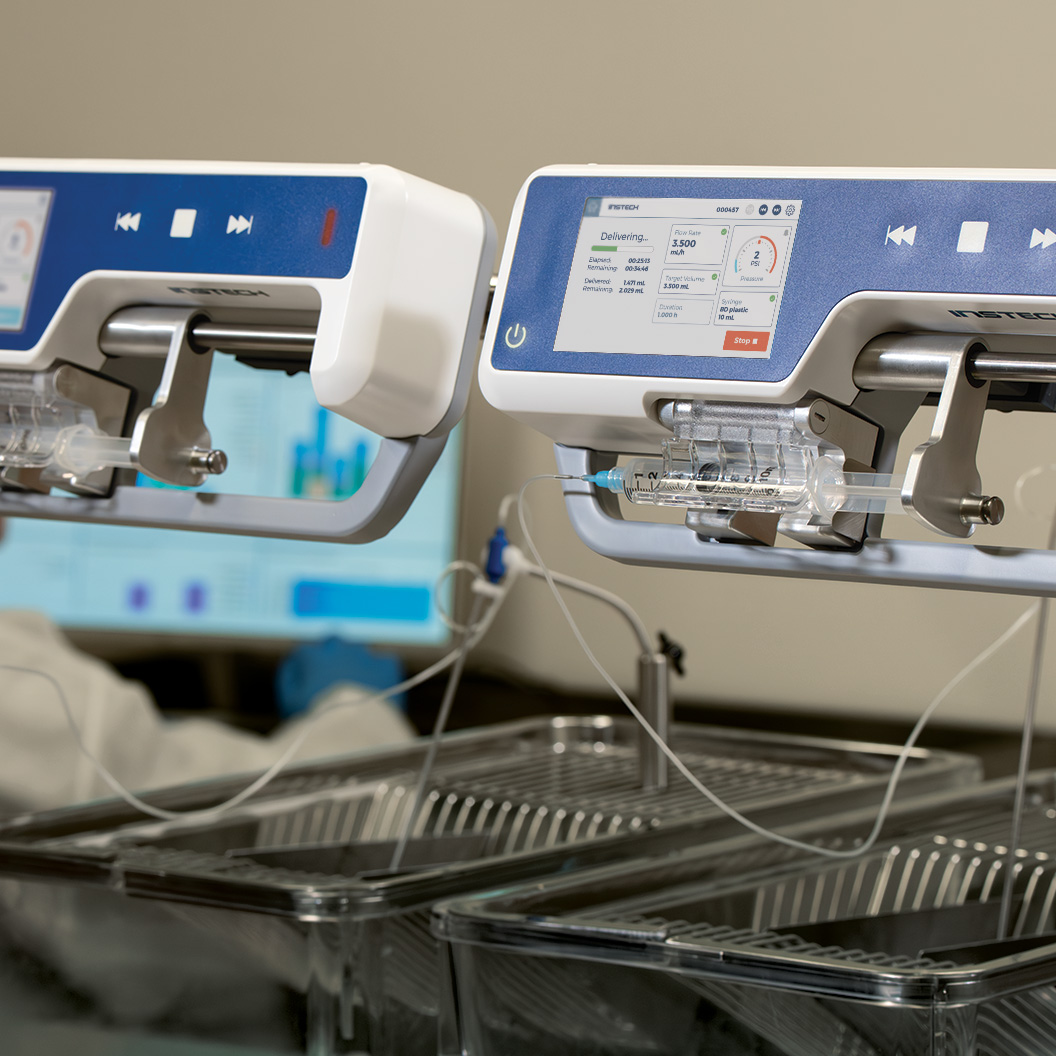
Some laboratory syringe pumps have a built-in two-syringe rack; others can accommodate racks so that one pump can push four, six, or even ten syringes at the same time. Syringe pumps can be expensive, so it’s tempting to have a pump that can multi-task. What are the downsides? There are four big ones, and we’ll discuss them here so that you can decide if the tradeoffs are worth it.
1. No pressure sensor or occlusion alarm
Any time you are infusing a live animal in an experiment that has a chance of an occlusion, you must have a pump that will prevent dangerous pressures, anything over 20–30 PSI, from building up. Ideally the pump will also have a pressure monitor so you can see when pressures are starting to rise, letting you take action before the alarm is tripped. Without this you are flying blind, risking animal safety, ruptures of your infusion lines, and the accuracy of your data.
This is not possible with a multi-syringe pump. These pumps are designed for the enormous forces required to drive multiple large syringes with viscous solutions. For example, the Harvard PHD Ultra pumps can generate 75 lbs of force. If one line occludes among a rack of ten, the pump has no way to detect it - it simply keeps pushing.
2. Varying or larger than needed dead volumes
Invariably some cages are closer to the multi-syringe pump than others, so you will either have infusion lines of different lengths or you’ll have to pick a single length based on the furthest cage.
If you have varying lengths, you’ll need to pay attention to the way you prime the lines so the timing of your doses is consistent. This gets particularly difficult if you are changing syringes mid-study from test article to saline, for example, or one dose to another.
If you have a longer line than necessary, you could be wasting precious test article. The best setup is to have one pump per animal, as close as possible to the cage, to minimize dead volume.
3. All animals get the same rate and the same start time
With one motor pushing every syringe, there is no way to run different animals at different rates or on different schedules. You cannot start one infusion at 09:00 and another at 09:30. You cannot titrate one animal to a lower dose while keeping the rest of the group at the planned dose. Any group-level flexibility you might want across your cohort has to be resolved by adding pumps or by accepting a compromise.
4. A single point of failure
If the multi-syringe pump fails mid-study, every animal on it is affected at once. A motor problem, a power interruption, or a control error that would cost you one animal on a single-syringe setup can cost you ten on a multi-syringe rack. In long studies with implanted catheters, that is not a risk you can absorb quietly.
How much do you actually save?
Multi-syringe pumps look economical on a per-syringe basis, but once you add pressure monitoring, tighter dead-volume control, and per-animal flexibility - usually by moving to a rack of smaller, single-syringe pumps positioned close to each cage - the gap narrows considerably. The relevant question is not the sticker price per channel. It is the total cost of a lost animal, a corrupted dataset, or a re-run.
The bottom line
Multi-syringe pumps have a legitimate role in benchtop chemistry and in high-force applications with well-behaved fluids. For live-animal infusion in rodents, especially over long studies through implanted catheters, the safer and more scientifically robust setup is one dedicated small pump per animal, with pressure monitoring and short infusion lines. It costs more up front. It protects the study.
Adapted from a blog post by Wyatt Boughter on the Instech Laboratories Blog.

NEED MORE INFORMATION ABOUT THIS PRODUCT?
Send us your emailRecent Blog Posts

.svg)


Advance Your Research
Contact NBT today for expert consultation on your neuroscience instrumentation needs.