.svg)
In Vitro Models of the Nervous System
From 2D neuronal cultures to 3D organoids and microfluidic systems, in vitro models of the nervous system offer researchers increasingly sophisticated tools for studying brain development, function, and disease.

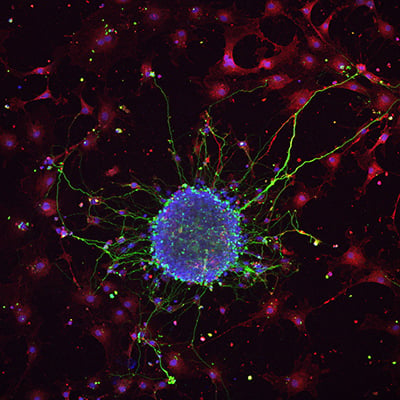
Understanding the nervous system is not just about studying cells. It is about decoding one of the most complex systems in biology. Neurons form dynamic networks, constantly communicating through electrical and chemical signals while interacting with astrocytes, microglia, and their surrounding environment. Recreating this complexity in the lab is challenging, but essential for studying development, function, and disease.
This is where in vitro models come in. They allow researchers to simplify complexity just enough to study specific mechanisms while still capturing key biological behaviors. Over time, these models have evolved from simple flat cultures to sophisticated 3D systems, organoids, and controlled microenvironments. Each model tells a different part of the story.
Flat but Powerful: Why 2D Neuronal Cultures Still Matter
Two-dimensional neuronal cultures are often the starting point in neuroscience, and for good reason. They provide a clean, controlled environment where individual cells and their behavior can be observed with high precision. In 2D systems, neurons grow on flat surfaces, making it easy to track neurite outgrowth, polarization, and synapse formation, while providing unmatched optical accessibility for high-resolution fluorescence imaging, calcium imaging, and live cell analysis.
This simplicity allows researchers to focus on specific cellular mechanisms while enabling highly quantitative analysis. Today, 2D neuronal cultures are central to automated imaging workflows, where thousands of cells are analyzed using high-content imaging and AI-based analysis. However, neurons in 2D still lack the spatial context and mechanical cues present in native tissue, which can influence how networks form, connect, and respond to stimuli.
Stepping into the Third Dimension
Moving from 2D to 3D does not just change the geometry — it changes how neurons behave. Instead of spreading on a flat surface, cells begin to navigate a surrounding matrix, making decisions about where to grow, connect, and stabilize their networks. This three-dimensional environment introduces spatial constraints, local gradients, and mechanical resistance, all of which influence how neuronal networks form and evolve over time.
Within 3D culture systems, brain organoids represent a higher level of biological complexity. Derived from pluripotent stem cells, these systems self-organize into tissue-like architectures with multiple neural cell types and region-specific identities, allowing researchers to recreate key aspects of human brain development and function in vitro.
When Do Organoids Start to Think?
Brain organoids do not think in a conscious sense. But they do something remarkable: they generate spontaneous electrical activity, form synchronized firing patterns, and begin to organize into functional networks. These early interactions offer a unique glimpse into how the brain builds itself. Researchers can observe how signals emerge, how connections stabilize, and how network behavior evolves over time.
At the same time, organoids come with challenges. The lack of vascularization limits nutrient supply and growth, and variability between samples can affect reproducibility. Careful handling and stable culture conditions are essential for generating consistent and reliable results.
From Structure to Function: Why the Microenvironment Matters
Building structure is only part of the story. To truly understand neuronal behavior, the surrounding microenvironment must also be controlled. Cells respond to physical and chemical cues such as flow, gradients, and spatial organization, which shape how networks form and function.
Microfluidic systems enable precise control over flow, gradients, and nutrient exchange, adding dynamic conditions to otherwise static cultures and improving physiological relevance. Micropatterning technologies bring an additional level of control by defining where neurons attach and how they connect, allowing researchers to standardize network formation and create reproducible neuronal circuits.
Conclusion: One System Is Not Enough
There is no single, perfect in vitro model of the nervous system. Each system captures a different level of complexity — from isolated cellular mechanisms to tissue-like organization and controlled interactions. The real power lies in combining these approaches: starting with 2D systems for mechanistic insights, moving into 3D cultures for physiological relevance, and integrating dynamic environments to build a more complete understanding of neuronal biology.

NEED MORE INFORMATION ABOUT THIS PRODUCT?
Send us your emailRecent Blog Posts


.svg)

Advance Your Research
Contact NBT today for expert consultation on your neuroscience instrumentation needs.