.svg)
Beyond the Brain: Physiological Signals in fNIRS Research
Exploring how Systemic Physiology-Augmented fNIRS (SPA-fNIRS) combines peripheral physiological signals with fNIRS data for cleaner results and richer neuroscience insights.
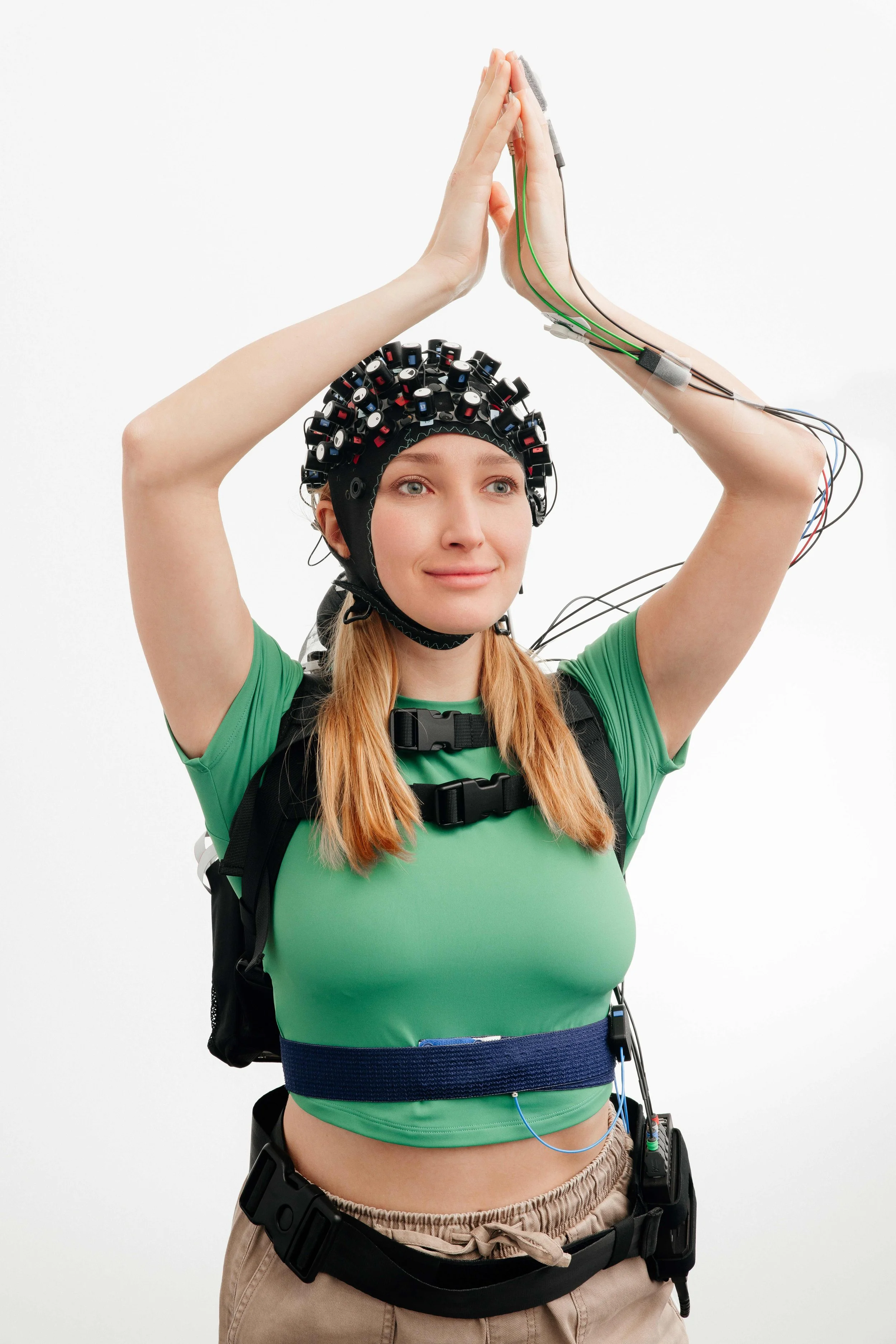
Functional Near Infrared Spectroscopy (fNIRS) is a flexible and non-invasive imaging technique, making it particularly attractive for studies in naturalistic, mobile, and social environments. One of the major advantages of fNIRS is the ease with which it can be combined with other modalities such as peripheral physiology.
Recent progress in fNIRS methods has identified two ways that physiological data can be incorporated into fNIRS analyses. First, fNIRS is designed to measure the cerebral hemodynamic responses evoked by neural activity. However, as the technique measures light absorption through both cerebral and extracerebral tissues, systemic physiological processes (such as cardiac pulsation, respiration, and autonomic fluctuations) can significantly contaminate the signal. Addressing these confounds is therefore critical for accurate interpretation.
The second application of combined fNIRS-peripheral physiology integrates both in order to investigate brain-body relationships by examining how peripheral physiology interacts with neural responses (joint analysis). This dual motivation, cleaner data and richer insights, has led to growing interest in what is now termed Systemic Physiology-Augmented fNIRS (SPA-fNIRS) (Scholkmann et al., 2022).
SPA-fNIRS for Denoising
fNIRS captures light absorption through tissue, which means it also picks up non-neural signals from the scalp, skin, and superficial vasculature. Even subtle changes in heart rate variability or respiration can shift the fNIRS baseline, mimicking brain activation or obscuring it entirely.
Peripheral signals can be measured concurrently and used to model and regress out non-neural variance. In fNIRS, there are two primary approaches: short-distance detectors capture extracerebral systemic signals, while dedicated peripheral physiology sensors directly measure specific physiological modalities. These approaches are complementary and can in principle be combined - leading to cleaner fNIRS data.
NIRxWINGS2: Seamless Systemic Physiology Integration
NIRxWINGS2 is NIRx Medical Technologies' dedicated module for capturing peripheral physiological data alongside fNIRS. Designed as an extension for the NIRSport2 system, NIRxWINGS2 empowers researchers to conduct SPA-fNIRS with minimal setup complexity.
- Respiration – Chest expansion and breathing rhythm
- Electrodermal Activity (EDA/GSR) – Sympathetic arousal
- Skin Temperature – Peripheral vasodilation/constriction
- Pulse Oximetry (PPG) – Heart rate and SpO₂
- Bipolar signals such as EMG and ECG – Muscle and cardiac activity
All data streams, including triggers, are fully synchronized within the NIRx Aurora software, eliminating the traditional headaches of integrating multiple systems. Wireless data transmission and onboard storage allow participants to move freely, even outside the lab, while still capturing high-quality multimodal datasets.
By integrating SPA-fNIRS with NIRxWINGS2, researchers can capture a comprehensive picture of both brain activity and peripheral physiological signals, enabling deeper insights into the dynamic interplay between neural processes and bodily states across diverse real-world applications.
Source: NIRx blog.

Shall we chat about this topic?
Contact usRecent Blog Posts


.svg)

Advance Your Research
Contact NBT today for expert consultation on your neuroscience instrumentation needs.